The Presocratic Reader

The Pythagorean School

DK 58
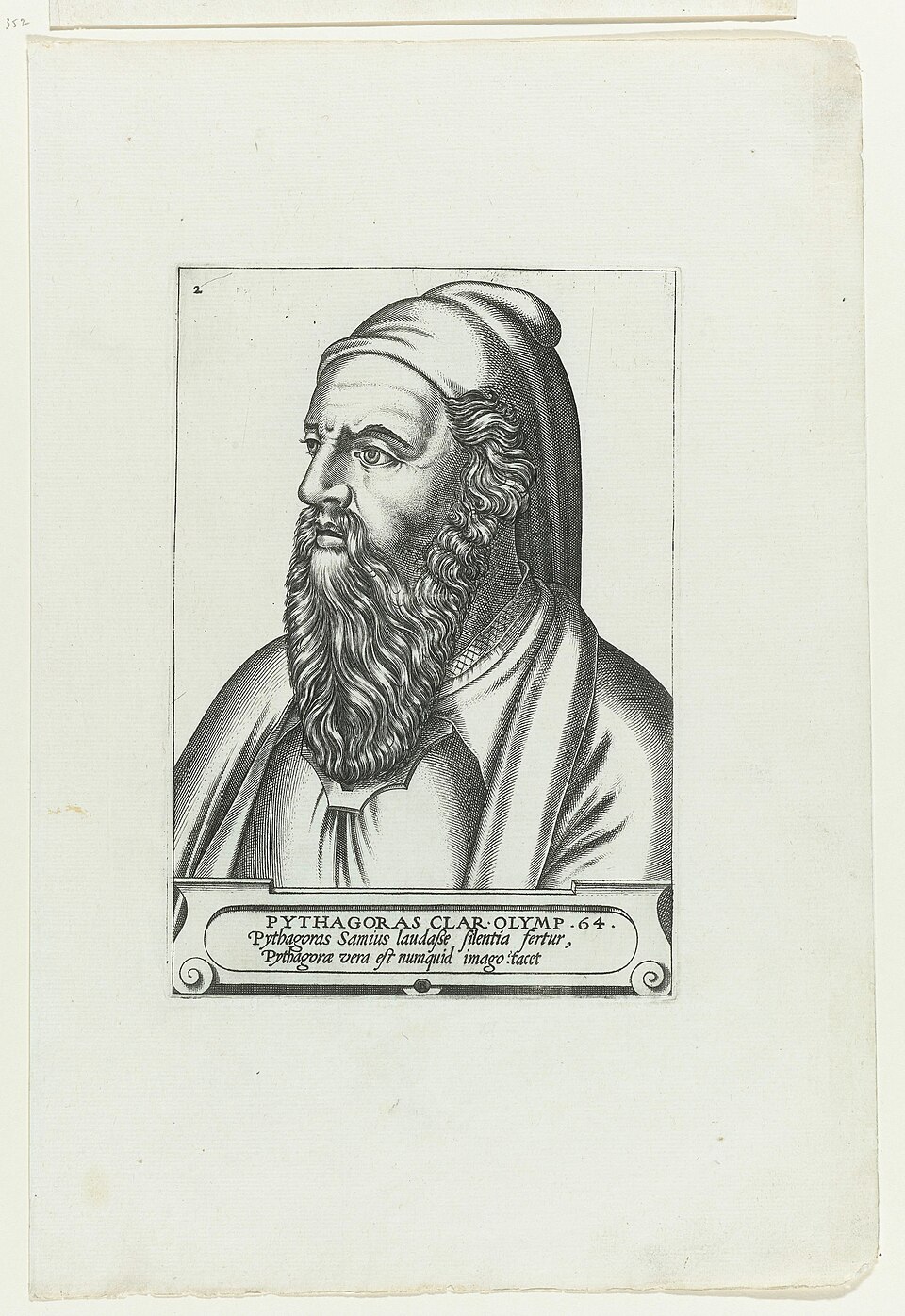
A Renaissance engraving of Pythagoras as a bearded man wearing a cap, with his name beneath the portrait.
René Boyvin · 1566Pythagoras, imagined in a Renaissance engraving.Artwork & source

Tap a Greek word for an LSJ definition.

Original textTranslation

Available translations: English

ἐπὶ δὲ τούτοις Πυθαγόρας τὴν περὶ αὐτὴν φιλοσοφίαν εἰς σχῆμα παιδείας ἐλευθέρου μετέστησεν, ἄνωθεν τὰς ἀρχὰς αὐτῆς ἐπισκοπούμενος καὶ ἀύλως καὶ νοερῶς τὰ θεωρήματα διερευνώμενος, ὃς δὴ καὶ τὴν τῶν ἀνὰ λόγον πραγματείαν καὶ τὴν τῶν κοσμικῶν σχημάτων σύστασιν ἀνεῦρεν. μετὰ δὲ τοῦτον Ἀναξαγόρας ὁ Κλαζομένιος πολλῶν ἐφήψατο τῶν κατὰ γεωμετρίαν καὶ Οἰνοπίδης ὁ Χῖος ὀλίγωι νεώτερος ὢν Ἀναξαγόρου ... ἐφ’ οἷς Ἱπποκράτης ὁ Χῖος, ὁ τὸν τοῦ μηνίσκου τετραγωνισμὸν εὑρών , καὶ Θεόδωρος ὁ Κυρηναῖος ἐγένοντο περὶ γεωμετρίαν ἐπιφανεῖς. πρῶτος γὰρ ὁ Ἱπποκράτης τῶν μνημονευομένων καὶ Στοιχεῖα συνέγραψεν. Πλάτων δ’ ἐπὶ τούτοις γενόμενος ... ἐν δὲ τούτωι τῶι χρόνωι καὶ Λεωδάμας ὁ Θάσιος ἦν καὶ Ἀρχύτας ὁ Ταραντῖνος καὶ Θεαίτητος ὁ Ἀθηναῖος, παρ’ ὧν ἐπηυξήθη τὰ θεωρήματα καὶ προῆλθεν εἰς ἐπιστημονικωτέραν σύστασιν.

After these (Thales and Ameristus or Mamercus) Pythagoras transformed the study of geometry into a liberal education, examining the principles of the science from the beginning and probing the theorems in an immaterial and intellectual manner: he it was who discovered the theory of irrationals (or ‘proportions’) and the construction of the cosmic figures.

After him [Pythagoras] Anaxagoras of Clazomenae dealt with many questions in geometry, and so did Oenopides of Chios, who was a little younger than Anaxagoras; … After them came Hippocrates of Chios, the discoverer of the quadrature of the lune, and Theodorus of Cyrene, both of whom became distinguished geometers; Hippocrates indeed was the first of whom it is recorded that he actually compiled Elements. Plato, who came next to them, … At this time too lived Leodamas of Thasos, Archytas of Taras, and Theaetetus of Athens, by whom the number of theorems was increased and a further advance was made towards a more scientific grouping of them.

Thomas L. Heath · A History of Greek Mathematics, vol. I (1921), pp. 141, 170
How this fragment survives
  • Proclus

    Commentary on Euclid’s Elements · S. 65, 15

    Citation in the source record

    PROCL. in Euclid. S. 65, 15

    Check the source record ↗

    Citation in a linked historical source record.

These are source citations recorded for this reading or its linked historical source unit. They do not describe the complete manuscript transmission. A supporting record may include a longer passage or a different editorial text.

Original-text edition
Hermann Diels, Die Fragmente der Vorsokratiker, 2nd edition, volume I (Berlin: Weidmann, 1906), chapter 45 B 1, pp. 269–270. Historical Greek running text; later DK chapter numbering is used only as the reader’s index.
Open the historical edition ↗

Notes & source

Two translated portions of the Proclus summary, joined with the same omissions as the Greek dossier. Heath offers “irrationals” with “proportions” as an alternative for the disputed reading. Outer quotation punctuation is normalized; words are preserved

The published translation is preserved. The historical original covers the same ancient passage; differences are noted below.

Removed later DK chapter cross-references and the explanatory sc. gloss; the Proclus passage is present in 1906 chapter 45 B 1. The passage boundaries match Heath; no English change.

No modern translation wording was changed. Bibliographic labels and normalized spacing are not presented as ancient words.

Hermann Diels, Die Fragmente der Vorsokratiker, 2nd edition, volume I (Berlin: Weidmann, 1906), chapter 45 B 1, pp. 269–270. Historical Greek running text; later DK chapter numbering is used only as the reader’s index. View original source ↗

English: Thomas L. Heath · A History of Greek Mathematics, vol. I (1921), pp. 141, 170 Published translation ↗

Source pages: 1 · 2

Additional original-language witness

Hermann Diels, Die Fragmente der Vorsokratiker, 2nd edition, volume I (Berlin: Weidmann, 1906), chapter 45 B 1, pp. 269–270. Historical Greek running text; later DK chapter numbering is used only as the reader’s index.

The published translation is preserved. The historical original covers the same ancient passage; differences are noted below.

Removed later DK chapter cross-references and the explanatory sc. gloss; the Proclus passage is present in 1906 chapter 45 B 1. The passage boundaries match Heath; no English change.

No modern translation wording was changed. Bibliographic labels and normalized spacing are not presented as ancient words.

PROCL. in Euclid. S. 65, 15 Friedl. ἐπὶ δὲ τούτοις Πυθαγόρας τὴν περὶ αὐτὴν φιλοσοφίαν εἰς σχῆμα παιδείας ἐλευθέρου μετέστησεν, ἄνωθεν τὰς ἀρχὰς αὐτῆς ἐπισκοπούμενος καὶ ἀύλως καὶ νοερῶς τὰ θεωρήματα διερευνώμενος, ὃς δὴ καὶ τὴν τῶν ἀνὰ λόγον πραγματείαν καὶ τὴν τῶν κοσμικῶν σχημάτων σύστασιν ἀνεῦρεν. μετὰ δὲ τοῦτον Ἀναξαγόρας ὁ Κλαζομένιος πολλῶν ἐφήψατο τῶν κατὰ γεωμετρίαν καὶ Οἰνοπίδης ὁ Χῖος ὀλίγωι νεώτερος ὢν Ἀναξαγόρου ... ἐφ’ οἷς Ἱπποκράτης ὁ Χῖος, ὁ τὸν τοῦ μηνίσκου τετραγωνισμὸν εὑρών , καὶ Θεόδωρος ὁ Κυρηναῖος ἐγένοντο περὶ γεωμετρίαν ἐπιφανεῖς. πρῶτος γὰρ ὁ Ἱπποκράτης τῶν μνημονευομένων καὶ Στοιχεῖα συνέγραψεν. Πλάτων δ’ ἐπὶ τούτοις γενόμενος ... ἐν δὲ τούτωι τῶι χρόνωι καὶ Λεωδάμας ὁ Θάσιος ἦν καὶ Ἀρχύτας ὁ Ταραντῖνος καὶ Θεαίτητος ὁ Ἀθηναῖος, παρ’ ὧν ἐπηυξήθη τὰ θεωρήματα καὶ προῆλθεν εἰς ἐπιστημονικωτέραν σύστασιν.

Witness source ↗

Historical original edition: public domain under the recorded term review.

Original edition: Historical original edition: public domain under the recorded term review.

Available translations & credits
  • English · Thomas L. Heath. A History of Greek Mathematics, vol. I (1921), pp. 141, 170. Default reading. Published translation ↗ Paired original ↗

    Source pages: 1 · 2

    Original edition: Historical original edition: public domain under the recorded term review.

Available translations: English

φησὶ δ’ ὁ Ἀλέξανδρος ἐν ταῖς τῶν Φιλοσόφων διαδοχαῖς καὶ ταῦτα εὑρηκέναι ἐν Πυθαγορικοῖς ὑπομνήμασιν· (25) ἀρχὴν μὲν ἁπάντων μονάδα, ἐκ δὲ τῆς μονάδος ἀόριστον δυάδα ὡς ἂν ὕλην τῆι μονάδι αἰτίωι ὄντι ὑποστῆναι, ἐκ δὲ τῆς μονάδος καὶ τῆς ἀορίστου δυάδος τοὺς ἀριθμούς, ἐκ δὲ τῶν ἀριθμῶν τὰ σημεῖα, ἐκ δὲ τούτων τὰς γραμμάς, ἐξ ὧν τὰ ἐπίπεδα σχήματα, ἐκ δὲ τῶν ἐπιπέδων τὰ στερεὰ σχήματα, ἐκ δὲ τούτων τὰ αἰσθητὰ σώματα, ὧν καὶ τὰ στοιχεῖα εἶναι τέτταρα, πῦρ, ὕδωρ, γῆν, ἀέρα, μεταβάλλειν δὲ καὶ τρέπεσθαι δι’ ὅλων. καὶ γίγνεσθαι ἐξ αὐτῶν κόσμον ἔμψυχον, νοερόν, σφαιροειδῆ, μέσην περιέχοντα τὴν γῆν καὶ αὐτὴν σφαιροειδῆ καὶ περιοικουμένην· (26) εἶναι δὲ καὶ ἀντίποδας καὶ τὰ ἡμῖν κάτω ἐκείνοις ἄνω. ἰσόμοιρά τε εἶναι ἐν τῶι κόσμωι φῶς καὶ σκότος καὶ θερμὸν καὶ ψυχρὸν καὶ ξηρὸν καὶ ὑγρόν, ὧν κατ’ ἐπικράτειαν θερμοῦ μὲν θέρος γίγνεσθαι, ψυχροῦ δὲ χειμῶνα ξηροῦ δ’ ἔαρ καὶ ὑγροῦ φθινόπωρον. ἐὰν δὲ ἰσομοιρῆι, τὰ κάλλιστα εἶναι τοῦ ἔτους, οὗ τὸ μὲν θάλλον ἔαρ ὑγιεινόν, τὸ δὲ φθίνον φθινόπωρον νοσερόν. ἀλλὰ καὶ τῆς ἡμέρας θάλλειν μὲν τὴν ἕω, φθίνειν δὲ τὴν ἑσπέραν, ὅθεν καὶ νοσερώτερον εἶναι. τόν τε περὶ τὴν γῆν αἰθέρα ἄσειστον καὶ νοσερὸν καὶ τὰ ἐν αὐτῶι πάντα θνητά, τὸν δὲ ἀνωτάτω ἀεικίνητόν τε εἶναι καὶ καθαρὸν καὶ ὑγιᾶ, καὶ πάντα τὰ ἐν αὐτῶι ἀθάνατα καὶ διὰ τοῦτο θεῖα. (27) ἥλιόν τε καὶ σελήνην καὶ τοὺς ἄλλους ἀστέρας εἶναι θεούς· ἐπικρατεῖ γὰρ τὸ θερμὸν ἐν αὐτοῖς, ὅπερ ἐστὶ ζωῆς αἴτιον. τήν τε σελήνην λάμπεσθαι ὑφ’ ἡλίου. καὶ ἀνθρώπωι εἶναι πρὸς θεοὺς συγγένειαν κατὰ τὸ μετέχειν ἄνθρωπον θερμοῦ· διὸ καὶ προνοεῖσθαι τὸν θεὸν ἡμῶν. εἱμαρμένην τῶν ὅλων καὶ κατὰ μέρος αἰτίαν εἶναι τῆς διοικήσεως. διήκειν τε ἀπὸ τοῦ ἡλίου ἀκτῖνα διὰ τοῦ αἰθέρος τοῦ τε ψυχροῦ καὶ παχέος (καλοῦσι δὲ τὸν μὲν ἀέρα ψυχρὸν αἰθέρα, τὴν δὲ θάλασσαν καὶ τὸ ὑγρὸν παχὺν αἰθέρα). ταύτην δὲ τὴν ἀκτῖνα καὶ εἰς τὰ βένθη δύεσθαι καὶ διὰ τοῦτο ζωοποιεῖν πάντα. (28) καὶ ζῆν μὲν πάντα ὅσα μετέχει τοῦ θερμοῦ· διὸ καὶ τὰ φυτὰ ζῶια εἶναι·, ψυχὴν μέντοι μὴ ἔχειν πάντα. εἶναι δὲ τὴν ψυχὴν ἀπόσπασμα αἰθέρος καὶ τοῦ θερμοῦ καὶ τοῦ ψυχροῦ, τῶι συμμετέχειν ψυχροῦ αἰθέρος. διαφέρειν τε ψυχὴν ζωῆς. ἀθάνατόν τε εἶναι αὐτήν, ἐπειδήπερ καὶ τὸ ἀφ’ οὗ ἀπέσπασται ἀθάνατόν ἐστι. τὰ δὲ ζῶια γεννᾶσθαι ἐξ ἀλλήλων ἀπὸ σπερμάτων, τὴν δὲ ἐκ γῆς γένεσιν ἀδύνατον ὑφίστασθαι. τὸ δὲ σπέρμα εἶναι σταγόνα ἐγκεφάλου περιέχουσαν ἐν ἑαυτῆι θερμὸν ἀτμόν· ταύτης δὲ προσφερομένης τῆι μήτραι ἀπὸ μὲν τοῦ ἐγκεφάλου ἰχῶρα καὶ ὑγρὸν καὶ αἷμα προΐεσθαι, ἐξ ὧν σάρκας τε καὶ νεῦρα καὶ ὀστᾶ καὶ τρίχας καὶ τὸ ὅλον συνίστασθαι σῶμα, ἀπὸ δὲ τοῦ ἀτμοῦ ψυχὴν καὶ αἴσθησιν. (29) μορφοῦσθαι δὲ τὸ μὲν πρῶτον παγὲν ἐν ἡμέραις τεσσαράκοντα, κατὰ δὲ τοὺς τῆς ἁρμονίας λόγους ἐν ἑπτὰ ἢ ἐννέα ἢ δέκα τὸ πλεῖστον μησὶ τελειωθὲν ἀποκυΐσκεσθαι τὸ βρέφος. ἔχειν δὲ ἐν αὐτῶι πάντας τοὺς λόγους τῆς ζωῆς, ὧν εἰρομένων συνέχεσθαι κατὰ τοὺς τῆς ἁρμονίας λόγους ἑκάστων ἐν τεταγμένοις καιροῖς ἐπιγινομένων. τήν τε αἴσθησιν κοινῶς, καὶ κατ’ εἶδος τὴν ὅρασιν, ἀτμόν τιν’ εἶναι ἄγαν θερμόν, καὶ διὰ τοῦτο λέγεται δι’ ἀέρος ὁρᾶν καὶ δι’ ὕδατος· ἀντερείδεσθαι γὰρ τὸ θερμὸν ἀπὸ τοῦ ψυχροῦ, ἐπεί τοι, εἰ ψυχρὸς ἦν ὁ ἐν τοῖς ὄμμασιν ἀτμός, διειστήκει ἂν πρὸς τὸν ὅμοιον ἀέρα· νῦν δὲ * * ἔστιν ἐν οἷς ἡλίου πύλας καλεῖ τοὺς ὀφθαλμούς· τὰ δ’ αὐτὰ καὶ περὶ τῆς ἀκοῆς καὶ τῶν λοιπῶν αἰσθήσεων δογματίζει. (30) τὴν δ’ ἀνθρώπου ψυχὴν διαιρεῖσθαι τριχῆι, εἴς τε νοῦν καὶ φρένας καὶ θυμόν. νοῦν μὲν οὖν καὶ θυμὸν εἶναι καὶ ἐν τοῖς ἄλλοις ζώιοις, φρένας δὲ μόνον ἐν ἀνθρώπωι. εἶναι δὲ τὴν ἀρχὴν τῆς ψυχῆς ἀπὸ καρδίας μέχρις ἐγκεφάλου, καὶ τὸ μὲν ἐν τῆι καρδίαι μέρος αὐτῆς ὑπάρχειν θυμόν, φρένας δὲ καὶ νοῦν τὰ ἐν τῶι ἐγκεφάλωι. σταγόνας δ’ εἶναι ἀπὸ τούτων τὰς αἰσθήσεις· καὶ τὸ μὲν φρόνιμον ἀθάνατον, τὰ δὲ λοιπὰ θνητά. τρέφεσθαί τε τὴν ψυχὴν ἀπὸ τοῦ αἵματος· τοὺς δὲ λόγους ψυχῆς ἀνέμους εἶναι. ἀόρατόν τ’ εἶναι αὐτὴν καὶ τοὺς λόγους, ἐπεὶ καὶ ὁ αἰθὴρ ἀόρατος. (31) δεσμά τε εἶναι τῆς ψυχῆς τὰς φλέβας καὶ τὰς ἀρτηρίας καὶ τὰ νεῦρα. ὅταν δ’ ἰσχύηι καὶ καθ’ αὑτὴν γενομένη ἠρεμῆι, δεσμὰ γίγνεσθαι αὐτῆς τοὺς λόγους καὶ τὰ ἔργα. ἐκριφθεῖσαν δ’ αὐτὴν ἐπὶ γῆς πλάζεσθαι ἐν τῶι ἀέρι ὁμοίαν τῶι σώματι. τὸν δὲ Ἑρμῆν ταμίαν εἶναι τῶν ψυχῶν καὶ διὰ τοῦτο πομπαῖον λέγεσθαι καὶ πυλαῖον καὶ χθόνιον, ἐπειδήπερ οὗτος εἰσπέμπει ἀπὸ τῶν σωμάτων τὰς ψυχὰς ἀπό τε γῆς καὶ ἐκ θαλάττης· καὶ ἄγεσθαι τὰς μὲν καθαρὰς ἐπὶ τὸν ὕψιστον, τὰς δὲ ἀκαθάρτους μήτε ἐκείναις πελάζειν μήτε ἀλλήλαις, δεῖσθαι δ’ ἐν ἀρρήκτοις δεσμοῖς ὑπὸ Ἐρινύων. (32) εἶναί τε πάντα τὸν ἀέρα ψυχῶν ἔμπλεων· καὶ τούτους δαίμονάς τε καὶ ἥρωας ὀνομάζεσθαι καὶ ὑπὸ τούτων πέμπεσθαι ἀνθρώποις τούς τε ὀνείρους καὶ τὰ σημεῖα νόσου τε καὶ ὑγιείας, καὶ οὐ μόνον ἀνθρώποις, ἀλλὰ καὶ προβάτοις καὶ τοῖς ἄλλοις κτήνεσιν. εἴς τε τούτους γίγνεσθαι τούς τε καθαρμοὺς καὶ ἀποτροπιασμοὺς μαντικήν τε πᾶσαν καὶ κληδόνας καὶ τὰ ὅμοια. μέγιστον δέ φησιν εἶναι τῶν ἐν ἀνθρώποις τὴν ψυχὴν πεῖσαι ἐπὶ τὸ ἀγαθὸν ἢ ἐπὶ τὸ κακόν. εὐδαιμονεῖν τε ἀνθρώπους, ὅταν ἀγαθὴ ψυχὴ προσγένηται, μηδέποτε δὲ ἠρεμεῖν μηδὲ τὸν αὐτὸν * * ῥόον κρατεῖν. (33) ὅρκιόν τε εἶναι τὸ δίκαιον, καὶ διὰ τοῦτο Δία ὅρκιον λέγεσθαι. τήν τε ἀρετὴν ἁρμονίαν εἶναι καὶ τὴν ὑγίειαν καὶ τὸ ἀγαθὸν ἅπαν καὶ τὸν θεόν· διὸ καὶ καθ’ ἁρμονίαν συνεστάναι τὰ ὅλα. φιλίαν τε εἶναι ἐναρμόνιον ἰσότητα. τιμὰς θεοῖς δεῖν νομίζειν καὶ ἥρωσι μὴ τὰς ἴσας, ἀλλὰ θεοῖς ἀεὶ μετ’ εὐφημίας λευχειμονοῦντας καὶ ἁγνεύοντας, ἥρωσι δὲ ἀπὸ μέσου ἡμέρας· τὴν δὲ ἁγνείαν εἶναι διὰ καθαρμῶν καὶ λουτρῶν καὶ περιρραντηρίων καὶ διὰ τοῦ καθαρεύειν ἀπό τε κήδους καὶ λεχοῦς καὶ μιάσματος παντός, καὶ ἀπέχεσθαι βρωτῶν θνησειδίων τε κρεῶν καὶ τριγλῶν καὶ μελανούρων καὶ ὠιῶν καὶ τῶν ὠιοτόκων ζώιων καὶ κυάμων καὶ τῶν ἄλλων ὧν παρακελεύονται καὶ οἱ τὰς τελετὰς ἐν τοῖς ἱεροῖς ἐπιτελοῦντες.

Alexander in his Successions of Philosophers says that he found in the Pythagorean memoirs the following tenets as well. The principle of all things is the monad or unit; arising from this monad the undefined dyad or two serves as material substratum to the monad, which is cause; from the monad and the undefined dyad spring numbers; from numbers, points; from points, lines; from lines, plane figures; from plane figures, solid figures; from solid figures, sensible bodies, the elements of which are four, fire, water, earth and air; these elements interchange and turn into one another completely, and combine to produce a universe animate, intelligent, spherical, with the earth at its centre, the earth itself too being spherical and inhabited round about. There are also antipodes, and our "down" is their "up." Light and darkness have equal part in the universe, so have hot and cold, and dry and moist; and of these, if hot preponderates, we have summer; if cold, winter; if dry, spring; if moist, late autumn. If all are in equilibrium, we have the best periods of the year, of which the freshness of spring constitutes the healthy season, and the decay of late autumn the unhealthy. So, too, in the day, freshness belongs to the morning, and decay to the evening, which is therefore more unhealthy. The air about the earth is stagnant and unwholesome, and all within it is mortal; but the uppermost air is ever-moved and pure and healthy, and all within it is immortal and consequently divine. The sun, the moon, and the other stars are gods; for, in them, there is a preponderance of heat, and heat is the cause of life. The moon is illumined by the sun. Gods and men are akin, inasmuch as man partakes of heat; therefore God takes thought for man. Fate is the cause of things being thus ordered both as a whole and separately. The sun's ray penetrates through the aether, whether cold or dense — the air they call cold aether, and the sea and moisture dense aether — and this ray descends even to the depths and for this reason quickens all things. All things live which partake of heat — this is why plants are living things — but all have not soul, which is a detached part of aether, partly the hot and partly the cold, for it partakes of cold aether too. Soul is distinct from life; it is immortal, since that from which it is detached is immortal. Living creatures are reproduced from one another by germination; there is no such thing as spontaneous generation from earth. The germ is a clot of brain containing hot vapour within it; and this, when brought to the womb, throws out, from the brain, ichor, fluid and blood, whence are formed flesh, sinews, bones, hairs, and the whole of the body, while soul and sense come from the vapour within. First congealing in about forty days, it receives form and, according to the ratios of "harmony," in seven, nine, or at the most ten, months, the mature child is brought forth. It has in it all the relations constituting life, and these, forming a continuous series, keep it together according to the ratios of harmony, each appearing at regulated intervals. Sense generally, and sight in particular, is a certain unusually hot vapour. This is why it is said to see through air and water, because the hot aether is resisted by the cold; for, if the vapour in the eyes had been cold, it would have been dissipated on meeting the air, its like. As it is, in certain [lines] he calls the eyes the portals of the sun. His conclusion is the same with regard to hearing and the other senses.

The soul of man, he says, is divided into three parts, intelligence, reason, and passion. Intelligence and passion are possessed by other animals as well, but reason by man alone. The seat of the soul extends from the heart to the brain; the part of it which is in the heart is passion, while the parts located in the brain are reason and intelligence. The senses are distillations from these. Reason is immortal, all else mortal. The soul draws nourishment from the blood; the faculties of the soul are winds, for they as well as the soul are invisible, just as the aether is invisible. The veins, arteries, and sinews are the bonds of the soul. But when it is strong and settled down into itself, reasonings and deeds become its bonds. When cast out upon the earth, it wanders in the air like the body. Hermes is the steward of souls, and for that reason is called Hermes the Escorter, Hermes the Keeper of the Gate, and Hermes of the Underworld, since it is he who brings in the souls from their bodies both by land and sea; and the pure are taken into the uppermost region, but the impure are not permitted to approach the pure or each other, but are bound by the Furies in bonds unbreakable. The whole air is full of souls which are called genii or heroes; these are they who send men dreams and signs of future disease and health, and not to men alone, but to sheep also and cattle as well; and it is to them that purifications and lustrations, all divination, omens and the like, have reference. The most momentous thing in human life is the art of winning the soul to good or to evil. Blest are the men who acquire a good soul; <if it be bad> they can never be at rest, nor ever keep the same course two days together.

Right has the force of an oath, and that is why Zeus is called the God of Oaths. Virtue is harmony, and so are health and all good and God himself; this is why they say that all things are constructed according to the laws of harmony. The love of friends is just concord and equality. We should not pay equal worship to gods and heroes, but to the gods always, with reverent silence, in white robes, and after purification, to the heroes only from midday onwards. Purification is by cleansing, baptism and lustration, and by keeping clean from all deaths and births and all pollution, and abstaining from meat and flesh of animals that have died, mullets, gurnards, eggs and egg‑sprung animals, beans, and the other abstinences prescribed by those who perform mystic rites in the temples.

R. D. Hicks · Diogenes Laertius: Lives of Eminent Philosophers, vol. II, Loeb Classical Library (1925), VIII.24–33
How this fragment survives

A source citation has not yet been identified for this reading.

A source citation has not yet been identified for this reading in the reviewed records. The linked edition remains available below.

Original-text edition
Diogenes Laertius, Lives of Eminent Philosophers, with an English translation by R. D. Hicks, volume II (London: William Heinemann; New York: G. P. Putnam’s Sons, 1925), Greek facing text of VIII 24–33, pp 340, 342, 344, 346, 348.
Open the historical edition ↗

Notes & source

Complete Alexander Polyhistor report in Diogenes Laertius VIII.24–33. The following Aristotle material (VIII.34 onward) is excluded

Hicks's supplied <if it be bad> is retained in the English as an editorial supplement; it is absent from the displayed Greek witness

The published translation is preserved. The historical original covers the same ancient passage; differences are noted below.

The original modern translation is Hicks; its wording is preserved exactly. The Greek now comes from the facing pages of that same 1925 edition.

Removed supplied οὐδέν, τῶν, τε and other later-edition readings where Hicks differs; retained the two lacuna marks printed by Hicks. The same-edition English governs alignment, without generating any translation.

Title capitals and standard iota-adscript/orthographic display conventions are normalized; the source’s substantive lexical readings are retained.

Diogenes Laertius, Lives of Eminent Philosophers, with an English translation by R. D. Hicks, volume II (London: William Heinemann; New York: G. P. Putnam’s Sons, 1925), Greek facing text of VIII 24–33, pp 340, 342, 344, 346, 348. View original source ↗

English: R. D. Hicks · Diogenes Laertius: Lives of Eminent Philosophers, vol. II, Loeb Classical Library (1925), VIII.24–33 Published translation ↗

Source pages: 1

Additional original-language witness

Diogenes Laertius, Lives of Eminent Philosophers, with an English translation by R. D. Hicks, volume II (London: William Heinemann; New York: G. P. Putnam’s Sons, 1925), Greek facing text of VIII 24–33, pp 340, 342, 344, 346, 348.

The published translation is preserved. The historical original covers the same ancient passage; differences are noted below.

The original modern translation is Hicks; its wording is preserved exactly. The Greek now comes from the facing pages of that same 1925 edition.

Removed supplied οὐδέν, τῶν, τε and other later-edition readings where Hicks differs; retained the two lacuna marks printed by Hicks. The same-edition English governs alignment, without generating any translation.

Title capitals and standard iota-adscript/orthographic display conventions are normalized; the source’s substantive lexical readings are retained.

Diogenes Laertius VIII24–33. φησὶ δ’ ὁ Ἀλέξανδρος ἐν ταῖς τῶν Φιλοσόφων διαδοχαῖς καὶ ταῦτα εὑρηκέναι ἐν Πυθαγορικοῖς ὑπομνήμασιν· (25) ἀρχὴν μὲν ἁπάντων μονάδα, ἐκ δὲ τῆς μονάδος ἀόριστον δυάδα ὡς ἂν ὕλην τῆι μονάδι αἰτίωι ὄντι ὑποστῆναι, ἐκ δὲ τῆς μονάδος καὶ τῆς ἀορίστου δυάδος τοὺς ἀριθμούς, ἐκ δὲ τῶν ἀριθμῶν τὰ σημεῖα, ἐκ δὲ τούτων τὰς γραμμάς, ἐξ ὧν τὰ ἐπίπεδα σχήματα, ἐκ δὲ τῶν ἐπιπέδων τὰ στερεὰ σχήματα, ἐκ δὲ τούτων τὰ αἰσθητὰ σώματα, ὧν καὶ τὰ στοιχεῖα εἶναι τέτταρα, πῦρ, ὕδωρ, γῆν, ἀέρα, μεταβάλλειν δὲ καὶ τρέπεσθαι δι’ ὅλων. καὶ γίγνεσθαι ἐξ αὐτῶν κόσμον ἔμψυχον, νοερόν, σφαιροειδῆ, μέσην περιέχοντα τὴν γῆν καὶ αὐτὴν σφαιροειδῆ καὶ περιοικουμένην· (26) εἶναι δὲ καὶ ἀντίποδας καὶ τὰ ἡμῖν κάτω ἐκείνοις ἄνω. ἰσόμοιρά τε εἶναι ἐν τῶι κόσμωι φῶς καὶ σκότος καὶ θερμὸν καὶ ψυχρὸν καὶ ξηρὸν καὶ ὑγρόν, ὧν κατ’ ἐπικράτειαν θερμοῦ μὲν θέρος γίγνεσθαι, ψυχροῦ δὲ χειμῶνα ξηροῦ δ’ ἔαρ καὶ ὑγροῦ φθινόπωρον. ἐὰν δὲ ἰσομοιρῆι, τὰ κάλλιστα εἶναι τοῦ ἔτους, οὗ τὸ μὲν θάλλον ἔαρ ὑγιεινόν, τὸ δὲ φθίνον φθινόπωρον νοσερόν. ἀλλὰ καὶ τῆς ἡμέρας θάλλειν μὲν τὴν ἕω, φθίνειν δὲ τὴν ἑσπέραν, ὅθεν καὶ νοσερώτερον εἶναι. τόν τε περὶ τὴν γῆν αἰθέρα ἄσειστον καὶ νοσερὸν καὶ τὰ ἐν αὐτῶι πάντα θνητά, τὸν δὲ ἀνωτάτω ἀεικίνητόν τε εἶναι καὶ καθαρὸν καὶ ὑγιᾶ, καὶ πάντα τὰ ἐν αὐτῶι ἀθάνατα καὶ διὰ τοῦτο θεῖα. (27) ἥλιόν τε καὶ σελήνην καὶ τοὺς ἄλλους ἀστέρας εἶναι θεούς· ἐπικρατεῖ γὰρ τὸ θερμὸν ἐν αὐτοῖς, ὅπερ ἐστὶ ζωῆς αἴτιον. τήν τε σελήνην λάμπεσθαι ὑφ’ ἡλίου. καὶ ἀνθρώπωι εἶναι πρὸς θεοὺς συγγένειαν κατὰ τὸ μετέχειν ἄνθρωπον θερμοῦ· διὸ καὶ προνοεῖσθαι τὸν θεὸν ἡμῶν. εἱμαρμένην τῶν ὅλων καὶ κατὰ μέρος αἰτίαν εἶναι τῆς διοικήσεως. διήκειν τε ἀπὸ τοῦ ἡλίου ἀκτῖνα διὰ τοῦ αἰθέρος τοῦ τε ψυχροῦ καὶ παχέος (καλοῦσι δὲ τὸν μὲν ἀέρα ψυχρὸν αἰθέρα, τὴν δὲ θάλασσαν καὶ τὸ ὑγρὸν παχὺν αἰθέρα). ταύτην δὲ τὴν ἀκτῖνα καὶ εἰς τὰ βένθη δύεσθαι καὶ διὰ τοῦτο ζωοποιεῖν πάντα. (28) καὶ ζῆν μὲν πάντα ὅσα μετέχει τοῦ θερμοῦ· διὸ καὶ τὰ φυτὰ ζῶια εἶναι·, ψυχὴν μέντοι μὴ ἔχειν πάντα. εἶναι δὲ τὴν ψυχὴν ἀπόσπασμα αἰθέρος καὶ τοῦ θερμοῦ καὶ τοῦ ψυχροῦ, τῶι συμμετέχειν ψυχροῦ αἰθέρος. διαφέρειν τε ψυχὴν ζωῆς. ἀθάνατόν τε εἶναι αὐτήν, ἐπειδήπερ καὶ τὸ ἀφ’ οὗ ἀπέσπασται ἀθάνατόν ἐστι. τὰ δὲ ζῶια γεννᾶσθαι ἐξ ἀλλήλων ἀπὸ σπερμάτων, τὴν δὲ ἐκ γῆς γένεσιν ἀδύνατον ὑφίστασθαι. τὸ δὲ σπέρμα εἶναι σταγόνα ἐγκεφάλου περιέχουσαν ἐν ἑαυτῆι θερμὸν ἀτμόν· ταύτης δὲ προσφερομένης τῆι μήτραι ἀπὸ μὲν τοῦ ἐγκεφάλου ἰχῶρα καὶ ὑγρὸν καὶ αἷμα προΐεσθαι, ἐξ ὧν σάρκας τε καὶ νεῦρα καὶ ὀστᾶ καὶ τρίχας καὶ τὸ ὅλον συνίστασθαι σῶμα, ἀπὸ δὲ τοῦ ἀτμοῦ ψυχὴν καὶ αἴσθησιν. (29) μορφοῦσθαι δὲ τὸ μὲν πρῶτον παγὲν ἐν ἡμέραις τεσσαράκοντα, κατὰ δὲ τοὺς τῆς ἁρμονίας λόγους ἐν ἑπτὰ ἢ ἐννέα ἢ δέκα τὸ πλεῖστον μησὶ τελειωθὲν ἀποκυΐσκεσθαι τὸ βρέφος. ἔχειν δὲ ἐν αὐτῶι πάντας τοὺς λόγους τῆς ζωῆς, ὧν εἰρομένων συνέχεσθαι κατὰ τοὺς τῆς ἁρμονίας λόγους ἑκάστων ἐν τεταγμένοις καιροῖς ἐπιγινομένων. τήν τε αἴσθησιν κοινῶς, καὶ κατ’ εἶδος τὴν ὅρασιν, ἀτμόν τιν’ εἶναι ἄγαν θερμόν, καὶ διὰ τοῦτο λέγεται δι’ ἀέρος ὁρᾶν καὶ δι’ ὕδατος· ἀντερείδεσθαι γὰρ τὸ θερμὸν ἀπὸ τοῦ ψυχροῦ, ἐπεί τοι, εἰ ψυχρὸς ἦν ὁ ἐν τοῖς ὄμμασιν ἀτμός, διειστήκει ἂν πρὸς τὸν ὅμοιον ἀέρα· νῦν δὲ * * ἔστιν ἐν οἷς ἡλίου πύλας καλεῖ τοὺς ὀφθαλμούς· τὰ δ’ αὐτὰ καὶ περὶ τῆς ἀκοῆς καὶ τῶν λοιπῶν αἰσθήσεων δογματίζει. (30) τὴν δ’ ἀνθρώπου ψυχὴν διαιρεῖσθαι τριχῆι, εἴς τε νοῦν καὶ φρένας καὶ θυμόν. νοῦν μὲν οὖν καὶ θυμὸν εἶναι καὶ ἐν τοῖς ἄλλοις ζώιοις, φρένας δὲ μόνον ἐν ἀνθρώπωι. εἶναι δὲ τὴν ἀρχὴν τῆς ψυχῆς ἀπὸ καρδίας μέχρις ἐγκεφάλου, καὶ τὸ μὲν ἐν τῆι καρδίαι μέρος αὐτῆς ὑπάρχειν θυμόν, φρένας δὲ καὶ νοῦν τὰ ἐν τῶι ἐγκεφάλωι. σταγόνας δ’ εἶναι ἀπὸ τούτων τὰς αἰσθήσεις· καὶ τὸ μὲν φρόνιμον ἀθάνατον, τὰ δὲ λοιπὰ θνητά. τρέφεσθαί τε τὴν ψυχὴν ἀπὸ τοῦ αἵματος· τοὺς δὲ λόγους ψυχῆς ἀνέμους εἶναι. ἀόρατόν τ’ εἶναι αὐτὴν καὶ τοὺς λόγους, ἐπεὶ καὶ ὁ αἰθὴρ ἀόρατος. (31) δεσμά τε εἶναι τῆς ψυχῆς τὰς φλέβας καὶ τὰς ἀρτηρίας καὶ τὰ νεῦρα. ὅταν δ’ ἰσχύηι καὶ καθ’ αὑτὴν γενομένη ἠρεμῆι, δεσμὰ γίγνεσθαι αὐτῆς τοὺς λόγους καὶ τὰ ἔργα. ἐκριφθεῖσαν δ’ αὐτὴν ἐπὶ γῆς πλάζεσθαι ἐν τῶι ἀέρι ὁμοίαν τῶι σώματι. τὸν δὲ Ἑρμῆν ταμίαν εἶναι τῶν ψυχῶν καὶ διὰ τοῦτο πομπαῖον λέγεσθαι καὶ πυλαῖον καὶ χθόνιον, ἐπειδήπερ οὗτος εἰσπέμπει ἀπὸ τῶν σωμάτων τὰς ψυχὰς ἀπό τε γῆς καὶ ἐκ θαλάττης· καὶ ἄγεσθαι τὰς μὲν καθαρὰς ἐπὶ τὸν ὕψιστον, τὰς δὲ ἀκαθάρτους μήτε ἐκείναις πελάζειν μήτε ἀλλήλαις, δεῖσθαι δ’ ἐν ἀρρήκτοις δεσμοῖς ὑπὸ Ἐρινύων. (32) εἶναί τε πάντα τὸν ἀέρα ψυχῶν ἔμπλεων· καὶ τούτους δαίμονάς τε καὶ ἥρωας ὀνομάζεσθαι καὶ ὑπὸ τούτων πέμπεσθαι ἀνθρώποις τούς τε ὀνείρους καὶ τὰ σημεῖα νόσου τε καὶ ὑγιείας, καὶ οὐ μόνον ἀνθρώποις, ἀλλὰ καὶ προβάτοις καὶ τοῖς ἄλλοις κτήνεσιν. εἴς τε τούτους γίγνεσθαι τούς τε καθαρμοὺς καὶ ἀποτροπιασμοὺς μαντικήν τε πᾶσαν καὶ κληδόνας καὶ τὰ ὅμοια. μέγιστον δέ φησιν εἶναι τῶν ἐν ἀνθρώποις τὴν ψυχὴν πεῖσαι ἐπὶ τὸ ἀγαθὸν ἢ ἐπὶ τὸ κακόν. εὐδαιμονεῖν τε ἀνθρώπους, ὅταν ἀγαθὴ ψυχὴ προσγένηται, μηδέποτε δὲ ἠρεμεῖν μηδὲ τὸν αὐτὸν * * ῥόον κρατεῖν. (33) ὅρκιόν τε εἶναι τὸ δίκαιον, καὶ διὰ τοῦτο Δία ὅρκιον λέγεσθαι. τήν τε ἀρετὴν ἁρμονίαν εἶναι καὶ τὴν ὑγίειαν καὶ τὸ ἀγαθὸν ἅπαν καὶ τὸν θεόν· διὸ καὶ καθ’ ἁρμονίαν συνεστάναι τὰ ὅλα. φιλίαν τε εἶναι ἐναρμόνιον ἰσότητα. τιμὰς θεοῖς δεῖν νομίζειν καὶ ἥρωσι μὴ τὰς ἴσας, ἀλλὰ θεοῖς ἀεὶ μετ’ εὐφημίας λευχειμονοῦντας καὶ ἁγνεύοντας, ἥρωσι δὲ ἀπὸ μέσου ἡμέρας· τὴν δὲ ἁγνείαν εἶναι διὰ καθαρμῶν καὶ λουτρῶν καὶ περιρραντηρίων καὶ διὰ τοῦ καθαρεύειν ἀπό τε κήδους καὶ λεχοῦς καὶ μιάσματος παντός, καὶ ἀπέχεσθαι βρωτῶν θνησειδίων τε κρεῶν καὶ τριγλῶν καὶ μελανούρων καὶ ὠιῶν καὶ τῶν ὠιοτόκων ζώιων καὶ κυάμων καὶ τῶν ἄλλων ὧν παρακελεύονται καὶ οἱ τὰς τελετὰς ἐν τοῖς ἱεροῖς ἐπιτελοῦντες.

Witness source ↗

Historical original edition: public domain under the recorded term review.

Original edition: Historical original edition: public domain under the recorded term review.

Available translations & credits
  • English · R. D. Hicks. Diogenes Laertius: Lives of Eminent Philosophers, vol. II, Loeb Classical Library (1925), VIII.24–33. Default reading. Published translation ↗ Paired original ↗

    Source pages: 1

    Original edition: Historical original edition: public domain under the recorded term review.

Available translations: English

ἐν δὲ τούτοις καὶ πρὸ τούτων οἱ καλούμενοι Πυθαγόρειοι τῶν μαθημάτων ἁψάμενοι πρῶτοι ταῦτα προήγαγον, καὶ ἐντραφέντες ἐν αὐτοῖς τὰς τούτων ἀρχὰς τῶν ὄντων ἀρχὰς ὠιήθησαν εἶναι πάντων. ἐπεὶ δὲ τούτων οἱ ἀριθμοὶ φύσει πρῶτοι, ἐν δὲ τοῖς ἀριθμοῖς ἐδόκουν θεωρεῖν ὁμοιώματα πολλὰ τοῖς οὖσι καὶ γιγνομένοις, μᾶλλον ἢ ἐν πυρὶ καὶ γῆι καὶ ὕδατι, ὅτι τὸ μὲν τοιονδὶ τῶν ἀριθμῶν πάθος δικαιοσύνη, τὸ δὲ τοιονδὶ ψυχὴ καὶ νοῦς, ἕτερον δὲ καιρὸς καὶ τῶν ἄλλων ὡς εἰπεῖν ἕκαστον ὁμοίως, ἔτι δὲ τῶν ἁρμονιῶν ἐν ἀριθμοῖς ὁρῶντες τὰ πάθη καὶ τοὺς λόγους, ἐπεὶ δὴ τὰ μὲν ἄλλα τοῖς ἀριθμοῖς ἐφαίνετο τὴν φύσιν ἀφωμοιῶσθαι πᾶσαν, οἱ δ’ ἀριθμοὶ πάσης τῆς φύσεως πρῶτοι, τὰ τῶν ἀριθμῶν στοιχεῖα τῶν ὄντων στοιχεῖα πάντων ὑπέλαβον εἶναι, καὶ τὸν ὅλον οὐρανὸν ἁρμονίαν εἶναι καὶ ἀριθμόν· καὶ ὅσα εἶχον ὁμολογούμενα δεικνύναι ἔν τε τοῖς ἀριθμοῖς καὶ ταῖς ἁρμονίαις πρὸς τὰ τοῦ οὐρανοῦ πάθη καὶ μέρη καὶ πρὸς τὴν ὅλην διακόσμησιν, ταῦτα συνάγοντες ἐφήρμοττον. κἂν εἴ τί που διέλειπε, προσεγλίχοντο τοῦ συνειρομένην πᾶσαν αὐτοῖς εἶναι τὴν πραγματείαν. λέγω δ’ οἷον, ἐπειδὴ τέλειον ἡ δεκὰς εἶναι δοκεῖ καὶ πᾶσαν περιειληφέναι τὴν τῶν ἀριθμῶν φύσιν, καὶ τὰ φερόμενα κατὰ τὸν οὐρανὸν δέκα μὲν εἶναί φασιν, ὄντων δὲ ἐννέα μόνον τῶν φανερῶν διὰ τοῦτο δεκάτην τὴν ἀντίχθονα ποιοῦσιν. διώρισται δὲ περὶ τούτων ἐν ἑτέροις ἡμῖν ἀκριβέστερον.

δοκεῖ δέ τισι καὶ τὸ ἀντιπεπονθὸς εἶναι ἁπλῶς δίκαιον, ὥσπερ οἱ Πυθαγόρειοι ἔφασαν· ὡρίζοντο γὰρ ἁπλῶς τὸ δίκαιον τὸ ἀντιπεπονθὸς ἄλλωι.

With these and before them (Anaxagoras, Empedokles, Atomists) those called Pythagoreans applying themselves to the sciences, first developed them; and being brought up in them they thought that the first principles of these (i.e. numbers) were the first principles of all things. And since of these (sciences) numbers are by nature the first, in numbers rather than in fire and earth and water they thought they saw many likenesses to things that are and that are coming to be, as, for instance, justice is such a property of numbers, and soul and mind are such a property, and another is opportunity, and of other things one may say the same of each one.

†And further, discerning in numbers the conditions and reasons of harmonies also†; since, moreover, other things seemed to be like numbers in their entire nature, and numbers were the first of every nature, they assumed that the elements of numbers were the elements of all things, and that the whole heavens were harmony and number. And whatever characteristics in numbers and harmonies they could show were in agreement with the properties of the heavens and its parts and with its whole arrangement, these they collected and adapted; and if there chanced to be any gap anywhere, they eagerly sought that the whole system might be connected with these (stray phenomena). To give an example of my meaning: inasmuch as ten seemed to be the perfect number and to embrace the whole nature of numbers, they asserted that the number of bodies moving through the heavens were ten, and when only nine were visible, for the reason just stated they postulated the counter-earth as the tenth. We have given a more definite account of these thinkers in other parts of our writings.

Reciprocity seems to some to be absolutely just, as the Pythagoreans say; for these defined the just as that which is reciprocal to another.

Arthur Fairbanks · The First Philosophers of Greece (1898)
How this fragment survives

These are source citations recorded for this reading or its linked historical source unit. They do not describe the complete manuscript transmission. A supporting record may include a longer passage or a different editorial text.

Original-text edition
Hermann Diels, Die Fragmente der Vorsokratiker, 2nd edition, volume I (Berlin: Weidmann, 1906), chapter 45 B 4, pp. 270–271. Historical Greek running text; later DK chapter numbering is used only as the reader’s index.
Open the historical edition ↗

Notes & source

Metaphysics 985b23–986a13 and Nicomachean Ethics 1132b21, Fairbanks pp. 136–137 and 143. The intervening Alexander/Magna Moralia/Metaphysics comparative excerpts remain in the dossier

The published translation is preserved. The historical original covers the same ancient passage; differences are noted below.

Corrected broken Greek word spaces ἄλλω ι and ἴσο ς. The main Metaphysics passage and separate Nicomachean Ethics sentence both occur in Diels 1906 B 4. The dossier Alexander/Magna Moralia/Metaphysics/ Ethics witnesses were checked separately on pp 270–271.

No modern translation wording was changed. Bibliographic labels and normalized spacing are not presented as ancient words.

Hermann Diels, Die Fragmente der Vorsokratiker, 2nd edition, volume I (Berlin: Weidmann, 1906), chapter 45 B 4, pp. 270–271. Historical Greek running text; later DK chapter numbering is used only as the reader’s index. View original source ↗

English: Arthur Fairbanks · The First Philosophers of Greece (1898) Published translation ↗

Source pages: 1

Additional original-language witness

Hermann Diels, Die Fragmente der Vorsokratiker, 2nd edition, volume I (Berlin: Weidmann, 1906), chapter 45 B 4, pp. 270–271. Historical Greek running text; later DK chapter numbering is used only as the reader’s index.

The published translation is preserved. The historical original covers the same ancient passage; differences are noted below.

Corrected broken Greek word spaces ἄλλω ι and ἴσο ς. The main Metaphysics passage and separate Nicomachean Ethics sentence both occur in Diels 1906 B 4. The dossier Alexander/Magna Moralia/Metaphysics/ Ethics witnesses were checked separately on pp 270–271.

No modern translation wording was changed. Bibliographic labels and normalized spacing are not presented as ancient words.

ARISTOT. Metaph. Α 5. 985b 23 ἐν δὲ τούτοις καὶ πρὸ τούτων οἱ καλούμενοι Πυθαγόρειοι τῶν μαθημάτων ἁψάμενοι πρῶτοι ταῦτα προήγαγον, καὶ ἐντραφέντες ἐν αὐτοῖς τὰς τούτων ἀρχὰς τῶν ὄντων ἀρχὰς ὠιήθησαν εἶναι πάντων. ἐπεὶ δὲ τούτων οἱ ἀριθμοὶ φύσει πρῶτοι, ἐν δὲ τοῖς ἀριθμοῖς ἐδόκουν θεωρεῖν ὁμοιώματα πολλὰ τοῖς οὖσι καὶ γιγνομένοις, μᾶλλον ἢ ἐν πυρὶ καὶ γῆι καὶ ὕδατι, ὅτι τὸ μὲν τοιονδὶ τῶν ἀριθμῶν πάθος δικαιοσύνη, τὸ δὲ τοιονδὶ ψυχὴ καὶ νοῦς, ἕτερον δὲ καιρὸς καὶ τῶν ἄλλων ὡς εἰπεῖν ἕκαστον ὁμοίως, ἔτι δὲ τῶν ἁρμονιῶν ἐν ἀριθμοῖς ὁρῶντες τὰ πάθη καὶ τοὺς λόγους, ἐπεὶ δὴ τὰ μὲν ἄλλα τοῖς ἀριθμοῖς ἐφαίνετο τὴν φύσιν ἀφωμοιῶσθαι πᾶσαν, οἱ δ’ ἀριθμοὶ πάσης τῆς φύσεως πρῶτοι, τὰ τῶν ἀριθμῶν στοιχεῖα τῶν ὄντων στοιχεῖα πάντων ὑπέλαβον εἶναι, καὶ τὸν ὅλον οὐρανὸν ἁρμονίαν εἶναι καὶ ἀριθμόν· καὶ ὅσα εἶχον ὁμολογούμενα δεικνύναι ἔν τε τοῖς ἀριθμοῖς καὶ ταῖς ἁρμονίαις πρὸς τὰ τοῦ οὐρανοῦ πάθη καὶ μέρη καὶ πρὸς τὴν ὅλην διακόσμησιν, ταῦτα συνάγοντες ἐφήρμοττον. κἂν εἴ τί που διέλειπε, προσεγλίχοντο τοῦ συνειρομένην πᾶσαν αὐτοῖς εἶναι τὴν πραγματείαν. λέγω δ’ οἷον, ἐπειδὴ τέλειον ἡ δεκὰς εἶναι δοκεῖ καὶ πᾶσαν περιειληφέναι τὴν τῶν ἀριθμῶν φύσιν, καὶ τὰ φερόμενα κατὰ τὸν οὐρανὸν δέκα μὲν εἶναί φασιν, ὄντων δὲ ἐννέα μόνον τῶν φανερῶν διὰ τοῦτο δεκάτην τὴν ἀντίχθονα ποιοῦσιν. διώρισται δὲ περὶ τούτων ἐν ἑτέροις ἡμῖν ἀκριβέστερον. ALEX. z. d. St. S. 41, 1 λέγει δὲ περὶ τούτων καὶ ἐν τοῖς Περὶ οὐρανοῦ καὶ ἐν ταῖς τῶν Πυθαγορικῶν δόξαις ἀκριβέστερον. 75, 15 τῆς δὲ τάξεως τῆς ἐν τῶι οὐρανῶι, ἣν ἐποιοῦντο τῶν ἀριθμῶν οἱ Πυθαγόρειοι, μνημονεύει ἐν τῶι δευτέρωι Περὶ τῆς Πυθαγορικῶν δόξης. [ARISTOT.] M. Mor. Α 1. 1182a 11 πρῶτος μὲν οὖν ἐνεχείρησε Πυθαγόρας περὶ ἀρετῆς εἰπεῖν, οὐκ ὀρθῶς δέ· τὰς γὰρ ἀρετὰς εἰς τοὺς ἀριθμοὺς ἀνάγων οὐκ οἰκείαν τῶν ἀρετῶν τὴν θεωρίαν ἐποιεῖτο· οὐ γάρ ἐστιν ἡ δικαιοσύνη ἀριθμὸς ἰσάκις ἴσος. ARISTOT. Metaph. Μ4. 1078b 21 οἱ δὲ Πυθαγόρειοι πρότερον περί τινων ὀλίγων, ὧν τοὺς λόγους εἰς τοὺς ἀριθμοὺς ἀνῆπτον, οἷον τί ἐστι καιρὸς ἢ τὸ δίκαιον ἢ γάμος, ἐκεῖνος δ’ εὐλόγως ἐζήτει τὸ τί ἐστιν. Eth. Nic. E 8. 1132b 21 δοκεῖ δέ τισι καὶ τὸ ἀντιπεπονθὸς εἶναι ἁπλῶς δίκαιον, ὥσπερ οἱ Πυθαγόρειοι ἔφασαν· ὡρίζοντο γὰρ ἁπλῶς τὸ δίκαιον τὸ ἀντιπεπονθὸς ἄλλωι.

Witness source ↗

Historical original edition: public domain under the recorded term review.

Original edition: Historical original edition: public domain under the recorded term review.

Available translations & credits
  • English · Arthur Fairbanks. The First Philosophers of Greece (1898). Default reading. Published translation ↗ Paired original ↗

    Source pages: 1

    Original edition: Historical original edition: public domain under the recorded term review.

Available translations: English

φαίνονται δὴ καὶ οὗτοι τὸν ἀριθμὸν νομίζοντες ἀρχὴν εἶναι καὶ ὡς ὕλην τοῖς οὖσι καὶ ὡς πάθη τε καὶ ἕξεις, τοῦ δὲ ἀριθμοῦ στοιχεῖα τό τε ἄρτιον καὶ τὸ περιττόν, τούτων δὲ τὸ μὲν ἄπειρον, τὸ δὲ πεπερασμένον, τὸ δ’ ἓν ἐξ ἀμφοτέρων εἶναι τούτων (καὶ γὰρ ἄρτιον εἶναι καὶ περιττόν), τὸν δ’ ἀριθμὸν ἐκ τοῦ ἑνός, ἀριθμοὺς δέ, καθάπερ εἴρηται, τὸν ὅλον οὐρανόν. ἕτεροι δὲ τῶν αὐτῶν τούτων τὰς ἀρχὰς δέκα λέγουσιν εἶναι τὰς κατὰ συστοιχίαν λεγομένας· πέρας καὶ ἄπειρον περιττὸν καὶ ἄρτιον ἓν καὶ πλῆθος δεξιὸν καὶ ἀριστερόν ἄρρεν καὶ θῆλυ ἠρεμοῦν καὶ κινούμενον εὐθὺ καὶ καμπύλον φῶς καὶ σκότος ἀγαθὸν καὶ κακόν τετράγωνον καὶ ἑτερόμηκες. ὅνπερ τρόπον ἔοικε καὶ Ἀλκμαίων ὁ Κροτωνιάτης ὑπολαβεῖν· καὶ ἤτοι οὗτος παρ’ ἐκείνων ἢ ἐκεῖνοι παρὰ τούτου παρέλαβον τὸν λόγον τοῦτον· καὶ γὰρ ἐγένετο τὴν ἡλικίαν Ἀλκμαίων ἐπὶ γέροντι Πυθαγόραι, ἀπεφήνατο δὲ παραπλησίως τούτοις. φησὶ γὰρ εἶναι δύο τὰ πολλὰ τῶν ἀνθρωπίνων, λέγων τὰς ἐναντιότητας οὐχ ὥσπερ οὗτοι διωρισμένας ἀλλὰ τὰς τυχούσας, οἷον λευκὸν μέλαν, γλυκὺ πικρόν, ἀγαθὸν κακόν, μέγα μικρόν. οὗτος μὲν οὖν ἀδιορίστως ἀπέρριψε περὶ τῶν λοιπῶν, οἱ δὲ Πυθαγόρειοι καὶ πόσαι καὶ τίνες αἱ ἐναντιώσεις ἀπεφήναντο. παρὰ μὲν οὖν τούτων ἀμφοῖν τοσοῦτον ἔστι λαβεῖν ὅτι τἀναντία ἀρχαὶ τῶν ὄντων· τὸ δὲ ὅσαι, παρὰ τῶν ἑτέρων, καὶ τίνες αὗταί εἰσιν. πῶς μέντοι πρὸς τὰς εἰρημένας αἰτίας ἐνδέχεται συναγαγεῖν, σαφῶς μὲν οὐ διήρθρωται παρ’ ἐκείνων, ἐοίκασι δ’ ὡς ἐν ὕλης εἴδει τὰ στοιχεῖα τάττειν· ἐκ τούτων γὰρ ὡς ἐνυπαρχόντων συνεστάναι καὶ πεπλάσθαι φασὶ τὴν οὐσίαν.

They certainly seem to consider number as the first principle and as it were the matter in things and in their conditions and states; and the odd and the even are elements of number, and of these the one is infinite and the other finite, and unity is the product of both of them, for it is both odd and even, and number arises from unity, and the whole heaven, as has been said, is numbers.

A different party in this same school say that the first principles are ten, named according to the following table:—finite and infinite, even and odd, one and many, right and left, male and female, rest and motion, straight and crooked, light and darkness, good and bad, square and oblong. After this manner Alkmaeon of Kroton seems to have conceived them, and either he received this doctrine from them or they from him; for Alkmaeon arrived at maturity when Pythagoras was an old man, and his teachings resembled theirs. For he says that most human affairs are twofold, not meaning opposites reached by definition, as did the former party, but opposites by chance—as, for example, white-black, sweet-bitter, good-bad, small-great. This philosopher let fall his opinions indefinitely about the rest, but the Pythagoreans declared the number of the opposites and what they were. From both one may learn this much, that opposites are the first principles of things; but from the latter he may learn the number of these, and what they are. But how it is possible to bring them into relation with the causes of which we have spoken if they have not clearly worked out; but they seem to range their elements under the category of matter, for they say that being is compounded and formed from them, and that they inhere in it.

Arthur Fairbanks · The First Philosophers of Greece (1898)
How this fragment survives

These are source citations recorded for this reading or its linked historical source unit. They do not describe the complete manuscript transmission. A supporting record may include a longer passage or a different editorial text.

Original-text edition
Hermann Diels, Die Fragmente der Vorsokratiker, 2nd edition, volume I (Berlin: Weidmann, 1906), chapter 45 B 5, p. 271. Historical Greek running text; later DK chapter numbering is used only as the reader’s index.
Open the historical edition ↗

Notes & source

Metaphysics 986a15–b8, Fairbanks pp. 137–138. The following general discussion of monists is outside Fairbanks’ selection and remains in the dossier. His order “even and odd” in the table is retained, although the Greek table reads odd/even

The published translation is preserved. The historical original covers the same ancient passage; differences are noted below.

Corrected ἑτερόμηκε ς and dossier νέοσ; removed later DK cross-references. The reading continues to omit Diels’s angle-bracket supplement νέος to retain the established Fairbanks alignment; this is an explicit omission of an editorial supplement, not an unidentified later text. Dossier retains the supplement. Dossier also corrects stray punctuation μιᾶ·.

No modern translation wording was changed. Bibliographic labels and normalized spacing are not presented as ancient words.

Hermann Diels, Die Fragmente der Vorsokratiker, 2nd edition, volume I (Berlin: Weidmann, 1906), chapter 45 B 5, p. 271. Historical Greek running text; later DK chapter numbering is used only as the reader’s index. View original source ↗

English: Arthur Fairbanks · The First Philosophers of Greece (1898) Published translation ↗

Source pages: 1

Additional original-language witness

Hermann Diels, Die Fragmente der Vorsokratiker, 2nd edition, volume I (Berlin: Weidmann, 1906), chapter 45 B 5, p. 271. Historical Greek running text; later DK chapter numbering is used only as the reader’s index.

The published translation is preserved. The historical original covers the same ancient passage; differences are noted below.

Corrected ἑτερόμηκε ς and dossier νέοσ; removed later DK cross-references. The reading continues to omit Diels’s angle-bracket supplement νέος to retain the established Fairbanks alignment; this is an explicit omission of an editorial supplement, not an unidentified later text. Dossier retains the supplement. Dossier also corrects stray punctuation μιᾶ·.

No modern translation wording was changed. Bibliographic labels and normalized spacing are not presented as ancient words.

ARISTOT. Metaph. Α 5. 986a 15 φαίνονται δὴ καὶ οὗτοι τὸν ἀριθμὸν νομίζοντες ἀρχὴν εἶναι καὶ ὡς ὕλην τοῖς οὖσι καὶ ὡς πάθη τε καὶ ἕξεις, τοῦ δὲ ἀριθμοῦ στοιχεῖα τό τε ἄρτιον καὶ τὸ περιττόν, τούτων δὲ τὸ μὲν ἄπειρον, τὸ δὲ πεπερασμένον, τὸ δ’ ἓν ἐξ ἀμφοτέρων εἶναι τούτων (καὶ γὰρ ἄρτιον εἶναι καὶ περιττόν), τὸν δ’ ἀριθμὸν ἐκ τοῦ ἑνός, ἀριθμοὺς δέ, καθάπερ εἴρηται, τὸν ὅλον οὐρανόν. ἕτεροι δὲ τῶν αὐτῶν τούτων τὰς ἀρχὰς δέκα λέγουσιν εἶναι τὰς κατὰ συστοιχίαν λεγομένας· πέρας καὶ ἄπειρον περιττὸν καὶ ἄρτιον ἓν καὶ πλῆθος δεξιὸν καὶ ἀριστερόν ἄρρεν καὶ θῆλυ ἠρεμοῦν καὶ κινούμενον εὐθὺ καὶ καμπύλον φῶς καὶ σκότος ἀγαθὸν καὶ κακόν τετράγωνον καὶ ἑτερόμηκες. ὅνπερ τρόπον ἔοικε καὶ Ἀλκμαίων ὁ Κροτωνιάτης ὑπολαβεῖν· καὶ ἤτοι οὗτος παρ’ ἐκείνων ἢ ἐκεῖνοι παρὰ τούτου παρέλαβον τὸν λόγον τοῦτον· καὶ γὰρ ἐγένετο τὴν ἡλικίαν Ἀλκμαίων 〈νέος〉 ἐπὶ γέροντι Πυθαγόραι, ἀπεφήνατο δὲ παραπλησίως τούτοις. φησὶ γὰρ εἶναι δύο τὰ πολλὰ τῶν ἀνθρωπίνων, λέγων τὰς ἐναντιότητας οὐχ ὥσπερ οὗτοι διωρισμένας ἀλλὰ τὰς τυχούσας, οἷον λευκὸν μέλαν, γλυκὺ πικρόν, ἀγαθὸν κακόν, μέγα μικρόν. οὗτος μὲν οὖν ἀδιορίστως ἀπέρριψε περὶ τῶν λοιπῶν, οἱ δὲ Πυθαγόρειοι καὶ πόσαι καὶ τίνες αἱ ἐναντιώσεις ἀπεφήναντο. παρὰ μὲν οὖν τούτων ἀμφοῖν τοσοῦτον ἔστι λαβεῖν ὅτι τἀναντία ἀρχαὶ τῶν ὄντων· τὸ δὲ ὅσαι, παρὰ τῶν ἑτέρων, καὶ τίνες αὗταί εἰσιν. πῶς μέντοι πρὸς τὰς εἰρημένας αἰτίας ἐνδέχεται συναγαγεῖν, σαφῶς μὲν οὐ διήρθρωται παρ’ ἐκείνων, ἐοίκασι δ’ ὡς ἐν ὕλης εἴδει τὰ στοιχεῖα τάττειν· ἐκ τούτων γὰρ ὡς ἐνυπαρχόντων συνεστάναι καὶ πεπλάσθαι φασὶ τὴν οὐσίαν. τῶν μὲν οὖν παλαιῶν καὶ πλείω λεγόντων τὰ στοιχεῖα τῆς φύσεως ἐκ τούτων ἱκανόν ἐστι θεωρῆσαι τὴν διάνοιαν· εἰσὶ δέ τινες οἳ περὶ τοῦ παντὸς ὡς ἂν μιᾶς οὔσης φύσεως ἀπεφήναντο, τρόπον δὲ οὐ τὸν αὐτὸν πάντες οὔτε τοῦ καλῶς οὔτε τοῦ κατὰ τὴν φύσιν. εἰς μὲν οὖν τὴν νῦν σκέψιν τῶν αἰτίων οὐδαμῶς συναρμόττει περὶ αὐτῶν ὁ λόγος· οὐ γὰρ ὥσπερ ἔνιοι τῶν φυσιολόγων ἓν ὑποθέμενοι τὸ ὂν ὅμως γεννῶσιν ὡς ἐξ ὕλης τοῦ ἑνός, ἀλλ’ ἕτερον τρόπον οὗτοι λέγουσιν· ἐκεῖνοι μὲν γὰρ προστιθέασι κίνησιν, γεννῶντές γε τὸ πᾶν, οὗτοι δὲ ἀκίνητον εἶναί φασιν.

Witness source ↗

Historical original edition: public domain under the recorded term review.

Original edition: Historical original edition: public domain under the recorded term review.

Available translations & credits
  • English · Arthur Fairbanks. The First Philosophers of Greece (1898). Default reading. Published translation ↗ Paired original ↗

    Source pages: 1

    Original edition: Historical original edition: public domain under the recorded term review.

Available translations: English

πιθανώτερον δ’ ἐοίκασιν οἱ Πυθαγόρειοι λέγειν περὶ αὐτοῦ, τιθέντες ἐν τῆι τῶν ἀγαθῶν συστοιχίαι τὸ ἕν.

And the Pythagoreans seem to speak more persuasively about it, putting the unity in the co-ordination of good things.

Arthur Fairbanks · The First Philosophers of Greece (1898)
How this fragment survives

These are source citations recorded for this reading or its linked historical source unit. They do not describe the complete manuscript transmission. A supporting record may include a longer passage or a different editorial text.

Original-text edition
Hermann Diels, Die Fragmente der Vorsokratiker, 2nd edition, volume I (Berlin: Weidmann, 1906), chapter 45 B 6, p. 272. Historical Greek running text; later DK chapter numbering is used only as the reader’s index.
Open the historical edition ↗

Notes & source

The published translation is preserved. The historical original covers the same ancient passage; differences are noted below.

Greek ancient passage compared with Diels 1906 scan; current excerpt boundaries and translation wording are retained.

No modern translation wording was changed. Bibliographic labels and normalized spacing are not presented as ancient words.

Hermann Diels, Die Fragmente der Vorsokratiker, 2nd edition, volume I (Berlin: Weidmann, 1906), chapter 45 B 6, p. 272. Historical Greek running text; later DK chapter numbering is used only as the reader’s index. View original source ↗

English: Arthur Fairbanks · The First Philosophers of Greece (1898) Published translation ↗

Source pages: 1

Additional original-language witness

Hermann Diels, Die Fragmente der Vorsokratiker, 2nd edition, volume I (Berlin: Weidmann, 1906), chapter 45 B 6, p. 272. Historical Greek running text; later DK chapter numbering is used only as the reader’s index.

The published translation is preserved. The historical original covers the same ancient passage; differences are noted below.

Greek ancient passage compared with Diels 1906 scan; current excerpt boundaries and translation wording are retained.

No modern translation wording was changed. Bibliographic labels and normalized spacing are not presented as ancient words.

ARISTOT. Eth. Nic. Α 4. 1096b 5 πιθανώτερον δ’ ἐοίκασιν οἱ Πυθαγόρειοι λέγειν περὶ αὐτοῦ, τιθέντες ἐν τῆι τῶν ἀγαθῶν συστοιχίαι τὸ ἕν.

Witness source ↗

Historical original edition: public domain under the recorded term review.

Original edition: Historical original edition: public domain under the recorded term review.

Available translations & credits
  • English · Arthur Fairbanks. The First Philosophers of Greece (1898). Default reading. Published translation ↗ Paired original ↗

    Source pages: 1

    Original edition: Historical original edition: public domain under the recorded term review.

Available translations: English

τὸ γὰρ κακὸν τοῦ ἀπείρου, ὡς οἱ Πυθαγόρειοι εἴκαζον, τὸ δ’ ἀγαθὸν τοῦ πεπερασμένου.

The evil partakes of the nature of the infinite, the good of the finite, as the Pythagoreans conjectured.

Arthur Fairbanks · The First Philosophers of Greece (1898)
How this fragment survives

A source citation has not yet been identified for this reading.

A source citation has not yet been identified for this reading in the reviewed records. The linked edition remains available below.

Original-text edition
Hermann Diels, Die Fragmente der Vorsokratiker, 2nd edition, volume I (Berlin: Weidmann, 1906), chapter 45 B 7, p. 272. Historical Greek running text; later DK chapter numbering is used only as the reader’s index.
Open the historical edition ↗

Notes & source

The published translation is preserved. The historical original covers the same ancient passage; differences are noted below.

Greek ancient passage compared with Diels 1906 scan; current excerpt boundaries and translation wording are retained.

No modern translation wording was changed. Bibliographic labels and normalized spacing are not presented as ancient words.

Hermann Diels, Die Fragmente der Vorsokratiker, 2nd edition, volume I (Berlin: Weidmann, 1906), chapter 45 B 7, p. 272. Historical Greek running text; later DK chapter numbering is used only as the reader’s index. View original source ↗

English: Arthur Fairbanks · The First Philosophers of Greece (1898) Published translation ↗

Source pages: 1

Additional original-language witness

Hermann Diels, Die Fragmente der Vorsokratiker, 2nd edition, volume I (Berlin: Weidmann, 1906), chapter 45 B 7, p. 272. Historical Greek running text; later DK chapter numbering is used only as the reader’s index.

The published translation is preserved. The historical original covers the same ancient passage; differences are noted below.

Greek ancient passage compared with Diels 1906 scan; current excerpt boundaries and translation wording are retained.

No modern translation wording was changed. Bibliographic labels and normalized spacing are not presented as ancient words.

—Eth. Nic. Β 5. 1106b 29 τὸ γὰρ κακὸν τοῦ ἀπείρου, ὡς οἱ Πυθαγόρειοι εἴκαζον, τὸ δ’ ἀγαθὸν τοῦ πεπερασμένου.

Witness source ↗

Historical original edition: public domain under the recorded term review.

Original edition: Historical original edition: public domain under the recorded term review.

Available translations & credits
  • English · Arthur Fairbanks. The First Philosophers of Greece (1898). Default reading. Published translation ↗ Paired original ↗

    Source pages: 1

    Original edition: Historical original edition: public domain under the recorded term review.

Available translations: English

μέχρι μὲν οὖν τῶν Ἰταλικῶν καὶ χωρὶς ἐκείνων μορυχώτερον εἰρήκασιν οἱ ἄλλοι περὶ αὐτῶν, πλήν, ὥσπερ εἴπομεν, δυοῖν αἰτίαιν τυγχάνουσι κεχρημένοι, καὶ τούτων τὴν ἑτέραν οἱ μὲν μίαν οἱ δὲ δύο ποιοῦσι, τὴν ὅθεν ἡ κίνησις· οἱ δὲ Πυθαγόρειοι δύο μὲν τὰς ἀρχὰς κατὰ τὸν αὐτὸν εἰρήκασι τρόπον, τοσοῦτον δὲ προσεπέθεσαν, ὃ καὶ ἴδιόν ἐστιν αὐτῶν, ὅτι τὸ πεπερασμένον καὶ τὸ ἄπειρον καὶ τὸ ἓν οὐχ ἑτέρας τινὰς ὠιήθησαν εἶναι φύσεις, οἷον πῦρ ἢ γῆν ἤ τι τοιοῦτον ἕτερον, ἀλλ’ αὐτὸ τὸ ἄπειρον καὶ αὐτὸ τὸ ἓν οὐσίαν εἶναι τούτων ὧν κατηγοροῦνται· διὸ καὶ ἀριθμὸν εἶναι τὴν οὐσίαν ἁπάντων. περί τε τούτων οὖν τοῦτον ἀπεφήναντο τὸν τρόπον, καὶ περὶ τοῦ τί ἐστιν ἤρξαντο μὲν λέγειν καὶ ὁρίζεσθαι, λίαν δ’ ἁπλῶς ἐπραγματεύθησαν. ὡρίζοντό τε γὰρ ἐπιπολαίως, καὶ ὧι πρώτωι ὑπάρξειεν ὁ λεχθεὶς ὅρος, τοῦτ’ εἶναι τὴν οὐσίαν τοῦ πράγματος ἐνόμιζον, ὥσπερ εἴ τις οἴοιτο ταὐτὸν εἶναι διπλάσιον καὶ τὴν δυάδα, διότι πρῶτον ὑπάρχει τοῖς δυσὶ τὸ διπλάσιον. ἀλλ’ οὐ ταὐτὸν ἔστιν ἴσως τὸ εἶναι διπλασίωι καὶ δυάδι. εἰ δὲ μή, πολλὰ τὸ ἓν ἔσται, ὃ κἀκείνοις συνέβαινεν.

Down to the Italian philosophers and with the exception of them the rest have spoken more reasonably about these principles, except that, as we said, they do indeed use two principles, and the one of these, whence is motion, some regard as one and others as twofold. The Pythagoreans, however, while they in similar manner assume two first principles, add this which is peculiar to themselves: that they do not think that the finite and the infinite and the one are certain other things by nature, such as fire or earth or any other such thing, but the infinite itself and unity itself are the essence of the things of which they are predicated, and so they make number the essence of all things. So they taught after this manner about them, and began to discourse and to define what being is, but they made it altogether too simple a matter. For they made their definitions superficially, and to whatever first the definition might apply, this they thought to be the essence of the matter; as if one should say that twofold and two were the same, because the twofold subsists in the two. But undoubtedly the two and the twofold are not the same; otherwise the one will be many—a consequence which even they would not draw.

Arthur Fairbanks · The First Philosophers of Greece (1898)
How this fragment survives

A source citation has not yet been identified for this reading.

A source citation has not yet been identified for this reading in the reviewed records. The linked edition remains available below.

Original-text edition
Hermann Diels, Die Fragmente der Vorsokratiker, 2nd edition, volume I (Berlin: Weidmann, 1906), chapter 45 B 8, p. 272. Historical Greek running text; later DK chapter numbering is used only as the reader’s index.
Open the historical edition ↗

Notes & source

Fairbanks’ historical wording, including “more reasonably” and the final negative, is retained without silent correction

The published translation is preserved. The historical original covers the same ancient passage; differences are noted below.

Greek ancient passage compared with Diels 1906 scan; current excerpt boundaries and translation wording are retained.

No modern translation wording was changed. Bibliographic labels and normalized spacing are not presented as ancient words.

Hermann Diels, Die Fragmente der Vorsokratiker, 2nd edition, volume I (Berlin: Weidmann, 1906), chapter 45 B 8, p. 272. Historical Greek running text; later DK chapter numbering is used only as the reader’s index. View original source ↗

English: Arthur Fairbanks · The First Philosophers of Greece (1898) Published translation ↗

Source pages: 1

Additional original-language witness

Hermann Diels, Die Fragmente der Vorsokratiker, 2nd edition, volume I (Berlin: Weidmann, 1906), chapter 45 B 8, p. 272. Historical Greek running text; later DK chapter numbering is used only as the reader’s index.

The published translation is preserved. The historical original covers the same ancient passage; differences are noted below.

Greek ancient passage compared with Diels 1906 scan; current excerpt boundaries and translation wording are retained.

No modern translation wording was changed. Bibliographic labels and normalized spacing are not presented as ancient words.

—Metaph. Α 5. 987a 9 μέχρι μὲν οὖν τῶν Ἰταλικῶν καὶ χωρὶς ἐκείνων μορυχώτερον εἰρήκασιν οἱ ἄλλοι περὶ αὐτῶν, πλήν, ὥσπερ εἴπομεν, δυοῖν αἰτίαιν τυγχάνουσι κεχρημένοι, καὶ τούτων τὴν ἑτέραν οἱ μὲν μίαν οἱ δὲ δύο ποιοῦσι, τὴν ὅθεν ἡ κίνησις· οἱ δὲ Πυθαγόρειοι δύο μὲν τὰς ἀρχὰς κατὰ τὸν αὐτὸν εἰρήκασι τρόπον, τοσοῦτον δὲ προσεπέθεσαν, ὃ καὶ ἴδιόν ἐστιν αὐτῶν, ὅτι τὸ πεπερασμένον καὶ τὸ ἄπειρον καὶ τὸ ἓν οὐχ ἑτέρας τινὰς ὠιήθησαν εἶναι φύσεις, οἷον πῦρ ἢ γῆν ἤ τι τοιοῦτον ἕτερον, ἀλλ’ αὐτὸ τὸ ἄπειρον καὶ αὐτὸ τὸ ἓν οὐσίαν εἶναι τούτων ὧν κατηγοροῦνται· διὸ καὶ ἀριθμὸν εἶναι τὴν οὐσίαν ἁπάντων. περί τε τούτων οὖν τοῦτον ἀπεφήναντο τὸν τρόπον, καὶ περὶ τοῦ τί ἐστιν ἤρξαντο μὲν λέγειν καὶ ὁρίζεσθαι, λίαν δ’ ἁπλῶς ἐπραγματεύθησαν. ὡρίζοντό τε γὰρ ἐπιπολαίως, καὶ ὧι πρώτωι ὑπάρξειεν ὁ λεχθεὶς ὅρος, τοῦτ’ εἶναι τὴν οὐσίαν τοῦ πράγματος ἐνόμιζον, ὥσπερ εἴ τις οἴοιτο ταὐτὸν εἶναι διπλάσιον καὶ τὴν δυάδα, διότι πρῶτον ὑπάρχει τοῖς δυσὶ τὸ διπλάσιον. ἀλλ’ οὐ ταὐτὸν ἔστιν ἴσως τὸ εἶναι διπλασίωι καὶ δυάδι. εἰ δὲ μή, πολλὰ τὸ ἓν ἔσται, ὃ κἀκείνοις συνέβαινεν.

Witness source ↗

Historical original edition: public domain under the recorded term review.

Original edition: Historical original edition: public domain under the recorded term review.

Available translations & credits
  • English · Arthur Fairbanks. The First Philosophers of Greece (1898). Default reading. Published translation ↗ Paired original ↗

    Source pages: 1

    Original edition: Historical original edition: public domain under the recorded term review.

Available translations: English

καὶ οἱ Πυθαγόρειοι δ’ ἕνα, τὸν μαθηματικόν , πλὴν οὐ κεχωρισμένον ἀλλ’ ἐκ τούτου τὰς αἰσθητὰς οὐσίας συνεστάναι φασίν. τὸν γὰρ ὅλον οὐρανὸν κατασκευάζουσιν ἐξ ἀριθμῶν, πλὴν οὐ μοναδικῶν, ἀλλὰ τὰς μονάδας ὑπολαμβάνουσιν ἔχειν μέγεθος· ὅπως δὲ τὸ πρῶτον ἓν συνέστη ἔχον μέγεθος, ἀπορεῖν ἐοίκασιν.

The Pythagoreans say that there is but one number, the mathematical, but things of sense are not separated from this, for they are composed of it; indeed, they construct the whole heaven out of numbers, but not out of unit numbers, for they assume that the unities have quantity; but how the first unity was so constituted as to have quantity, they seem at a loss to say.

Arthur Fairbanks · The First Philosophers of Greece (1898)
How this fragment survives

A source citation has not yet been identified for this reading.

A source citation has not yet been identified for this reading in the reviewed records. The linked edition remains available below.

Original-text edition
Hermann Diels, Die Fragmente der Vorsokratiker, 2nd edition, volume I (Berlin: Weidmann, 1906), chapter 45 B 9, p. 272. Historical Greek running text; later DK chapter numbering is used only as the reader’s index.
Open the historical edition ↗

Notes & source

The published translation is preserved. The historical original covers the same ancient passage; differences are noted below.

Removed malformed explanatory [ἀρθμόν]; the historical edition prints a German explanation containing correctly spelled ἀριθμόν. This is an editorial gloss, not Aristotle’s sentence.

No modern translation wording was changed. Bibliographic labels and normalized spacing are not presented as ancient words.

Hermann Diels, Die Fragmente der Vorsokratiker, 2nd edition, volume I (Berlin: Weidmann, 1906), chapter 45 B 9, p. 272. Historical Greek running text; later DK chapter numbering is used only as the reader’s index. View original source ↗

English: Arthur Fairbanks · The First Philosophers of Greece (1898) Published translation ↗

Source pages: 1

Additional original-language witness

Hermann Diels, Die Fragmente der Vorsokratiker, 2nd edition, volume I (Berlin: Weidmann, 1906), chapter 45 B 9, p. 272. Historical Greek running text; later DK chapter numbering is used only as the reader’s index.

The published translation is preserved. The historical original covers the same ancient passage; differences are noted below.

Removed malformed explanatory [ἀρθμόν]; the historical edition prints a German explanation containing correctly spelled ἀριθμόν. This is an editorial gloss, not Aristotle’s sentence.

No modern translation wording was changed. Bibliographic labels and normalized spacing are not presented as ancient words.

— —Μ 6. 1080b 16 καὶ οἱ Πυθαγόρειοι δ’ ἕνα, τὸν μαθηματικόν , πλὴν οὐ κεχωρισμένον ἀλλ’ ἐκ τούτου τὰς αἰσθητὰς οὐσίας συνεστάναι φασίν. τὸν γὰρ ὅλον οὐρανὸν κατασκευάζουσιν ἐξ ἀριθμῶν, πλὴν οὐ μοναδικῶν, ἀλλὰ τὰς μονάδας ὑπολαμβάνουσιν ἔχειν μέγεθος· ὅπως δὲ τὸ πρῶτον ἓν συνέστη ἔχον μέγεθος, ἀπορεῖν ἐοίκασιν.

Witness source ↗

Historical original edition: public domain under the recorded term review.

Original edition: Historical original edition: public domain under the recorded term review.

Available translations & credits
  • English · Arthur Fairbanks. The First Philosophers of Greece (1898). Default reading. Published translation ↗ Paired original ↗

    Source pages: 1

    Original edition: Historical original edition: public domain under the recorded term review.

Available translations: English

ὁ δὲ τῶν Πυθαγορείων τρόπος τῆι μὲν ἐλάττους ἔχει δυσχερείας τῶν πρότερον εἰρημένων, τῆι δὲ ἰδίας ἑτέρας. τὸ μὲν γὰρ μὴ χωριστὸν ποιεῖν τὸν ἀριθμὸν ἀφαιρεῖται πολλὰ τῶν ἀδυνάτων· τὸ δὲ τὰ σώματα ἐξ ἀριθμῶν εἶναι συγκείμενα, καὶ τὸν ἀριθμὸν τοῦτον εἶναι μαθηματικόν, ἀδύνατόν ἐστιν. οὔτε γὰρ ἄτομα μεγέθη λέγειν ἀληθές· εἴ θ’ ὅτι μάλιστα τοῦτον ἔχει τὸν τρόπον, οὐχ αἵ γε μονάδες μέγεθος ἔχουσιν. μέγεθος δ’ ἐξ ἀδιαιρέτων συγκεῖσθαι πῶς δυνατόν; ἀλλὰ μὴν ὅ γ’ ἀριθμητικὸς ἀριθμὸς μοναδικός ἐστιν. ἐκεῖνοι δὲ τὸν ἀριθμὸν τὰ ὄντα λέγουσιν· τὰ γοῦν θεωρήματα προσάπτουσι τοῖς σώμασιν ὡς ἐξ ἐκείνων ὄντων τῶν ἀριθμῶν.

The Pythagorean standpoint has on the one hand fewer difficulties than those that have been discussed, but it has new difficulties of its own. The fact that they do not regard number as separate, removes many of the contradictions; but it is impossible that bodies should consist of numbers, and that this number should be mathematical. Nor is it true that indivisible elements have quantity; but, granted that they have this quality of indivisibility, the units have no quantity; for how can quantity be composed of indivisible elements? but arithmetical number consists of units. But these say that things are number; at least, they adapt their speculations to such bodies as consist of elements which are numbers.

Arthur Fairbanks · The First Philosophers of Greece (1898)
How this fragment survives

These are source citations recorded for this reading or its linked historical source unit. They do not describe the complete manuscript transmission. A supporting record may include a longer passage or a different editorial text.

Original-text edition
Hermann Diels, Die Fragmente der Vorsokratiker, 2nd edition, volume I (Berlin: Weidmann, 1906), chapter 45 B 10, p. 272. Historical Greek running text; later DK chapter numbering is used only as the reader’s index.
Open the historical edition ↗

Notes & source

The published translation is preserved. The historical original covers the same ancient passage; differences are noted below.

Greek ancient passage compared with Diels 1906 scan; current excerpt boundaries and translation wording are retained.

No modern translation wording was changed. Bibliographic labels and normalized spacing are not presented as ancient words.

Hermann Diels, Die Fragmente der Vorsokratiker, 2nd edition, volume I (Berlin: Weidmann, 1906), chapter 45 B 10, p. 272. Historical Greek running text; later DK chapter numbering is used only as the reader’s index. View original source ↗

English: Arthur Fairbanks · The First Philosophers of Greece (1898) Published translation ↗

Source pages: 1

Additional original-language witness

Hermann Diels, Die Fragmente der Vorsokratiker, 2nd edition, volume I (Berlin: Weidmann, 1906), chapter 45 B 10, p. 272. Historical Greek running text; later DK chapter numbering is used only as the reader’s index.

The published translation is preserved. The historical original covers the same ancient passage; differences are noted below.

Greek ancient passage compared with Diels 1906 scan; current excerpt boundaries and translation wording are retained.

No modern translation wording was changed. Bibliographic labels and normalized spacing are not presented as ancient words.

ARISTOT. Metaph. Μ 8. 1083b 8 ὁ δὲ τῶν Πυθαγορείων τρόπος τῆι μὲν ἐλάττους ἔχει δυσχερείας τῶν πρότερον εἰρημένων, τῆι δὲ ἰδίας ἑτέρας. τὸ μὲν γὰρ μὴ χωριστὸν ποιεῖν τὸν ἀριθμὸν ἀφαιρεῖται πολλὰ τῶν ἀδυνάτων· τὸ δὲ τὰ σώματα ἐξ ἀριθμῶν εἶναι συγκείμενα, καὶ τὸν ἀριθμὸν τοῦτον εἶναι μαθηματικόν, ἀδύνατόν ἐστιν. οὔτε γὰρ ἄτομα μεγέθη λέγειν ἀληθές· εἴ θ’ ὅτι μάλιστα τοῦτον ἔχει τὸν τρόπον, οὐχ αἵ γε μονάδες μέγεθος ἔχουσιν. μέγεθος δ’ ἐξ ἀδιαιρέτων συγκεῖσθαι πῶς δυνατόν; ἀλλὰ μὴν ὅ γ’ ἀριθμητικὸς ἀριθμὸς μοναδικός ἐστιν. ἐκεῖνοι δὲ τὸν ἀριθμὸν τὰ ὄντα λέγουσιν· τὰ γοῦν θεωρήματα προσάπτουσι τοῖς σώμασιν ὡς ἐξ ἐκείνων ὄντων τῶν ἀριθμῶν.

Witness source ↗

Historical original edition: public domain under the recorded term review.

Original edition: Historical original edition: public domain under the recorded term review.

Available translations & credits
  • English · Arthur Fairbanks. The First Philosophers of Greece (1898). Default reading. Published translation ↗ Paired original ↗

    Source pages: 1

    Original edition: Historical original edition: public domain under the recorded term review.

Available translations: English

ὅσοι δὲ ὑπολαμβάνουσιν, ὥσπερ οἱ Πυθαγόρειοι καὶ Σπεύσιππος, τὸ κάλλιστον καὶ ἄριστον μὴ ἐν ἀρχῆι εἶναι, διὰ τὸ καὶ τῶν φυτῶν καὶ τῶν ζώιων τὰς ἀρχὰς αἴτια μὲν εἶναι, τὸ δὲ καλὸν καὶ τέλειον ἐν τοῖς ἐκ τούτων, οὐκ ὀρθῶς οἴονται.

And they are wrong who assume, as do the Pythagoreans and Speusippos, that the most beautiful and the best is not in the first principle, because the first principles of plants and animals are indeed causes; for that which is beautiful and perfect is in what comes from these first principles.

Arthur Fairbanks · The First Philosophers of Greece (1898)
How this fragment survives

A source citation has not yet been identified for this reading.

A source citation has not yet been identified for this reading in the reviewed records. The linked edition remains available below.

Original-text edition
Hermann Diels, Die Fragmente der Vorsokratiker, 2nd edition, volume I (Berlin: Weidmann, 1906), chapter 45 B 11, p. 272. Historical Greek running text; later DK chapter numbering is used only as the reader’s index.
Open the historical edition ↗

Notes & source

The published translation is preserved. The historical original covers the same ancient passage; differences are noted below.

Greek ancient passage compared with Diels 1906 scan; current excerpt boundaries and translation wording are retained.

No modern translation wording was changed. Bibliographic labels and normalized spacing are not presented as ancient words.

Hermann Diels, Die Fragmente der Vorsokratiker, 2nd edition, volume I (Berlin: Weidmann, 1906), chapter 45 B 11, p. 272. Historical Greek running text; later DK chapter numbering is used only as the reader’s index. View original source ↗

English: Arthur Fairbanks · The First Philosophers of Greece (1898) Published translation ↗

Source pages: 1

Additional original-language witness

Hermann Diels, Die Fragmente der Vorsokratiker, 2nd edition, volume I (Berlin: Weidmann, 1906), chapter 45 B 11, p. 272. Historical Greek running text; later DK chapter numbering is used only as the reader’s index.

The published translation is preserved. The historical original covers the same ancient passage; differences are noted below.

Greek ancient passage compared with Diels 1906 scan; current excerpt boundaries and translation wording are retained.

No modern translation wording was changed. Bibliographic labels and normalized spacing are not presented as ancient words.

— —Λ 7. 1072b 30 ὅσοι δὲ ὑπολαμβάνουσιν, ὥσπερ οἱ Πυθαγόρειοι καὶ Σπεύσιππος, τὸ κάλλιστον καὶ ἄριστον μὴ ἐν ἀρχῆι εἶναι, διὰ τὸ καὶ τῶν φυτῶν καὶ τῶν ζώιων τὰς ἀρχὰς αἴτια μὲν εἶναι, τὸ δὲ καλὸν καὶ τέλειον ἐν τοῖς ἐκ τούτων, οὐκ ὀρθῶς οἴονται.

Witness source ↗

Historical original edition: public domain under the recorded term review.

Original edition: Historical original edition: public domain under the recorded term review.

Available translations & credits
  • English · Arthur Fairbanks. The First Philosophers of Greece (1898). Default reading. Published translation ↗ Paired original ↗

    Source pages: 1

    Original edition: Historical original edition: public domain under the recorded term review.

Available translations: English

τὴν δὲ μέθεξιν τοὔνομα μόνον μετέβαλεν. οἱ μὲν γὰρ Πυθαγόρειοι μιμήσει τὰ ὄντα φασὶν εἶναι τῶν ἀριθμῶν, Πλάτων δὲ μεθέξει·

And Plato only changed the name, for the Pythagoreans say that things exist by imitation of numbers, but Plato, by sharing the nature of numbers.

Arthur Fairbanks · The First Philosophers of Greece (1898)
How this fragment survives

A source citation has not yet been identified for this reading.

A source citation has not yet been identified for this reading in the reviewed records. The linked edition remains available below.

Original-text edition
Hermann Diels, Die Fragmente der Vorsokratiker, 2nd edition, volume I (Berlin: Weidmann, 1906), chapter 45 B 12, p. 272. Historical Greek running text; later DK chapter numbering is used only as the reader’s index.
Open the historical edition ↗

Notes & source

The concluding sentence asking what imitation/participation is has no equivalent in this published selection and remains in the dossier

The published translation is preserved. The historical original covers the same ancient passage; differences are noted below.

Greek ancient passage compared with Diels 1906 scan; current excerpt boundaries and translation wording are retained.

No modern translation wording was changed. Bibliographic labels and normalized spacing are not presented as ancient words.

Hermann Diels, Die Fragmente der Vorsokratiker, 2nd edition, volume I (Berlin: Weidmann, 1906), chapter 45 B 12, p. 272. Historical Greek running text; later DK chapter numbering is used only as the reader’s index. View original source ↗

English: Arthur Fairbanks · The First Philosophers of Greece (1898) Published translation ↗

Source pages: 1

Additional original-language witness

Hermann Diels, Die Fragmente der Vorsokratiker, 2nd edition, volume I (Berlin: Weidmann, 1906), chapter 45 B 12, p. 272. Historical Greek running text; later DK chapter numbering is used only as the reader’s index.

The published translation is preserved. The historical original covers the same ancient passage; differences are noted below.

Greek ancient passage compared with Diels 1906 scan; current excerpt boundaries and translation wording are retained.

No modern translation wording was changed. Bibliographic labels and normalized spacing are not presented as ancient words.

— —Α 6. 987b 10 τὴν δὲ μέθεξιν τοὔνομα μόνον μετέβαλεν. οἱ μὲν γὰρ Πυθαγόρειοι μιμήσει τὰ ὄντα φασὶν εἶναι τῶν ἀριθμῶν, Πλάτων δὲ μεθέξει· τὴν μέντοι γε μέθεξιν ἢ τὴν μίμησιν ἥτις ἂν εἴη τῶν εἰδῶν, ἀφεῖσαν ἐν κοινῶι ζητεῖν.

Witness source ↗

Historical original edition: public domain under the recorded term review.

Original edition: Historical original edition: public domain under the recorded term review.

Available translations & credits
  • English · Arthur Fairbanks. The First Philosophers of Greece (1898). Default reading. Published translation ↗ Paired original ↗

    Source pages: 1

    Original edition: Historical original edition: public domain under the recorded term review.

Available translations: English

τὸ μέντοι γε ἓν οὐσίαν εἶναι, καὶ μὴ ἕτερόν γέ τι ὂν λέγεσθαι ἕν, παραπλησίως τοῖς Πυθαγορείοις ἔλεγε καὶ τὸ τοὺς ἀριθμοὺς αἰτίους εἶναι τοῖς ἄλλοις τῆς οὐσίας ὡσαύτως ἐκείνοις. τὸ δὲ ἀντὶ τοῦ ἀπείρου ὡς ἑνὸς δυάδα ποιῆσαι, τὸ δὲ ἄπειρον ἐκ μεγάλου καὶ μικροῦ, τοῦτ’ ἴδιον· καὶ ἔτι ὁ μὲν τοὺς ἀριθμοὺς παρὰ τὰ αἰσθητά, οἱ δ’ ἀριθμοὺς εἶναί φασιν αὐτὰ τὰ πράγματα, καὶ τὰ μαθηματικὰ μεταξὺ τούτων οὐ τιθέασιν. τὸ μὲν οὖν τὸ ἓν καὶ τοὺς ἀριθμοὺς παρὰ τὰ πράγματα ποιῆσαι, καὶ μὴ ὥσπερ οἱ Πυθαγόρειοι, καὶ ἡ τῶν εἰδῶν εἰσαγωγὴ διὰ τὴν ἐν τοῖς λόγοις ἐγένετο σκέψιν

But that the one is the real essence of things, and not something else with unity as an attribute, he affirms, agreeing with the Pythagoreans; and in harmony with them he affirms that numbers are the principles of being for other things. But it is peculiar to him that instead of a single infinite he posits a double infinite, an infinite of greatness and of littleness; and it is also peculiar to him that he separates numbers from things that are seen, while they say that numbers are the things themselves, and do not interpose mathematical objects between them. This separation of the one and numbers from things, in contrast with the position of the Pythagoreans, and the introduction of ideas, are the consequence of his investigation by concepts.

Arthur Fairbanks · The First Philosophers of Greece (1898)
How this fragment survives

A source citation has not yet been identified for this reading.

A source citation has not yet been identified for this reading in the reviewed records. The linked edition remains available below.

Original-text edition
Hermann Diels, Die Fragmente der Vorsokratiker, 2nd edition, volume I (Berlin: Weidmann, 1906), chapter 45 B 13, pp. 272–273. Historical Greek running text; later DK chapter numbering is used only as the reader’s index.
Open the historical edition ↗

Notes & source

The final parenthesis about earlier philosophers not participating in dialectic is outside Fairbanks’ selection and remains in the dossier

The published translation is preserved. The historical original covers the same ancient passage; differences are noted below.

Greek ancient passage compared with Diels 1906 scan; current excerpt boundaries and translation wording are retained.

No modern translation wording was changed. Bibliographic labels and normalized spacing are not presented as ancient words.

Hermann Diels, Die Fragmente der Vorsokratiker, 2nd edition, volume I (Berlin: Weidmann, 1906), chapter 45 B 13, pp. 272–273. Historical Greek running text; later DK chapter numbering is used only as the reader’s index. View original source ↗

English: Arthur Fairbanks · The First Philosophers of Greece (1898) Published translation ↗

Source pages: 1

Additional original-language witness

Hermann Diels, Die Fragmente der Vorsokratiker, 2nd edition, volume I (Berlin: Weidmann, 1906), chapter 45 B 13, pp. 272–273. Historical Greek running text; later DK chapter numbering is used only as the reader’s index.

The published translation is preserved. The historical original covers the same ancient passage; differences are noted below.

Greek ancient passage compared with Diels 1906 scan; current excerpt boundaries and translation wording are retained.

No modern translation wording was changed. Bibliographic labels and normalized spacing are not presented as ancient words.

— —Α 6. 987b 22 τὸ μέντοι γε ἓν οὐσίαν εἶναι, καὶ μὴ ἕτερόν γέ τι ὂν λέγεσθαι ἕν, παραπλησίως τοῖς Πυθαγορείοις ἔλεγε καὶ τὸ τοὺς ἀριθμοὺς αἰτίους εἶναι τοῖς ἄλλοις τῆς οὐσίας ὡσαύτως ἐκείνοις. τὸ δὲ ἀντὶ τοῦ ἀπείρου ὡς ἑνὸς δυάδα ποιῆσαι, τὸ δὲ ἄπειρον ἐκ μεγάλου καὶ μικροῦ, τοῦτ’ ἴδιον· καὶ ἔτι ὁ μὲν τοὺς ἀριθμοὺς παρὰ τὰ αἰσθητά, οἱ δ’ ἀριθμοὺς εἶναί φασιν αὐτὰ τὰ πράγματα, καὶ τὰ μαθηματικὰ μεταξὺ τούτων οὐ τιθέασιν. τὸ μὲν οὖν τὸ ἓν καὶ τοὺς ἀριθμοὺς παρὰ τὰ πράγματα ποιῆσαι, καὶ μὴ ὥσπερ οἱ Πυθαγόρειοι, καὶ ἡ τῶν εἰδῶν εἰσαγωγὴ διὰ τὴν ἐν τοῖς λόγοις ἐγένετο σκέψιν (οἱ γὰρ πρότεροι διαλεκτικῆς οὐ μετεῖχον) κτλ.

Witness source ↗

Historical original edition: public domain under the recorded term review.

Original edition: Historical original edition: public domain under the recorded term review.

Available translations & credits
  • English · Arthur Fairbanks. The First Philosophers of Greece (1898). Default reading. Published translation ↗ Paired original ↗

    Source pages: 1

    Original edition: Historical original edition: public domain under the recorded term review.

Available translations: English

Πυθαγόρας Μνησάρχου Σάμιος πρῶτος φιλοσοφίαν τούτωι τῶι ῥήματι προσαγορεύσας ἀρχὰς τοὺς ἀριθμοὺς καὶ τὰς συμμετρίας τὰς ἐν τούτοις, ἃς καὶ ἁρμονίας καλεῖ, τὰ δὲ ἐξ ἀμφοτέρων σύνθετα στοιχεῖα, καλούμενα δὲ γεωμετρικά. πάλιν δὲ τὴν μονάδα καὶ τὴν ἀόριστον δυάδα ἐν ταῖς ἀρχαῖς. σπεύδει δὲ αὐτῶι τῶν ἀρχῶν ἡ μὲν ἐπὶ τὸ ποιητικὸν αἴτιον καὶ εἰδικόν, ὅπερ ἐστὶ νοῦς ὁ θεός, ἡ δὲ ἐπὶ τὸ παθητικόν τε καὶ ὑλικόν, ὅπερ ἐστὶν ὁ ὁρατὸς κόσμος. εἶναι δὲ τὴν φύσιν τοῦ ἀριθμοῦ δέκα. μέχρι γὰρ τῶν δέκα πάντες Ἕλληνες, πάντες βάρβαροι ἀριθμοῦσιν, ἐφ’ ἃ ἐλθόντες πάλιν ἀναποδοῦσιν ἐπὶ τὴν μονάδα. καὶ τῶν δέκα πάλιν, φησίν, ἡ δύναμίς ἐστιν ἐν τοῖς τέσσαρσι καὶ τῆι τετράδι. τὸ δὲ αἴτιον· εἴ τις ἀπὸ τῆς μονάδος [ἀναποδῶν] κατὰ πρόσθεσιν τιθείη τοὺς ἀριθμοὺς ἄχρι τῶν τεσσάρων προελθὼν ἐκπληρώσει τὸν 〈τῶν〉 δέκα ἀριθμόν· ἐὰν δὲ ὑπερβάληι τις τὸν τῆς τετράδος, καὶ τῶν δέκα ὑπερεκπεσεῖται· οἷον εἴ τις θείη ἓν καὶ δύο προσθείη καὶ τρία καὶ τούτοις τέσσαρα, τὸν τῶν δέκα ἐκπληρώσει ἀριθμόν. ὥστε ὁ ἀριθμὸς κατὰ μὲν μονάδα ἐν τοῖς δέκα, κατὰ δὲ δύναμιν ἐν τοῖς τέσσαρσι. διὸ καὶ ἐπεφθέγγοντο οἱ Πυθαγόρειοι ὡς μεγίστου ὅρκου ὄντος τῆς τετράδος οὐ μὰ τὸν ἁμετέραι κεφαλᾶι παραδόντα τετρακτύν παγὰν ἀενάου φύσεως ῥίζωμά τ’ ἔχουσαν. καὶ ἡ ἡμετέρα ψυχή, φησίν, ἐκ τετράδος σύγκειται. εἶναι γὰρ νοῦν ἐπιστήμην δόξαν αἴσθησιν, ἐξ ὧν πᾶσα τέχνη καὶ ἐπιστήμη καὶ αὐτοὶ λογικοί ἐσμεν

Pythagoras, son of Mnesarchos, a Samian, who was the first to call this matter by the name of philosophy, assumed as first principles the numbers and the symmetries existing in them, which he calls harmonies, and the elements compounded of both, that are called geometrical. And again he includes the monad and the undefined dyad among the first principles; and for him one of the first principles tends toward the creative and form-giving cause, which is intelligence, that is god, and the other tends toward the passive and material cause, which is the visible universe. And he says that the starting-point of number is the decad; for all Greeks and all barbarians count as far as ten, and when they get as far as this they return to the monad. And again, he says, the power of the ten is in the four and the tetrad. And the reason is this: if any one †returning† from the monad adds the numbers in a series as far as the four, he will fill out the number ten (i.e. 1 + 2 + 3 + 4 = 10); but if he goes beyond the number of the tetrad, he will exceed the ten. Just as if one should add one and two and should add to these three and four, he will fill out the number ten; so that according to the monad number is in the ten, but potentially in the four. Wherefore the Pythagoreans were wont to speak as though the greatest oath were the tetrad: ‘By him that transmitted to our soul the tetraktys, which has the spring and root of ever-flowing nature.’ And our soul, he says, is composed of the tetrad; for it is intelligence, understanding, opinion, sense, from which things come every art and science, and we ourselves become reasoning beings.

Arthur Fairbanks · The First Philosophers of Greece (1898)
How this fragment survives

A source citation has not yet been identified for this reading.

A source citation has not yet been identified for this reading in the reviewed records. The linked edition remains available below.

Original-text edition
Hermann Diels, Die Fragmente der Vorsokratiker, 2nd edition, volume I (Berlin: Weidmann, 1906), chapter 45 B 15, p. 273. Historical Greek running text; later DK chapter numbering is used only as the reader’s index.
Open the historical edition ↗

Notes & source

Full Aëtius excerpt, through the four faculties of the soul. Fairbanks’ explanatory parenthesis (1 + 2 + 3 + 4 = 10) is part of his published translation

The published translation is preserved. The historical original covers the same ancient passage; differences are noted below.

Corrected τῆς μονάδας to τῆς μονάδος from printed p. 273. Text-critical brackets around ἀναποδῶν and supplied τῶν already appear in 1906. Translation wording is unchanged.

No modern translation wording was changed. Bibliographic labels and normalized spacing are not presented as ancient words.

Hermann Diels, Die Fragmente der Vorsokratiker, 2nd edition, volume I (Berlin: Weidmann, 1906), chapter 45 B 15, p. 273. Historical Greek running text; later DK chapter numbering is used only as the reader’s index. View original source ↗

English: Arthur Fairbanks · The First Philosophers of Greece (1898) Published translation ↗

Source pages: 1

Additional original-language witness

Hermann Diels, Die Fragmente der Vorsokratiker, 2nd edition, volume I (Berlin: Weidmann, 1906), chapter 45 B 15, p. 273. Historical Greek running text; later DK chapter numbering is used only as the reader’s index.

The published translation is preserved. The historical original covers the same ancient passage; differences are noted below.

Corrected τῆς μονάδας to τῆς μονάδος from printed p. 273. Text-critical brackets around ἀναποδῶν and supplied τῶν already appear in 1906. Translation wording is unchanged.

No modern translation wording was changed. Bibliographic labels and normalized spacing are not presented as ancient words.

AËT. I 3, 8 (D. 280) Πυθαγόρας Μνησάρχου Σάμιος πρῶτος φιλοσοφίαν τούτωι τῶι ῥήματι προσαγορεύσας ἀρχὰς τοὺς ἀριθμοὺς καὶ τὰς συμμετρίας τὰς ἐν τούτοις, ἃς καὶ ἁρμονίας καλεῖ, τὰ δὲ ἐξ ἀμφοτέρων σύνθετα στοιχεῖα, καλούμενα δὲ γεωμετρικά. πάλιν δὲ τὴν μονάδα καὶ τὴν ἀόριστον δυάδα ἐν ταῖς ἀρχαῖς. σπεύδει δὲ αὐτῶι τῶν ἀρχῶν ἡ μὲν ἐπὶ τὸ ποιητικὸν αἴτιον καὶ εἰδικόν, ὅπερ ἐστὶ νοῦς ὁ θεός, ἡ δὲ ἐπὶ τὸ παθητικόν τε καὶ ὑλικόν, ὅπερ ἐστὶν ὁ ὁρατὸς κόσμος. εἶναι δὲ τὴν φύσιν τοῦ ἀριθμοῦ δέκα. μέχρι γὰρ τῶν δέκα πάντες Ἕλληνες, πάντες βάρβαροι ἀριθμοῦσιν, ἐφ’ ἃ ἐλθόντες πάλιν ἀναποδοῦσιν ἐπὶ τὴν μονάδα. καὶ τῶν δέκα πάλιν, φησίν, ἡ δύναμίς ἐστιν ἐν τοῖς τέσσαρσι καὶ τῆι τετράδι. τὸ δὲ αἴτιον· εἴ τις ἀπὸ τῆς μονάδος [ἀναποδῶν] κατὰ πρόσθεσιν τιθείη τοὺς ἀριθμοὺς ἄχρι τῶν τεσσάρων προελθὼν ἐκπληρώσει τὸν 〈τῶν〉 δέκα ἀριθμόν· ἐὰν δὲ ὑπερβάληι τις τὸν τῆς τετράδος, καὶ τῶν δέκα ὑπερεκπεσεῖται· οἷον εἴ τις θείη ἓν καὶ δύο προσθείη καὶ τρία καὶ τούτοις τέσσαρα, τὸν τῶν δέκα ἐκπληρώσει ἀριθμόν. ὥστε ὁ ἀριθμὸς κατὰ μὲν μονάδα ἐν τοῖς δέκα, κατὰ δὲ δύναμιν ἐν τοῖς τέσσαρσι. διὸ καὶ ἐπεφθέγγοντο οἱ Πυθαγόρειοι ὡς μεγίστου ὅρκου ὄντος τῆς τετράδος οὐ μὰ τὸν ἁμετέραι κεφαλᾶι παραδόντα τετρακτύν παγὰν ἀενάου φύσεως ῥίζωμά τ’ ἔχουσαν. καὶ ἡ ἡμετέρα ψυχή, φησίν, ἐκ τετράδος σύγκειται. εἶναι γὰρ νοῦν ἐπιστήμην δόξαν αἴσθησιν, ἐξ ὧν πᾶσα τέχνη καὶ ἐπιστήμη καὶ αὐτοὶ λογικοί ἐσμεν κτλ.

Witness source ↗

Historical original edition: public domain under the recorded term review.

Original edition: Historical original edition: public domain under the recorded term review.

Available translations & credits
  • English · Arthur Fairbanks. The First Philosophers of Greece (1898). Default reading. Published translation ↗ Paired original ↗

    Source pages: 1

    Original edition: Historical original edition: public domain under the recorded term review.

Available translations: English

καθάπερ γάρ φασι καὶ οἱ Πυθαγόρειοι, τὸ πᾶν καὶ τὰ πάντα τοῖς τρισὶν ὥρισται· τελευτὴ γὰρ καὶ μέσον καὶ ἀρχὴ τὸν ἀριθμὸν ἔχει τὸν τοῦ παντός, ταῦτα δὲ τὸν τῆς τριάδος.

For as the Pythagoreans say, the all and all things are defined by threes; for end and middle and beginning constitute the number of the all, and also the number of the triad.

Arthur Fairbanks · The First Philosophers of Greece (1898)
How this fragment survives
  • Aristotle
    Citation in the source record

    ARISTOT. de caelo Α 1. 268a 10

    Check the source record ↗

    The source author is explicit; the work’s abbreviation has not yet been expanded.

    Citation in a linked historical source record.

These are source citations recorded for this reading or its linked historical source unit. They do not describe the complete manuscript transmission. A supporting record may include a longer passage or a different editorial text.

Original-text edition
Hermann Diels, Die Fragmente der Vorsokratiker, 2nd edition, volume I (Berlin: Weidmann, 1906), chapter 45 B 17, p. 273. Historical Greek running text; later DK chapter numbering is used only as the reader’s index.
Open the historical edition ↗

Notes & source

The published translation is preserved. The historical original covers the same ancient passage; differences are noted below.

Greek ancient passage compared with Diels 1906 scan; current excerpt boundaries and translation wording are retained.

No modern translation wording was changed. Bibliographic labels and normalized spacing are not presented as ancient words.

Hermann Diels, Die Fragmente der Vorsokratiker, 2nd edition, volume I (Berlin: Weidmann, 1906), chapter 45 B 17, p. 273. Historical Greek running text; later DK chapter numbering is used only as the reader’s index. View original source ↗

English: Arthur Fairbanks · The First Philosophers of Greece (1898) Published translation ↗

Source pages: 1

Additional original-language witness

Hermann Diels, Die Fragmente der Vorsokratiker, 2nd edition, volume I (Berlin: Weidmann, 1906), chapter 45 B 17, p. 273. Historical Greek running text; later DK chapter numbering is used only as the reader’s index.

The published translation is preserved. The historical original covers the same ancient passage; differences are noted below.

Greek ancient passage compared with Diels 1906 scan; current excerpt boundaries and translation wording are retained.

No modern translation wording was changed. Bibliographic labels and normalized spacing are not presented as ancient words.

ARISTOT. de caelo Α 1. 268a 10 καθάπερ γάρ φασι καὶ οἱ Πυθαγόρειοι, τὸ πᾶν καὶ τὰ πάντα τοῖς τρισὶν ὥρισται· τελευτὴ γὰρ καὶ μέσον καὶ ἀρχὴ τὸν ἀριθμὸν ἔχει τὸν τοῦ παντός, ταῦτα δὲ τὸν τῆς τριάδος.

Witness source ↗

Historical original edition: public domain under the recorded term review.

Original edition: Historical original edition: public domain under the recorded term review.

Available translations & credits
  • English · Arthur Fairbanks. The First Philosophers of Greece (1898). Default reading. Published translation ↗ Paired original ↗

    Source pages: 1

    Original edition: Historical original edition: public domain under the recorded term review.

Available translations: English

τῶν μὲν ἱστορεῖν τὰ ἀρχαῖα βουλομένων ἀκούοντας τὸ θεώρημα τοῦτο εἰς Πυθαγόραν ἀναπεμπόντων ἔστιν εὑρεῖν καὶ βουθυτεῖν λεγόντων αὐτὸν ἐπὶ τῆι εὑρέσει.

If we listen to those who wish to recount ancient history, we may find some of them referring this theorem to Pythagoras, and saying that he sacrificed an ox in honour of his discovery.

Thomas L. Heath · A History of Greek Mathematics, vol. I (1921), p. 145
How this fragment survives
  • Proclus

    Commentary on Euclid’s Elements · I 47 p. 426, 6

    Citation in the source record

    PROCL. in Eucl. I 47 p. 426, 6

    Check the source record ↗

    Citation in a linked historical source record.

These are source citations recorded for this reading or its linked historical source unit. They do not describe the complete manuscript transmission. A supporting record may include a longer passage or a different editorial text.

Original-text edition
Hermann Diels, Die Fragmente der Vorsokratiker, 2nd edition, volume I (Berlin: Weidmann, 1906), chapter 45 B 19, p. 273. Historical Greek running text; later DK chapter numbering is used only as the reader’s index.
Open the historical edition ↗

Notes & source

Complete Proclus attribution notice. The preceding theorem title supplied by the fragment editor is retained in the dossier

The published translation is preserved. The historical original covers the same ancient passage; differences are noted below.

Greek ancient passage compared with Diels 1906 scan; current excerpt boundaries and translation wording are retained.

No modern translation wording was changed. Bibliographic labels and normalized spacing are not presented as ancient words.

Hermann Diels, Die Fragmente der Vorsokratiker, 2nd edition, volume I (Berlin: Weidmann, 1906), chapter 45 B 19, p. 273. Historical Greek running text; later DK chapter numbering is used only as the reader’s index. View original source ↗

English: Thomas L. Heath · A History of Greek Mathematics, vol. I (1921), p. 145 Published translation ↗

Source pages: 1

Additional original-language witness

Hermann Diels, Die Fragmente der Vorsokratiker, 2nd edition, volume I (Berlin: Weidmann, 1906), chapter 45 B 19, p. 273. Historical Greek running text; later DK chapter numbering is used only as the reader’s index.

The published translation is preserved. The historical original covers the same ancient passage; differences are noted below.

Greek ancient passage compared with Diels 1906 scan; current excerpt boundaries and translation wording are retained.

No modern translation wording was changed. Bibliographic labels and normalized spacing are not presented as ancient words.

PROCL. in Eucl. I 47 p. 426, 6 Fr. (ἐν τοῖς ὀρθογωνίοις τριγώνοις τὸ ἀπὸ τῆς τὴν ὀρθὴν γωνίαν ὑποτεινούσης πλευρᾶς τετράγωνον ἴσον ἐστὶ τοῖς ἀπὸ τῶν τὴν ὀρθὴν γωνίαν περιεχουσῶν πλευρῶν τετραγώνοις) τῶν μὲν ἱστορεῖν τὰ ἀρχαῖα βουλομένων ἀκούοντας τὸ θεώρημα τοῦτο εἰς Πυθαγόραν ἀναπεμπόντων ἔστιν εὑρεῖν καὶ βουθυτεῖν λεγόντων αὐτὸν ἐπὶ τῆι εὑρέσει.

Witness source ↗

Historical original edition: public domain under the recorded term review.

Original edition: Historical original edition: public domain under the recorded term review.

Available translations & credits
  • English · Thomas L. Heath. A History of Greek Mathematics, vol. I (1921), p. 145. Default reading. Published translation ↗ Paired original ↗

    Source pages: 1

    Original edition: Historical original edition: public domain under the recorded term review.

Available translations: English

ἔστι μὲν ἀρχαῖα, φασὶν οἱ περὶ τὸν Εὔδημον , καὶ τῆς τῶν Πυθαγορείων μούσης εὑρήματα ταῦτα ἡ παραβολὴ τῶν χωρίων καὶ ἡ ὑπερβολὴ καὶ ἡ ἔλλειψις.

These things, says Eudemus, are ancient, being discoveries of the Muse of the Pythagoreans, I mean the application of areas (παραβολὴ τῶν χωρίων), their exceeding (ὑπερβολή) and their falling short (ἔλλειψις).

Thomas L. Heath · A History of Greek Mathematics, vol. I (1921), p. 150
How this fragment survives

A source citation has not yet been identified for this reading.

A source citation has not yet been identified for this reading in the reviewed records. The linked edition remains available below.

Original-text edition
Hermann Diels, Die Fragmente der Vorsokratiker, 2nd edition, volume I (Berlin: Weidmann, 1906), chapter 45 B 20, p. 274. Historical Greek running text; later DK chapter numbering is used only as the reader’s index.
Open the historical edition ↗

Notes & source

Complete Proclus sentence quoted by DK. The editorial theorem heading remains in the source dossier

The published translation is preserved. The historical original covers the same ancient passage; differences are noted below.

Removed moved Spengel fragment citation from the Greek sentence and restored historical ἡ παραβολή (current ἥ τε παραβολή). The ancient statement and Heath’s translation have the same content.

No modern translation wording was changed. Bibliographic labels and normalized spacing are not presented as ancient words.

Hermann Diels, Die Fragmente der Vorsokratiker, 2nd edition, volume I (Berlin: Weidmann, 1906), chapter 45 B 20, p. 274. Historical Greek running text; later DK chapter numbering is used only as the reader’s index. View original source ↗

English: Thomas L. Heath · A History of Greek Mathematics, vol. I (1921), p. 150 Published translation ↗

Source pages: 1

Additional original-language witness

Hermann Diels, Die Fragmente der Vorsokratiker, 2nd edition, volume I (Berlin: Weidmann, 1906), chapter 45 B 20, p. 274. Historical Greek running text; later DK chapter numbering is used only as the reader’s index.

The published translation is preserved. The historical original covers the same ancient passage; differences are noted below.

Removed moved Spengel fragment citation from the Greek sentence and restored historical ἡ παραβολή (current ἥ τε παραβολή). The ancient statement and Heath’s translation have the same content.

No modern translation wording was changed. Bibliographic labels and normalized spacing are not presented as ancient words.

—in Eucl. I 44 p. 419, 15 (παρὰ τὴν δοθεῖσαν εὐθεῖαν τῶι δοθέντι τριγώνωι ἴσον παραλληλόγραμμον παραβαλεῖν ἐν γωνίαι, ἥ ἐστιν ἴση τῆι δοθείσηι γωνίαι εὐθυγράμμωι) ἔστι μὲν ἀρχαῖα, φασὶν οἱ περὶ τὸν Εὔδημον , καὶ τῆς τῶν Πυθαγορείων μούσης εὑρήματα ταῦτα ἡ παραβολὴ τῶν χωρίων καὶ ἡ ὑπερβολὴ καὶ ἡ ἔλλειψις.

Witness source ↗

Historical original edition: public domain under the recorded term review.

Original edition: Historical original edition: public domain under the recorded term review.

Available translations & credits
  • English · Thomas L. Heath. A History of Greek Mathematics, vol. I (1921), p. 150. Default reading. Published translation ↗ Paired original ↗

    Source pages: 1

    Original edition: Historical original edition: public domain under the recorded term review.

Available translations: English

ἔστω τρίγωνον τὸ ΑΒΓ, καὶ ἤχθω διὰ τοῦ Α τῆι ΒΓ παράλληλος ἡ ΔΕ. ἐπεὶ οὖν παράλληλοί εἰσιν αἱ ΒΓ ΔΕ, καὶ αἱ ἐναλλὰξ ἴσαι εἰσίν· ἴση ἄρα ἡ μὲν ὑπὸ ΔΑΒ τῆι ὑπὸ ΑΒΓ, ἡ δὲ ὑπὸ ΕΑΓ τῆι ὑπὸ ΑΓΒ. κοινὴ προσκείσθω ἡ 〈ὑπὸ〉 ΒΑΓ. αἱ ἄρα ὑπὸ ΔΑΒ ΒΑΓ ΓΑΕ, τουτέστιν αἱ ὑπὸ ΔΑΒ ΒΑΕ, τουτέστιν αἱ δύο ὀρθαὶ ἴσαι εἰσὶ ταῖς τοῦ ΑΒΓ τριγώνου τρισὶ γωνίαις. αἱ ἄρα τρεῖς τοῦ τριγώνου δύο ὀρθαῖς εἰσιν ἴσαι‘.

Let ABC be any triangle; through A draw DE parallel to BC.

Then, since BC, DE are parallel, the alternate angles DAB, ABC are equal.

Similarly the alternate angles EAC, ACB are equal.

Therefore the sum of the angles ABC, ACB is equal to the sum of the angles DAB, EAC.

Add to each sum the angle BAC; therefore the sum of the three angles ABC, ACB, BAC, i.e. the three angles of the triangle, is equal to the sum of the angles DAB, BAC, CAE, i.e. to two right angles.

Thomas L. Heath · A History of Greek Mathematics, vol. I (1921), p. 143
How this fragment survives
  • Proclus

    Commentary on Euclid’s Elements · I 32 p. 379, 2

    Citation in the source record

    PROCL. in Eucl. I 32 p. 379, 2

    Check the source record ↗

    Citation in a linked historical source record.

These are source citations recorded for this reading or its linked historical source unit. They do not describe the complete manuscript transmission. A supporting record may include a longer passage or a different editorial text.

Original-text edition
Hermann Diels, Die Fragmente der Vorsokratiker, 2nd edition, volume I (Berlin: Weidmann, 1906), chapter 45 B 21, p. 274. Historical Greek running text; later DK chapter numbering is used only as the reader’s index.
Open the historical edition ↗

Notes & source

Heath's published rendering of the complete geometric proof, following his explicit account of Eudemus and Proclus. The theorem heading and introductory attribution remain in the dossier. Latin point labels A, B, C, D, E correspond to Greek Α, Β, Γ, Δ, Ε; Heath rearranges the two equal sums without changing the argument

The published translation is preserved. The historical original covers the same ancient passage; differences are noted below.

Removed Spengel bibliographic insertion from the dossier. Geometry proof and supplied ὑπὸ occur in 1906 p 274. The proof’s current excerpt boundaries are retained.

No modern translation wording was changed. Bibliographic labels and normalized spacing are not presented as ancient words.

Hermann Diels, Die Fragmente der Vorsokratiker, 2nd edition, volume I (Berlin: Weidmann, 1906), chapter 45 B 21, p. 274. Historical Greek running text; later DK chapter numbering is used only as the reader’s index. View original source ↗

English: Thomas L. Heath · A History of Greek Mathematics, vol. I (1921), p. 143 Published translation ↗

Source pages: 1

Additional original-language witness

Hermann Diels, Die Fragmente der Vorsokratiker, 2nd edition, volume I (Berlin: Weidmann, 1906), chapter 45 B 21, p. 274. Historical Greek running text; later DK chapter numbering is used only as the reader’s index.

The published translation is preserved. The historical original covers the same ancient passage; differences are noted below.

Removed Spengel bibliographic insertion from the dossier. Geometry proof and supplied ὑπὸ occur in 1906 p 274. The proof’s current excerpt boundaries are retained.

No modern translation wording was changed. Bibliographic labels and normalized spacing are not presented as ancient words.

PROCL. in Eucl. I 32 p. 379, 2 (παντὸς τριγώνου μιᾶς τῶν πλευρῶν προσεκβληθείσης ἡ ἐκτὸς γωνία δυσὶ ταῖς ἐντὸς καὶ ἀπεναντίον ἴση ἐστί, καὶ αἱ ἐντὸς τοῦ τριγώνου τρεῖς γωνίαι δυσὶν ὀρθαῖς ἴσαι εἰσίν) Εὔδημος δὲ ὁ Περιπατητικὸς εἰς τοὺς Πυθαγορείους ἀναπέμπει τὴν τοῦδε τοῦ θεωρήματος εὕρεσιν, ὅτι τρίγωνον ἅπαν δυσὶν ὀρθαῖς ἴσας ἔχει τὰς ἐντὸς γωνίας καὶ δεικνύναι φησὶν αὐτοὺς οὕτω τὸ προκείμενον· ‘ἔστω τρίγωνον τὸ ΑΒΓ, καὶ ἤχθω διὰ τοῦ Α τῆι ΒΓ παράλληλος ἡ ΔΕ. ἐπεὶ οὖν παράλληλοί εἰσιν αἱ ΒΓ ΔΕ, καὶ αἱ ἐναλλὰξ ἴσαι εἰσίν· ἴση ἄρα ἡ μὲν ὑπὸ ΔΑΒ τῆι ὑπὸ ΑΒΓ, ἡ δὲ ὑπὸ ΕΑΓ τῆι ὑπὸ ΑΓΒ. κοινὴ προσκείσθω ἡ 〈ὑπὸ〉 ΒΑΓ. αἱ ἄρα ὑπὸ ΔΑΒ ΒΑΓ ΓΑΕ, τουτέστιν αἱ ὑπὸ ΔΑΒ ΒΑΕ, τουτέστιν αἱ δύο ὀρθαὶ ἴσαι εἰσὶ ταῖς τοῦ ΑΒΓ τριγώνου τρισὶ γωνίαις. αἱ ἄρα τρεῖς τοῦ τριγώνου δύο ὀρθαῖς εἰσιν ἴσαι‘.

Witness source ↗

Historical original edition: public domain under the recorded term review.

Original edition: Historical original edition: public domain under the recorded term review.

Available translations & credits
  • English · Thomas L. Heath. A History of Greek Mathematics, vol. I (1921), p. 143. Default reading. Published translation ↗ Paired original ↗

    Source pages: 1

    Original edition: Historical original edition: public domain under the recorded term review.

Available translations: English

οἱ μὲν οὖν καλούμενοι Πυθαγόρειοι ταῖς μὲν ἀρχαῖς καὶ τοῖς στοιχείοις ἐκτοπωτέροις χρῶνται τῶν φυσιολόγων (τὸ δ’ αἴτιον ὅτι παρέλαβον αὐτὰς οὐκ ἐξ αἰσθητῶν· τὰ γὰρ μαθηματικὰ τῶν ὄντων ἄνευ κινήσεώς ἐστιν, ἔξω τῶν περὶ τὴν ἀστρολογίαν), διαλέγονται μέντοι καὶ πραγματεύονται περὶ φύσεως πάντα· γεννῶσί τε γὰρ τὸν οὐρανόν, καὶ περὶ τὰ τούτου μέρη καὶ τὰ πάθη καὶ τὰ ἔργα διατηροῦσι τὸ συμβαῖνον. καὶ τὰς ἀρχὰς καὶ τὰ αἴτια εἰς ταῦτα καταναλίσκουσιν, ὡς ὁμολογοῦντες τοῖς ἄλλοις φυσιολόγοις ὅτι τό γε ὂν τοῦτ’ ἐστὶν ὅσον αἰσθητόν ἐστι καὶ περιείληφεν ὁ καλούμενος οὐρανός. τὰς δ’ αἰτίας καὶ τὰς ἀρχάς, ὥσπερ εἴπομεν, ἱκανὰς λέγουσιν ἐπαναβῆναι καὶ ἐπὶ τὰ ἀνωτέρω τῶν ὄντων, καὶ μᾶλλον ἢ τοῖς περὶ φύσεως λόγοις ἁρμοττούσας. ἐκ τίνος μέντοι τρόπου κίνησις ἔσται πέρατος καὶ ἀπείρου μόνον ὑποκειμένων καὶ περιττοῦ καὶ ἀρτίου, οὐθὲν λέγουσιν, ἢ πῶς δυνατὸν ἄνευ κινήσεως καὶ μεταβολῆς γένεσιν εἶναι καὶ φθορὰν ἢ τὰ τῶν φερομένων ἔργα κατὰ τὸν οὐρανόν. ἔτι δὲ εἴτε δοίη τις αὐτοῖς ἐκ τούτων εἶναι τὸ μέγεθος εἴτε δειχθείη τοῦτο, ὅμως τίνα τρόπον ἔσται τὰ μὲν κοῦφα τὰ δὲ βάρος ἔχοντα τῶν σωμάτων; ἐξ ὧν γὰρ ὑποτίθενται καὶ λέγουσιν, οὐθὲν μᾶλλον περὶ τῶν μαθηματικῶν λέγουσι σωμάτων ἢ περὶ τῶν αἰσθητῶν· διὸ περὶ πυρὸς ἢ γῆς ἢ τῶν ἄλλων τῶν τοιούτων σωμάτων οὐδ’ ὁτιοῦν εἰρήκασιν, ἅτε οὐθὲν περὶ τῶν αἰσθητῶν οἶμαι λέγοντες ἴδιον. ἔτι δὲ πῶς δεῖ λαβεῖν αἴτια μὲν εἶναι τὰ τοῦ ἀριθμοῦ πάθη καὶ τὸν ἀριθμὸν τῶν κατὰ τὸν οὐρανὸν ὄντων καὶ γιγνομένων καὶ ἐξ ἀρχῆς καὶ νῦν, ἀριθμὸν δ’ ἄλλον μηθένα εἶναι παρὰ τὸν ἀριθμὸν τοῦτον ἐξ οὗ συνέστηκεν ὁ κόσμος; ὅταν γὰρ ἐν τωιδὶ μὲν τῶι μέρει δόξα καιρὸς αὐτοῖς ἦι, μικρὸν δὲ ἄνωθεν ἢ κάτωθεν ἀδικία καὶ κρίσις ἢ μίξις, ἀπόδειξιν δὲ λέγωσιν ὅτι τούτων ἓν ἕκαστον ἀριθμός ἐστι, συμβαίνει δὲ κατὰ τοῦτον τὸν τόπον ἤδη πλῆθος εἶναι τῶν συνισταμένων μεγεθῶν διὰ τὸ τὰ πάθη ταῦτα ἀκολουθεῖν τοῖς τόποις ἑκάστοις, πότερον οὗτος ὁ αὐτός ἐστιν ἀριθμὸς ὁ ἐν τῶι οὐρανῶι, ὃν δεῖ λαβεῖν ὅτι τούτων ἕκαστόν ἐστιν, ἢ παρὰ τοῦτον ἄλλος;

Now those who are called Pythagoreans use principles and elements yet stranger than those of the physicists, in that they do not take them from the sphere of sense, for mathematical objects are without motion, except in the case of astronomy. Still, they discourse about everything in nature and study it; they construct the heaven, they observe what happens in its parts †and their states and motions†; they apply to these their first principles and causes, as though they agreed entirely with the other physicists that being is only what is perceptible and what that which is called heaven includes. But their causes and first principles, they say, are such as to lead up to the higher parts of reality, and are in harmony with this rather than with the doctrines of nature. In what manner motion will take place when finite and infinite, odd and even, are the only underlying realities, they do not say; nor how it is possible for genesis and destruction to take place without motion and change, or for the heavenly bodies to revolve. Farther, if one grant to them that greatness arises from these principles, or if this could be proved, nevertheless, how will it be that some bodies are light and some heavy? For their postulates and statements apply no more to mathematical objects than to things of sense; accordingly they have said nothing at all about fire or earth or any such objects, because I think they have no distinctive doctrine about things of sense. Farther, how is it necessary to assume that number and states of number are the causes of what is in the heavens and what is taking place there from the beginning and now, and that there is no other number than that out of which the world is composed? For when opinion and opportune time are at a certain point in the heavens, and a little farther up or down are injustice and judgment or a mixture of them, and they bring forward as proof that each one of these is number, and the result then is that at this place there is already a multitude of compounded quantities because those states of number have each their place—is this number in heaven the same which it is necessary to assume that each of these things is, or is it something different?

Arthur Fairbanks · The First Philosophers of Greece (1898)
How this fragment survives
  • Aristotle
    Citation in the source record

    ARISTOT. Metaphys. Α 8. 989b 29

    Check the source record ↗

    The source author is explicit; the work’s abbreviation has not yet been expanded.

    Citation in a linked historical source record.

These are source citations recorded for this reading or its linked historical source unit. They do not describe the complete manuscript transmission. A supporting record may include a longer passage or a different editorial text.

Original-text edition
Hermann Diels, Die Fragmente der Vorsokratiker, 2nd edition, volume I (Berlin: Weidmann, 1906), chapter 45 B 22, p. 274. Historical Greek running text; later DK chapter numbering is used only as the reader’s index.
Open the historical edition ↗

Notes & source

Fairbanks pp. 139–141. The conjectural supplement about “audacity” and a separate location is omitted from the parallel Greek because it is absent from Fairbanks’ reading. His ensuing sentence about Plato is outside this DK fragment

The published translation is preserved. The historical original covers the same ancient passage; differences are noted below.

Restored καλούμενοι Πυθαγόρειοι after οἱ μὲν οὖν, which agrees with Fairbanks’s “those who are called Pythagoreans”. Reading intentionally retains omission of Diels’s supplied καὶ 〈τόλμα, ἐν τωιδὶ δὲ〉 to align with Fairbanks; this omission is explicit. Dossier retains Diels’s supplement with repaired τόλμ α spacing.

No modern translation wording was changed. Bibliographic labels and normalized spacing are not presented as ancient words.

Hermann Diels, Die Fragmente der Vorsokratiker, 2nd edition, volume I (Berlin: Weidmann, 1906), chapter 45 B 22, p. 274. Historical Greek running text; later DK chapter numbering is used only as the reader’s index. View original source ↗

English: Arthur Fairbanks · The First Philosophers of Greece (1898) Published translation ↗

Source pages: 1

Additional original-language witness

Hermann Diels, Die Fragmente der Vorsokratiker, 2nd edition, volume I (Berlin: Weidmann, 1906), chapter 45 B 22, p. 274. Historical Greek running text; later DK chapter numbering is used only as the reader’s index.

The published translation is preserved. The historical original covers the same ancient passage; differences are noted below.

Restored καλούμενοι Πυθαγόρειοι after οἱ μὲν οὖν, which agrees with Fairbanks’s “those who are called Pythagoreans”. Reading intentionally retains omission of Diels’s supplied καὶ 〈τόλμα, ἐν τωιδὶ δὲ〉 to align with Fairbanks; this omission is explicit. Dossier retains Diels’s supplement with repaired τόλμ α spacing.

No modern translation wording was changed. Bibliographic labels and normalized spacing are not presented as ancient words.

ARISTOT. Metaphys. Α 8. 989b 29 οἱ μὲν οὖν καλούμενοι Πυθαγόρειοι ταῖς μὲν ἀρχαῖς καὶ τοῖς στοιχείοις ἐκτοπωτέροις χρῶνται τῶν φυσιολόγων (τὸ δ’ αἴτιον ὅτι παρέλαβον αὐτὰς οὐκ ἐξ αἰσθητῶν· τὰ γὰρ μαθηματικὰ τῶν ὄντων ἄνευ κινήσεώς ἐστιν, ἔξω τῶν περὶ τὴν ἀστρολογίαν), διαλέγονται μέντοι καὶ πραγματεύονται περὶ φύσεως πάντα· γεννῶσί τε γὰρ τὸν οὐρανόν, καὶ περὶ τὰ τούτου μέρη καὶ τὰ πάθη καὶ τὰ ἔργα διατηροῦσι τὸ συμβαῖνον. καὶ τὰς ἀρχὰς καὶ τὰ αἴτια εἰς ταῦτα καταναλίσκουσιν, ὡς ὁμολογοῦντες τοῖς ἄλλοις φυσιολόγοις ὅτι τό γε ὂν τοῦτ’ ἐστὶν ὅσον αἰσθητόν ἐστι καὶ περιείληφεν ὁ καλούμενος οὐρανός. τὰς δ’ αἰτίας καὶ τὰς ἀρχάς, ὥσπερ εἴπομεν, ἱκανὰς λέγουσιν ἐπαναβῆναι καὶ ἐπὶ τὰ ἀνωτέρω τῶν ὄντων, καὶ μᾶλλον ἢ τοῖς περὶ φύσεως λόγοις ἁρμοττούσας. ἐκ τίνος μέντοι τρόπου κίνησις ἔσται πέρατος καὶ ἀπείρου μόνον ὑποκειμένων καὶ περιττοῦ καὶ ἀρτίου, οὐθὲν λέγουσιν, ἢ πῶς δυνατὸν ἄνευ κινήσεως καὶ μεταβολῆς γένεσιν εἶναι καὶ φθορὰν ἢ τὰ τῶν φερομένων ἔργα κατὰ τὸν οὐρανόν. ἔτι δὲ εἴτε δοίη τις αὐτοῖς ἐκ τούτων εἶναι τὸ μέγεθος εἴτε δειχθείη τοῦτο, ὅμως τίνα τρόπον ἔσται τὰ μὲν κοῦφα τὰ δὲ βάρος ἔχοντα τῶν σωμάτων; ἐξ ὧν γὰρ ὑποτίθενται καὶ λέγουσιν, οὐθὲν μᾶλλον περὶ τῶν μαθηματικῶν λέγουσι σωμάτων ἢ περὶ τῶν αἰσθητῶν· διὸ περὶ πυρὸς ἢ γῆς ἢ τῶν ἄλλων τῶν τοιούτων σωμάτων οὐδ’ ὁτιοῦν εἰρήκασιν, ἅτε οὐθὲν περὶ τῶν αἰσθητῶν οἶμαι λέγοντες ἴδιον. ἔτι δὲ πῶς δεῖ λαβεῖν αἴτια μὲν εἶναι τὰ τοῦ ἀριθμοῦ πάθη καὶ τὸν ἀριθμὸν τῶν κατὰ τὸν οὐρανὸν ὄντων καὶ γιγνομένων καὶ ἐξ ἀρχῆς καὶ νῦν, ἀριθμὸν δ’ ἄλλον μηθένα εἶναι παρὰ τὸν ἀριθμὸν τοῦτον ἐξ οὗ συνέστηκεν ὁ κόσμος; ὅταν γὰρ ἐν τωιδὶ μὲν τῶι μέρει δόξα καὶ 〈 τόλμα, ἐν τωιδὶ δὲ〉 καιρὸς αὐτοῖς ἦι, μικρὸν δὲ ἄνωθεν ἢ κάτωθεν ἀδικία καὶ κρίσις ἢ μίξις, ἀπόδειξιν δὲ λέγωσιν ὅτι τούτων ἓν ἕκαστον ἀριθμός ἐστι, συμβαίνει δὲ κατὰ τοῦτον τὸν τόπον ἤδη πλῆθος εἶναι τῶν συνισταμένων μεγεθῶν διὰ τὸ τὰ πάθη ταῦτα ἀκολουθεῖν τοῖς τόποις ἑκάστοις, πότερον οὗτος ὁ αὐτός ἐστιν ἀριθμὸς ὁ ἐν τῶι οὐρανῶι, ὃν δεῖ λαβεῖν ὅτι τούτων ἕκαστόν ἐστιν, ἢ παρὰ τοῦτον ἄλλος;

Witness source ↗

Historical original edition: public domain under the recorded term review.

Original edition: Historical original edition: public domain under the recorded term review.

Available translations & credits
  • English · Arthur Fairbanks. The First Philosophers of Greece (1898). Default reading. Published translation ↗ Paired original ↗

    Source pages: 1

    Original edition: Historical original edition: public domain under the recorded term review.

Available translations: English

δοκεῖ δέ τισι τὰ τοῦ σώματος πέρατα, οἷον ἐπιφάνεια καὶ γραμμὴ καὶ στιγμὴ καὶ μονάς, εἶναι οὐσίαι, καὶ μᾶλλον ἢ τὸ σῶμα καὶ τὸ στερεόν. ἔτι παρὰ τὰ αἰσθητὰ οἱ μὲν οὐκ οἴονται εἶναι οὐθὲν τοιοῦτον, οἱ δὲ πλείω καὶ μᾶλλον ὄντα ἀίδια ὥσπερ Πλάτων τά τ’ εἴδη κτλ.

But to some the boundaries of bodies (as superficies, and line, and point, and monad) seem to be substances, and that, too, rather than body and solidity. Further, with the exception of things that are sensible, some are not of opinion that there is anything in existence of the kind, but others, that there are many such, and that especially those entities have a subsistence which are eternal; as Plato considered both forms …

John Henry M’Mahon · The Metaphysics of Aristotle (1857), VI.2 [modern VII.2], p. 168
How this fragment survives

A source citation has not yet been identified for this reading.

A source citation has not yet been identified for this reading in the reviewed records. The linked edition remains available below.

Original-text edition
Hermann Diels, Die Fragmente der Vorsokratiker, 2nd edition, volume I (Berlin: Weidmann, 1906), chapter 45 B 23, pp. 274–275. Historical Greek running text; later DK chapter numbering is used only as the reader’s index.
Open the historical edition ↗

Notes & source

The excerpt stops after Plato’s forms, as does the Greek DK excerpt (κτλ.). Chapter numbering follows the 1857 edition, with the modern book number supplied for clarity

The published translation is preserved. The historical original covers the same ancient passage; differences are noted below.

Greek ancient passage compared with Diels 1906 scan; current excerpt boundaries and translation wording are retained.

No modern translation wording was changed. Bibliographic labels and normalized spacing are not presented as ancient words.

Hermann Diels, Die Fragmente der Vorsokratiker, 2nd edition, volume I (Berlin: Weidmann, 1906), chapter 45 B 23, pp. 274–275. Historical Greek running text; later DK chapter numbering is used only as the reader’s index. View original source ↗

English: John Henry M’Mahon · The Metaphysics of Aristotle (1857), VI.2 [modern VII.2], p. 168 Published translation ↗

Source pages: 1

Additional original-language witness

Hermann Diels, Die Fragmente der Vorsokratiker, 2nd edition, volume I (Berlin: Weidmann, 1906), chapter 45 B 23, pp. 274–275. Historical Greek running text; later DK chapter numbering is used only as the reader’s index.

The published translation is preserved. The historical original covers the same ancient passage; differences are noted below.

Greek ancient passage compared with Diels 1906 scan; current excerpt boundaries and translation wording are retained.

No modern translation wording was changed. Bibliographic labels and normalized spacing are not presented as ancient words.

— —Ζ 2. 1028b 16 δοκεῖ δέ τισι τὰ τοῦ σώματος πέρατα, οἷον ἐπιφάνεια καὶ γραμμὴ καὶ στιγμὴ καὶ μονάς, εἶναι οὐσίαι, καὶ μᾶλλον ἢ τὸ σῶμα καὶ τὸ στερεόν. ἔτι παρὰ τὰ αἰσθητὰ οἱ μὲν οὐκ οἴονται εἶναι οὐθὲν τοιοῦτον, οἱ δὲ πλείω καὶ μᾶλλον ὄντα ἀίδια ὥσπερ Πλάτων τά τ’ εἴδη κτλ.

Witness source ↗

Historical original edition: public domain under the recorded term review.

Original edition: Historical original edition: public domain under the recorded term review.

Available translations & credits
  • English · John Henry M’Mahon. The Metaphysics of Aristotle (1857), VI.2 [modern VII.2], p. 168. Default reading. Published translation ↗ Paired original ↗

    Source pages: 1

    Original edition: Historical original edition: public domain under the recorded term review.

Available translations: English

εἰσὶ δέ τινες οἳ ἐκ τοῦ πέρατα εἶναι καὶ ἔσχατα τὴν στιγμὴν μὲν γραμμῆς, ταύτην δ’ ἐπιπέδου, τοῦτο δὲ τοῦ στερεοῦ, οἴονται εἶναι ἀνάγκην τοιαύτας φύσεις εἶναι.

But there are some who, from the fact of the existence of boundaries, and extremities—viz., from a point being the boundary of a line, and again, a line of a surface, and a surface of a solid—imagine that natures of this description exist necessarily.

John Henry M’Mahon · The Metaphysics of Aristotle (1857), XIII.3 [modern XIV.3], p. 401
How this fragment survives

A source citation has not yet been identified for this reading.

A source citation has not yet been identified for this reading in the reviewed records. The linked edition remains available below.

Original-text edition
Hermann Diels, Die Fragmente der Vorsokratiker, 2nd edition, volume I (Berlin: Weidmann, 1906), chapter 45 B 24, p. 275. Historical Greek running text; later DK chapter numbering is used only as the reader’s index.
Open the historical edition ↗

Notes & source

Complete sentence cited by DK; book numbering differs in M’Mahon’s 1857 edition

The published translation is preserved. The historical original covers the same ancient passage; differences are noted below.

Greek ancient passage compared with Diels 1906 scan; current excerpt boundaries and translation wording are retained.

No modern translation wording was changed. Bibliographic labels and normalized spacing are not presented as ancient words.

Hermann Diels, Die Fragmente der Vorsokratiker, 2nd edition, volume I (Berlin: Weidmann, 1906), chapter 45 B 24, p. 275. Historical Greek running text; later DK chapter numbering is used only as the reader’s index. View original source ↗

English: John Henry M’Mahon · The Metaphysics of Aristotle (1857), XIII.3 [modern XIV.3], p. 401 Published translation ↗

Source pages: 1

Additional original-language witness

Hermann Diels, Die Fragmente der Vorsokratiker, 2nd edition, volume I (Berlin: Weidmann, 1906), chapter 45 B 24, p. 275. Historical Greek running text; later DK chapter numbering is used only as the reader’s index.

The published translation is preserved. The historical original covers the same ancient passage; differences are noted below.

Greek ancient passage compared with Diels 1906 scan; current excerpt boundaries and translation wording are retained.

No modern translation wording was changed. Bibliographic labels and normalized spacing are not presented as ancient words.

— —Ν 3. 1090b 5 εἰσὶ δέ τινες οἳ ἐκ τοῦ πέρατα εἶναι καὶ ἔσχατα τὴν στιγμὴν μὲν γραμμῆς, ταύτην δ’ ἐπιπέδου, τοῦτο δὲ τοῦ στερεοῦ, οἴονται εἶναι ἀνάγκην τοιαύτας φύσεις εἶναι.

Witness source ↗

Historical original edition: public domain under the recorded term review.

Original edition: Historical original edition: public domain under the recorded term review.

Available translations & credits
  • English · John Henry M’Mahon. The Metaphysics of Aristotle (1857), XIII.3 [modern XIV.3], p. 401. Default reading. Published translation ↗ Paired original ↗

    Source pages: 1

    Original edition: Historical original edition: public domain under the recorded term review.

Available translations: English

ἀποροῦσί τινες ἤδη καὶ ἐπὶ τοῦ κύκλου καὶ τοῦ τριγώνου, ὡς οὐ προσῆκον γραμμαῖς ὁρίζεσθαι καὶ τῶι συνεχεῖ, ἀλλὰ πάντα ταῦτα ὁμοίως λέγεσθαι ὡσανεὶ σάρκες ἢ ὀστᾶ τοῦ ἀνθρώπου καὶ χαλκὸς καὶ λίθος τοῦ ἀνδριάντος. καὶ ἀνάγουσι πάντα εἰς τοὺς ἀριθμούς, καὶ γραμμῆς τὸν λόγον τὸν τῶν δύο εἶναί φασιν.

certain philosophers now are involved in doubt, in the case both of a circle and in the case of a triangle, as if it were not fitting for lines, and that which is contained within lines, also to be defined by continuity; but that all should be predicated in a similar manner with the flesh or bones of a man, and the brass and stone of a statue, and they refer all things to numbers: and the definition of a line, they say, is that of the duad.

John Henry M’Mahon · The Metaphysics of Aristotle (1857), VI.11 [modern VII.11], p. 193
How this fragment survives

A source citation has not yet been identified for this reading.

A source citation has not yet been identified for this reading in the reviewed records. The linked edition remains available below.

Original-text edition
Hermann Diels, Die Fragmente der Vorsokratiker, 2nd edition, volume I (Berlin: Weidmann, 1906), chapter 45 B 25, p. 275. Historical Greek running text; later DK chapter numbering is used only as the reader’s index.
Open the historical edition ↗

Notes & source

Exact published clause corresponding to the complete DK excerpt; its initial lower-case letter reflects its position after M’Mahon’s introductory clause

The published translation is preserved. The historical original covers the same ancient passage; differences are noted below.

Greek ancient passage compared with Diels 1906 scan; current excerpt boundaries and translation wording are retained.

No modern translation wording was changed. Bibliographic labels and normalized spacing are not presented as ancient words.

Hermann Diels, Die Fragmente der Vorsokratiker, 2nd edition, volume I (Berlin: Weidmann, 1906), chapter 45 B 25, p. 275. Historical Greek running text; later DK chapter numbering is used only as the reader’s index. View original source ↗

English: John Henry M’Mahon · The Metaphysics of Aristotle (1857), VI.11 [modern VII.11], p. 193 Published translation ↗

Source pages: 1

Additional original-language witness

Hermann Diels, Die Fragmente der Vorsokratiker, 2nd edition, volume I (Berlin: Weidmann, 1906), chapter 45 B 25, p. 275. Historical Greek running text; later DK chapter numbering is used only as the reader’s index.

The published translation is preserved. The historical original covers the same ancient passage; differences are noted below.

Greek ancient passage compared with Diels 1906 scan; current excerpt boundaries and translation wording are retained.

No modern translation wording was changed. Bibliographic labels and normalized spacing are not presented as ancient words.

— —Ζ 11. 1036b 8 ἀποροῦσί τινες ἤδη καὶ ἐπὶ τοῦ κύκλου καὶ τοῦ τριγώνου, ὡς οὐ προσῆκον γραμμαῖς ὁρίζεσθαι καὶ τῶι συνεχεῖ, ἀλλὰ πάντα ταῦτα ὁμοίως λέγεσθαι ὡσανεὶ σάρκες ἢ ὀστᾶ τοῦ ἀνθρώπου καὶ χαλκὸς καὶ λίθος τοῦ ἀνδριάντος. καὶ ἀνάγουσι πάντα εἰς τοὺς ἀριθμούς, καὶ γραμμῆς τὸν λόγον τὸν τῶν δύο εἶναί φασιν.

Witness source ↗

Historical original edition: public domain under the recorded term review.

Original edition: Historical original edition: public domain under the recorded term review.

Available translations & credits
  • English · John Henry M’Mahon. The Metaphysics of Aristotle (1857), VI.11 [modern VII.11], p. 193. Default reading. Published translation ↗ Paired original ↗

    Source pages: 1

    Original edition: Historical original edition: public domain under the recorded term review.

Available translations: English

οἱ μὲν οὖν Πυθαγόρειοι πότερον οὐ ποιοῦσιν ἢ ποιοῦσι γένεσιν, οὐθὲν δεῖ διστάζειν· φανερῶς γὰρ λέγουσιν ὡς τοῦ ἑνὸς συσταθέντος, εἴτ’ ἐξ ἐπιπέδων εἴτ’ ἐκ χροᾶς εἴτ’ ἐκ σπέρματος εἴτ’ ἐξ ὧν ἀποροῦσιν εἰπεῖν, εὐθὺς τὸ ἔγγιστα τοῦ ἀπείρου ὅτι εἵλκετο καὶ ἐπεραίνετο ὑπὸ τοῦ πέρατος. ἀλλ’ ἐπειδὴ κοσμοποιοῦσι καὶ φυσικῶς βούλονται λέγειν, δίκαιον αὐτοὺς ἐξετάζειν τῆι περὶ φύσεως, ἐκ δὲ τῆς νῦν ἀφεῖναι μεθόδου· ... τοῦ μὲν οὖν περιττοῦ γένεσιν οὔ φασιν, ὡς δῆλον ὅτι τοῦ ἀρτίου οὔσης γενέσεως.

As to the Pythagoreans, indeed, therefore, they have no need to labour under doubt whether they do not introduce or do introduce generation; for they manifestly affirm that unity has been established, and that, accordingly, what is immediately nearest to the Infinite, whether from surfaces, or from colour, or from seed, or from such things as they are at a loss to declare, is so, because it has been dragged forward, and bounded by a limit or termination. Since, however, they frame Cosmogonies, and wish to express themselves physically, it is just that they should institute some inquiry concerning Nature, but as a departure from the present method of investigation; …

They do not speak of the generation of the odd number, therefore, as if it were a thing evident that of the even there is in existence a generation;

John Henry M’Mahon · The Metaphysics of Aristotle (1857), XIII.3–4 [modern XIV.3–4], pp. 403–404
How this fragment survives

A source citation has not yet been identified for this reading.

A source citation has not yet been identified for this reading in the reviewed records. The linked edition remains available below.

Original-text edition
Hermann Diels, Die Fragmente der Vorsokratiker, 2nd edition, volume I (Berlin: Weidmann, 1906), chapter 45 B 26, p. 275. Historical Greek running text; later DK chapter numbering is used only as the reader’s index.
Open the historical edition ↗

Notes & source

Both passages, with the same intervening omission as the Greek. M’Mahon’s old reading and syntax are preserved; the final semicolon is the exact published stopping point

The published translation is preserved. The historical original covers the same ancient passage; differences are noted below.

Restored historical χροᾶς in place of χροιᾶς. Both mean colour; M’Mahon’s translation is unchanged.

No modern translation wording was changed. Bibliographic labels and normalized spacing are not presented as ancient words.

Hermann Diels, Die Fragmente der Vorsokratiker, 2nd edition, volume I (Berlin: Weidmann, 1906), chapter 45 B 26, p. 275. Historical Greek running text; later DK chapter numbering is used only as the reader’s index. View original source ↗

English: John Henry M’Mahon · The Metaphysics of Aristotle (1857), XIII.3–4 [modern XIV.3–4], pp. 403–404 Published translation ↗

Source pages: 1 · 2

Additional original-language witness

Hermann Diels, Die Fragmente der Vorsokratiker, 2nd edition, volume I (Berlin: Weidmann, 1906), chapter 45 B 26, p. 275. Historical Greek running text; later DK chapter numbering is used only as the reader’s index.

The published translation is preserved. The historical original covers the same ancient passage; differences are noted below.

Restored historical χροᾶς in place of χροιᾶς. Both mean colour; M’Mahon’s translation is unchanged.

No modern translation wording was changed. Bibliographic labels and normalized spacing are not presented as ancient words.

— —Ν 3. 1091a 13 οἱ μὲν οὖν Πυθαγόρειοι πότερον οὐ ποιοῦσιν ἢ ποιοῦσι γένεσιν, οὐθὲν δεῖ διστάζειν· φανερῶς γὰρ λέγουσιν ὡς τοῦ ἑνὸς συσταθέντος, εἴτ’ ἐξ ἐπιπέδων εἴτ’ ἐκ χροᾶς εἴτ’ ἐκ σπέρματος εἴτ’ ἐξ ὧν ἀποροῦσιν εἰπεῖν, εὐθὺς τὸ ἔγγιστα τοῦ ἀπείρου ὅτι εἵλκετο καὶ ἐπεραίνετο ὑπὸ τοῦ πέρατος. ἀλλ’ ἐπειδὴ κοσμοποιοῦσι καὶ φυσικῶς βούλονται λέγειν, δίκαιον αὐτοὺς ἐξετάζειν τῆι περὶ φύσεως, ἐκ δὲ τῆς νῦν ἀφεῖναι μεθόδου· ... τοῦ μὲν οὖν περιττοῦ γένεσιν οὔ φασιν, ὡς δῆλον ὅτι τοῦ ἀρτίου οὔσης γενέσεως.

Witness source ↗

Historical original edition: public domain under the recorded term review.

Original edition: Historical original edition: public domain under the recorded term review.

Available translations & credits
  • English · John Henry M’Mahon. The Metaphysics of Aristotle (1857), XIII.3–4 [modern XIV.3–4], pp. 403–404. Default reading. Published translation ↗ Paired original ↗

    Source pages: 1 · 2

    Original edition: Historical original edition: public domain under the recorded term review.

Available translations: English

ἀπορήσειε δ’ ἄν τις καὶ τί τὸ εὖ ἐστι τὸ ἀπὸ τῶν ἀριθμῶν τῶι ἐν ἀριθμῶι εἶναι τὴν μίξιν, ἢ ἐν εὐλογίστωι ἢ ἐν περιττῶι. νυνὶ γὰρ οὐθὲν ὑγιεινότερον τρὶς τρία ἂν ἧι τὸ μελίκρατον κεκραμένον, ἀλλὰ μᾶλλον ὠφελήσειεν ἂν ἐν οὐθενὶ λόγωι ὂν ὑδαρὲς δὲ ἢ ἐν ἀριθμῶι ἄκρατον ὄν, ἔτι οἱ λόγοι ἐν προσθέσει ἀριθμῶν εἰσιν οἱ τῶν μίξεων, οὐκ ἐν ἀριθμοῖς, οἷον τρία πρὸς δύο, ἀλλ’ οὐ τρὶς δύο. τὸ γὰρ αὐτὸ δεῖ γένος εἶναι ἐν ταῖς πολλαπλασιώσεσιν. ὥστε δεῖ μετρεῖσθαι τῶι τε Α τὸν στοῖχον ἐφ’ οὗ ΑΒΓ καὶ τῶι Δ τὸν ΔΕΖ· ὥστε τῶι αὐτῶι πάντα. οὔκουν ἔσται πυρὸς ΒΕΓΖ, καὶ ὕδατος ἀριθμὸς δὶς τρία. εἰ δ’ ἀνάγκη πάντα ἀριθμοῦ κοινωνεῖν, ἀνάγκη πολλὰ συμβαίνειν τὰ αὐτά, καὶ ἀριθμὸν τὸν αὐτὸν τῶιδε καὶ ἄλλωι. ἆρ’ οὖν τοῦτ’ αἴτιον καὶ διὰ τοῦτό ἐστι τὸ πρᾶγμα, ἢ ἄδηλον; οἷον ἔστι τις τῶν τοῦ ἡλίου φορῶν ἀριθμός, καὶ πάλιν τῶν τῆς σελήνης, καὶ τῶν ζώιων γε ἑκάστου τοῦ βίου καὶ ἡλικίας· τί οὖν κωλύει ἐνίους μὲν τούτων τετραγώνους εἶναι, ἐνίους δὲ κύβους καὶ ἴσους, τοὺς δὲ διπλασίους; οὐθὲν γὰρ κωλύει, ἀλλ’ ἀνάγκη ἐν τούτοις στρέφεσθαι, εἰ ἀριθμοῦ πάντα ἐκοινώνει ἐνεδέχετό τε τὰ διαφέροντα ὑπὸ τὸν αὐτὸν ἀριθμὸν πίπτειν. ὥστ’ εἴ τισιν ὁ αὐτὸς ἀριθμὸς συνεβεβήκει, ταὐτὰ ἂν ἦν ἀλλήλοις ἐκεῖνα τὸ αὐτὸ εἶδος ἀριθμοῦ ἔχοντα, οἷον ἥλιος καὶ σελήνη τὰ αὐτά. ἀλλὰ διὰ τί αἴτια ταῦτα; ἑπτὰ μὲν φωνήεντα, ἑπτὰ δὲ χορδαὶ ἢ ἁρμονίαι, ἑπτὰ δὲ αἱ πλειάδες, ἐν ἑπτὰ δὲ ὀδόντας βάλλει (ἔνιά γε, ἔνια δ’ οὔ), ἑπτὰ δὲ οἱ ἐπὶ Θήβας. ἆρ’ οὖν, ὅτι τοιοσδὶ ὁ ἀριθμὸς πέφυκεν, διὰ τοῦτο ἢ ἐκεῖνοι ἐγένοντο ἑπτὰ ἢ ἡ πλειὰς ἑπτὰ ἀστέρων ἐστίν; ἢ οἱ μὲν διὰ τὰς πύλας ἢ ἄλλην τινὰ αἰτίαν, τὴν δὲ ἡμεῖς οὕτως ἀριθμοῦμεν; τὴν δὲ ἄρκτον γε δώδεκα, οἱ δὲ πλείους. ἐπεὶ καὶ τὸ Ξ Ψ Ζ συμφωνίας φασὶν εἶναι καί, ὅτι ἐκεῖναι τρεῖς, καὶ ταῦτα τρία. ὅτι δὲ μυρία ἂν εἴη τοιαῦτα, οὐθὲν μέλει· τῶι γὰρ Γ καὶ Ρ εἴη ἂν ἓν σημεῖον. εἰ δ’ ὅτι διπλάσιον τῶν ἄλλων ἕκαστον, ἄλλο δ’ οὔ, αἴτιον δὴ ὅτι τριῶν ὄντων τόπων ἑνὶ ἐφ’ ἑκάστου ἐπιφέρεται τὸ σίγμα, διὰ τοῦτο τρία μόνον ἐστίν, ἀλλ’ οὐχ ὅτι αἱ συμφωνίαι τρεῖς, ἐπεὶ πλείους γε αἱ συμφωνίαι· ἐνταῦθα δ’ οὐκέτι δύναται. ὅμοιοι δὴ καὶ οὗτοι τοῖς ἀρχαίοις Ὁμηρικοῖς, οἳ μικρὰς ὁμοιότητας ὁρῶσι, μεγάλας δὲ παρορῶσιν. λέγουσι δέ τινες ὅτι πολλὰ τοιαῦτα, οἷον αἵ τε μέσαι ἡ μὲν ἐννέα ἡ δὲ ὀκτώ, καὶ τὸ ἔπος δεκαεπτά, ἰσάριθμον τούτοις· βαίνεται δ’ ἐν μὲν τῶι δεξιῶι ἐννέα συλλαβαῖς, ἐν δὲ τῶι ἀριστερῶι ὀκτώ. καὶ ὅτι ἴσον τὸ διάστημα ἔν τε τοῖς γράμμασιν ἀπὸ τοῦ Α πρὸς τὸ Ω, καὶ ἀπὸ τοῦ βόμβυκος ἐπὶ τὴν ὀξυτάτην νεάτην ἐν αὐλοῖς, ἧς [?] ὁ ἀριθμὸς ἴσος τῆι οὐλομελείαι τοῦ οὐρανοῦ. ὁρᾶν δὲ δεῖ, μὴ τοιαῦτα οὐθεὶς ἂν ἀπορήσειεν οὔτε λέγειν οὔθ’ εὑρίσκειν ἐν τοῖς ἀιδίοις, ἐπεὶ καὶ ἐν τοῖς φθαρτοῖς. ἀλλ’ αἱ ἐν τοῖς ἀριθμοῖς φύσεις αἱ ἐπαινούμεναι καὶ τὰ τούτοις ἐναντία καὶ ὅλως τὰ ἐν τοῖς μαθήμασιν, ὡς μὲν λέγουσί τινες καὶ αἴτια ποιοῦσι τῆς φύσεως, ἔοικεν οὕτωσί γε σκοπουμένους διαφεύγειν· κατ’ οὐθένα γὰρ τρόπον τῶν διωρισμένων περὶ τὰς ἀρχὰς οὐθὲν αὐτῶν αἴτιον. ἔστιν ὣς μέντοι ποιοῦσι φανερὸν ὅτι τὸ εὖ ὑπάρχει καὶ τῆς συστοιχίας ἐστὶ τῆς τοῦ καλοῦ τὸ περιττόν, τὸ εὐθύ, τὸ ἴσον [αἱ δυνάμεις ἐνίων ἀριθμῶν]· ἅμα γὰρ ὧραι καὶ ἀριθμὸς τοιοσδί. καὶ τἆλλα δὴ ὅσα συνάγουσιν ἐκ τῶν μαθηματικῶν θεωρημάτων πάντα ταύτην ἔχει τὴν δύναμιν. διὸ καὶ ἔοικε συμπτώμασιν· ἔστι γὰρ συμβεβηκότα μέν, ἀλλ’ οἰκεῖα ἀλλήλοις πάντα, ἓν δὲ τὸ ἀνὰ λόγον· ἐν ἑκάστηι γὰρ τοῦ ὄντος κατηγορίαι ἐστὶ τὸ ἀνὰ λόγον, ὡς εὐθὺ ἐν μήκει, οὕτως ἐν πλάτει τὸ ὁμαλόν, ἴσως ἐν ἀριθμῶι τὸ περιττόν, ἐν δὲ χρόαι τὸ λευκόν.

One, however, might also doubt what “the well” is which originates from numbers, if mixture is to be found in number, either in that which is rational, or in that which is odd. For now would nothing more conducive to health arise from water and honey being thrice three times mingled; but it would be of more service in that way supposing that there were to subsist no proportion in the condiments, but that it be watery, or, in number that which is an unmixed entity. Farther, the ratios—I mean those belonging to the mixtures—consequent upon the addition of numbers are not found in numbers themselves, as the ratio between 3 and 2 is that of 3:2, not thrice two, however, for there ought to be the same genus in the multiplications. Wherefore, it is necessary that both by the A should be measured the order in which the ABG is to be found, and by the D, that which DEZ will assume. Wherefore, there must be the same measure in all things. Therefore, there will be of fire BEGZ, and of water the number twice three.

But if it be necessary that all things should participate of number, it is requisite, likewise, that there should be a concurrence of many things that are the same, and there should be the same number for this and for another. Is this thing, therefore, a cause, and on account of this is there anything that is done, or is it obscure, such, for instance, as is a certain number of the revolutionary movements of the sun; and, again, of those of the moon; and the life and age of each animal creation, at least? What obstruction, then, I may ask, is there to some of these being square, but others of them cubical and equal to each other, and others twofold. For there is no hindrance to this: but it is necessary that they be intimately connected with these, if all things are wont to participate in common of number; and if it should be admissible that things which differ from each other should fall under the same number. Wherefore, if the same number happens to be found in certain things, those will be the same with one another, having the same form of number; as sun and moon will be the same, having the same numerical form.

But why are these the causes of things? There are seven vowels, no doubt, and seven chords or harmonies, and seven Pleiades, and within seven years some animals cast their teeth—some, at any rate, do so, and some do not—and seven in number were those warriors that undertook the famous expedition against Thebes. Is it, then, the case, because such a particular number is naturally suited for such purposes, that on this account either those chieftains amounted to seven, or that the Pleiades consist of seven stars; or were the “Septem contra Thebas” so on account of the gates of Thebes, or through some other different cause? If, however, we reckon in this manner, and assign twelve stars to Arcturus, at least, yet others agree in assigning a greater number; since X Y Z they affirm to constitute symphonies, and that because those are three, these also are three. But that there may be ten thousand things of this sort no one in the least feels any concern; for G and R would be one sign. But if because each of the others is twofold, but another is not so—now the cause is, inasmuch as there being three places, one in each is added to S—on this account there subsist three only, but not because there are three symphonies, since there are, at least, more symphonies than three; yet in the present instance there cannot any longer be more than three. Now, these philosophers, also, are not unlike the ancient interpreters of Homer, who discover minute, but fail to observe important, similitudes.

Certain speculators, however, assert that there are many such like particulars; as, for instance, even as regards media, one medium is nine, whereas another is eight, and a verse of seventeen feet is equal in number to these. Now they say that the verse ascends on the right in nine syllables, but in eight on the left, and that the distance is equal, both in letters from A to Z, and in musical instruments from the most grave sound to the most acute, the number of which constitutes an equality in the all-various melody of the Heaven. One ought not, however, to observe things of this kind (for no one would entertain a shadow of doubt as regards them); nor ought we to make any assertions concerning them, nor to attempt to discover them in things that are eternal; since, also, they are to be discovered in things that are subject to corruption.

Those natures, however, in numbers that are the subjects of applause, and the things contrary to these, and in general those that fall under our notice in the mathematical sciences—as some, in fact, affirm them to be, and constitute them as causes of Nature—appear to persons, at least, who view the matter in this light, to escape their notice; for according to no one of the modes of those that are defined respecting first principles is any of them causative. And yet they do make manifest that point, namely, that “the well” has a subsistence, and that to the co-ordination in the case of the fair belong the odd, the straight, the equal, the powers of certain numbers. For at the same time subsist seasons, and such a particular number, and other things, therefore, of this sort—such as they gather from mathematical theorems—these all involve this power or capacity. Wherefore, also, they seem like unto casual coincidences; for they are accidents, no doubt, yet all are appropriate to one another, the analogical, however, is one. For in each category of entity is there the analogical; as the straight in length is analogous to the even in superficies, to, perhaps, the odd in number, and in colour to the white.

John Henry M’Mahon · The Metaphysics of Aristotle (1857), XIII.6 [modern XIV.6], pp. 410–413
How this fragment survives

A source citation has not yet been identified for this reading.

A source citation has not yet been identified for this reading in the reviewed records. The linked edition remains available below.

Original-text edition
Hermann Diels, Die Fragmente der Vorsokratiker, 2nd edition, volume I (Berlin: Weidmann, 1906), chapter 45 B 27, pp. 275–276. Historical Greek running text; later DK chapter numbering is used only as the reader’s index.
Open the historical edition ↗

Notes & source

Complete cited passage through the analogy with white. The final paragraph of Aristotle’s chapter, beginning “Further, numbers…”, is outside the DK quotation and is excluded

The published historical English is preserved, including its numerical and musical terminology, its rendering 'Arcturus' for the Bear, and Latin transliterations of Greek letters. These are characteristics of M’Mahon’s translation, not changes to the displayed Greek

The published translation is preserved. The historical original covers the same ancient passage; differences are noted below.

Restored unbracketed νεάτην from 1906; no lexical replacement. Printed 1906 reading otherwise agrees apart from orthography/punctuation. The questioned ἧς and bracketed αἱ δυνάμεις phrase are already present in 1906.

No modern translation wording was changed. Bibliographic labels and normalized spacing are not presented as ancient words.

Hermann Diels, Die Fragmente der Vorsokratiker, 2nd edition, volume I (Berlin: Weidmann, 1906), chapter 45 B 27, pp. 275–276. Historical Greek running text; later DK chapter numbering is used only as the reader’s index. View original source ↗

English: John Henry M’Mahon · The Metaphysics of Aristotle (1857), XIII.6 [modern XIV.6], pp. 410–413 Published translation ↗

Source pages: 1 · 2 · 3 · 4

Additional original-language witness

Hermann Diels, Die Fragmente der Vorsokratiker, 2nd edition, volume I (Berlin: Weidmann, 1906), chapter 45 B 27, pp. 275–276. Historical Greek running text; later DK chapter numbering is used only as the reader’s index.

The published translation is preserved. The historical original covers the same ancient passage; differences are noted below.

Restored unbracketed νεάτην from 1906; no lexical replacement. Printed 1906 reading otherwise agrees apart from orthography/punctuation. The questioned ἧς and bracketed αἱ δυνάμεις phrase are already present in 1906.

No modern translation wording was changed. Bibliographic labels and normalized spacing are not presented as ancient words.

— —Ν 6. 1092b 26 ἀπορήσειε δ’ ἄν τις καὶ τί τὸ εὖ ἐστι τὸ ἀπὸ τῶν ἀριθμῶν τῶι ἐν ἀριθμῶι εἶναι τὴν μίξιν, ἢ ἐν εὐλογίστωι ἢ ἐν περιττῶι. νυνὶ γὰρ οὐθὲν ὑγιεινότερον τρὶς τρία ἂν ἧι τὸ μελίκρατον κεκραμένον, ἀλλὰ μᾶλλον ὠφελήσειεν ἂν ἐν οὐθενὶ λόγωι ὂν ὑδαρὲς δὲ ἢ ἐν ἀριθμῶι ἄκρατον ὄν, ἔτι οἱ λόγοι ἐν προσθέσει ἀριθμῶν εἰσιν οἱ τῶν μίξεων, οὐκ ἐν ἀριθμοῖς, οἷον τρία πρὸς δύο, ἀλλ’ οὐ τρὶς δύο. τὸ γὰρ αὐτὸ δεῖ γένος εἶναι ἐν ταῖς πολλαπλασιώσεσιν. ὥστε δεῖ μετρεῖσθαι τῶι τε Α τὸν στοῖχον ἐφ’ οὗ ΑΒΓ καὶ τῶι Δ τὸν ΔΕΖ· ὥστε τῶι αὐτῶι πάντα. οὔκουν ἔσται πυρὸς ΒΕΓΖ, καὶ ὕδατος ἀριθμὸς δὶς τρία. εἰ δ’ ἀνάγκη πάντα ἀριθμοῦ κοινωνεῖν, ἀνάγκη πολλὰ συμβαίνειν τὰ αὐτά, καὶ ἀριθμὸν τὸν αὐτὸν τῶιδε καὶ ἄλλωι. ἆρ’ οὖν τοῦτ’ αἴτιον καὶ διὰ τοῦτό ἐστι τὸ πρᾶγμα, ἢ ἄδηλον; οἷον ἔστι τις τῶν τοῦ ἡλίου φορῶν ἀριθμός, καὶ πάλιν τῶν τῆς σελήνης, καὶ τῶν ζώιων γε ἑκάστου τοῦ βίου καὶ ἡλικίας· τί οὖν κωλύει ἐνίους μὲν τούτων τετραγώνους εἶναι, ἐνίους δὲ κύβους καὶ ἴσους, τοὺς δὲ διπλασίους; οὐθὲν γὰρ κωλύει, ἀλλ’ ἀνάγκη ἐν τούτοις στρέφεσθαι, εἰ ἀριθμοῦ πάντα ἐκοινώνει ἐνεδέχετό τε τὰ διαφέροντα ὑπὸ τὸν αὐτὸν ἀριθμὸν πίπτειν. ὥστ’ εἴ τισιν ὁ αὐτὸς ἀριθμὸς συνεβεβήκει, ταὐτὰ ἂν ἦν ἀλλήλοις ἐκεῖνα τὸ αὐτὸ εἶδος ἀριθμοῦ ἔχοντα, οἷον ἥλιος καὶ σελήνη τὰ αὐτά. ἀλλὰ διὰ τί αἴτια ταῦτα; ἑπτὰ μὲν φωνήεντα, ἑπτὰ δὲ χορδαὶ ἢ ἁρμονίαι, ἑπτὰ δὲ αἱ πλειάδες, ἐν ἑπτὰ δὲ ὀδόντας βάλλει (ἔνιά γε, ἔνια δ’ οὔ), ἑπτὰ δὲ οἱ ἐπὶ Θήβας. ἆρ’ οὖν, ὅτι τοιοσδὶ ὁ ἀριθμὸς πέφυκεν, διὰ τοῦτο ἢ ἐκεῖνοι ἐγένοντο ἑπτὰ ἢ ἡ πλειὰς ἑπτὰ ἀστέρων ἐστίν; ἢ οἱ μὲν διὰ τὰς πύλας ἢ ἄλλην τινὰ αἰτίαν, τὴν δὲ ἡμεῖς οὕτως ἀριθμοῦμεν; τὴν δὲ ἄρκτον γε δώδεκα, οἱ δὲ πλείους. ἐπεὶ καὶ τὸ Ξ Ψ Ζ συμφωνίας φασὶν εἶναι καί, ὅτι ἐκεῖναι τρεῖς, καὶ ταῦτα τρία. ὅτι δὲ μυρία ἂν εἴη τοιαῦτα, οὐθὲν μέλει· τῶι γὰρ Γ καὶ Ρ εἴη ἂν ἓν σημεῖον. εἰ δ’ ὅτι διπλάσιον τῶν ἄλλων ἕκαστον, ἄλλο δ’ οὔ, αἴτιον δὴ ὅτι τριῶν ὄντων τόπων ἑνὶ ἐφ’ ἑκάστου ἐπιφέρεται τὸ σίγμα, διὰ τοῦτο τρία μόνον ἐστίν, ἀλλ’ οὐχ ὅτι αἱ συμφωνίαι τρεῖς, ἐπεὶ πλείους γε αἱ συμφωνίαι· ἐνταῦθα δ’ οὐκέτι δύναται. ὅμοιοι δὴ καὶ οὗτοι τοῖς ἀρχαίοις Ὁμηρικοῖς, οἳ μικρὰς ὁμοιότητας ὁρῶσι, μεγάλας δὲ παρορῶσιν. λέγουσι δέ τινες ὅτι πολλὰ τοιαῦτα, οἷον αἵ τε μέσαι ἡ μὲν ἐννέα ἡ δὲ ὀκτώ, καὶ τὸ ἔπος δεκαεπτά, ἰσάριθμον τούτοις· βαίνεται δ’ ἐν μὲν τῶι δεξιῶι ἐννέα συλλαβαῖς, ἐν δὲ τῶι ἀριστερῶι ὀκτώ. καὶ ὅτι ἴσον τὸ διάστημα ἔν τε τοῖς γράμμασιν ἀπὸ τοῦ Α πρὸς τὸ Ω, καὶ ἀπὸ τοῦ βόμβυκος ἐπὶ τὴν ὀξυτάτην νεάτην ἐν αὐλοῖς, ἧς [?] ὁ ἀριθμὸς ἴσος τῆι οὐλομελείαι τοῦ οὐρανοῦ. ὁρᾶν δὲ δεῖ, μὴ τοιαῦτα οὐθεὶς ἂν ἀπορήσειεν οὔτε λέγειν οὔθ’ εὑρίσκειν ἐν τοῖς ἀιδίοις, ἐπεὶ καὶ ἐν τοῖς φθαρτοῖς. ἀλλ’ αἱ ἐν τοῖς ἀριθμοῖς φύσεις αἱ ἐπαινούμεναι καὶ τὰ τούτοις ἐναντία καὶ ὅλως τὰ ἐν τοῖς μαθήμασιν, ὡς μὲν λέγουσί τινες καὶ αἴτια ποιοῦσι τῆς φύσεως, ἔοικεν οὕτωσί γε σκοπουμένους διαφεύγειν· κατ’ οὐθένα γὰρ τρόπον τῶν διωρισμένων περὶ τὰς ἀρχὰς οὐθὲν αὐτῶν αἴτιον. ἔστιν ὣς μέντοι ποιοῦσι φανερὸν ὅτι τὸ εὖ ὑπάρχει καὶ τῆς συστοιχίας ἐστὶ τῆς τοῦ καλοῦ τὸ περιττόν, τὸ εὐθύ, τὸ ἴσον [αἱ δυνάμεις ἐνίων ἀριθμῶν]· ἅμα γὰρ ὧραι καὶ ἀριθμὸς τοιοσδί. καὶ τἆλλα δὴ ὅσα συνάγουσιν ἐκ τῶν μαθηματικῶν θεωρημάτων πάντα ταύτην ἔχει τὴν δύναμιν. διὸ καὶ ἔοικε συμπτώμασιν· ἔστι γὰρ συμβεβηκότα μέν, ἀλλ’ οἰκεῖα ἀλλήλοις πάντα, ἓν δὲ τὸ ἀνὰ λόγον· ἐν ἑκάστηι γὰρ τοῦ ὄντος κατηγορίαι ἐστὶ τὸ ἀνὰ λόγον, ὡς εὐθὺ ἐν μήκει, οὕτως ἐν πλάτει τὸ ὁμαλόν, ἴσως ἐν ἀριθμῶι τὸ περιττόν, ἐν δὲ χρόαι τὸ λευκόν.

Witness source ↗

Historical original edition: public domain under the recorded term review.

Original edition: Historical original edition: public domain under the recorded term review.

Available translations & credits
  • English · John Henry M’Mahon. The Metaphysics of Aristotle (1857), XIII.6 [modern XIV.6], pp. 410–413. Default reading. Published translation ↗ Paired original ↗

    Source pages: 1 · 2 · 3 · 4

    Original edition: Historical original edition: public domain under the recorded term review.

Available translations: English

πάντες γὰρ οἱ δοκοῦντες ἀξιολόγως ἧφθαι τῆς τοιαύτης φιλοσοφίας πεποίηνται λόγον περὶ τοῦ ἀπείρου καὶ πάντες ὡς ἀρχήν τινα τιθέασι τῶν ὄντων, οἱ μὲν ὥσπερ οἱ Πυθαγόρειοι καὶ Πλάτων καθ’ αὑτό, οὐχ ὡς συμβεβηκός τινι ἑτέρωι, ἀλλ’ οὐσίαν αὐτὸ ὂν τὸ ἄπειρον. πλὴν οἱ μὲν Πυθαγόρειοι ἐν τοῖς αἰσθητοῖς (οὐ γὰρ χωριστὸν ποιοῦσιν τὸν ἀριθμόν), καὶ εἶναι τὸ ἔξω τοῦ οὐρανοῦ ἄπειρον

For all who think they have worthily applied themselves to such philosophy, have discoursed concerning the infinite, and they all have asserted some first principle of things—some, like the Pythagoreans and Plato, a first principle existing by itself, not connected with anything else, but being itself the infinite in its essence. Only the Pythagoreans found it among things perceived by sense (for they say that number is not an abstraction), and they held that it was the infinite outside the heavens.

Arthur Fairbanks · The First Philosophers of Greece (1898)
How this fragment survives

These are source citations recorded for this reading or its linked historical source unit. They do not describe the complete manuscript transmission. A supporting record may include a longer passage or a different editorial text.

Original-text edition
Hermann Diels, Die Fragmente der Vorsokratiker, 2nd edition, volume I (Berlin: Weidmann, 1906), chapter 45 B 28, p. 276. Historical Greek running text; later DK chapter numbering is used only as the reader’s index.
Open the historical edition ↗

Notes & source

The first Aristotle excerpt, Physics 203a1–7. Aristotle’s continuation about gnomons and the Stobaeus/Simplicius parallels remain in the source dossier

The published translation is preserved. The historical original covers the same ancient passage; differences are noted below.

Restored article οἱ before Πυθαγόρειοι from 1906; removed German editorial gloss in dossier. Aristotle, Stobaeus and Simplicius dossier passages checked on p 276.

No modern translation wording was changed. Bibliographic labels and normalized spacing are not presented as ancient words.

Hermann Diels, Die Fragmente der Vorsokratiker, 2nd edition, volume I (Berlin: Weidmann, 1906), chapter 45 B 28, p. 276. Historical Greek running text; later DK chapter numbering is used only as the reader’s index. View original source ↗

English: Arthur Fairbanks · The First Philosophers of Greece (1898) Published translation ↗

Source pages: 1

Additional original-language witness

Hermann Diels, Die Fragmente der Vorsokratiker, 2nd edition, volume I (Berlin: Weidmann, 1906), chapter 45 B 28, p. 276. Historical Greek running text; later DK chapter numbering is used only as the reader’s index.

The published translation is preserved. The historical original covers the same ancient passage; differences are noted below.

Restored article οἱ before Πυθαγόρειοι from 1906; removed German editorial gloss in dossier. Aristotle, Stobaeus and Simplicius dossier passages checked on p 276.

No modern translation wording was changed. Bibliographic labels and normalized spacing are not presented as ancient words.

ARISTOT. Phys. Γ 4. 203 a 1 πάντες γὰρ οἱ δοκοῦντες ἀξιολόγως ἧφθαι τῆς τοιαύτης φιλοσοφίας πεποίηνται λόγον περὶ τοῦ ἀπείρου καὶ πάντες ὡς ἀρχήν τινα τιθέασι τῶν ὄντων, οἱ μὲν ὥσπερ οἱ Πυθαγόρειοι καὶ Πλάτων καθ’ αὑτό, οὐχ ὡς συμβεβηκός τινι ἑτέρωι, ἀλλ’ οὐσίαν αὐτὸ ὂν τὸ ἄπειρον. πλὴν οἱ μὲν Πυθαγόρειοι ἐν τοῖς αἰσθητοῖς (οὐ γὰρ χωριστὸν ποιοῦσιν τὸν ἀριθμόν), καὶ εἶναι τὸ ἔξω τοῦ οὐρανοῦ ἄπειρον ... καὶ οἱ μὲν τὸ ἄπειρον εἶναι τὸ ἄρτιον· τοῦτο γὰρ ἐναπολαμβανόμενον καὶ ὑπὸ τοῦ περιττοῦ περαινόμενον παρέχειν τοῖς οὖσι τὴν ἀπειρίαν· σημεῖον δ’ εἶναι τούτου τὸ συμβαῖνον ἐπὶ τῶν ἀριθμῶν· περιτιθεμένων γὰρ τῶν γνωμόνων περὶ τὸ ἓν καὶ χωρὶς ὁτὲ μὲν ἄλλο ἀεὶ γίγνεσθαι τὸ εἶδος, ὁτὲ δὲ ἕν. Stob. Ecl. I pr. 10 p. 22, 16 W. τῆι μονάδι τῶν ἐφεξῆς περισσῶν γνωμόνων περιτιθεμένων ὁ γινόμενος ἀεὶ τετράγωνός ἐστι· τῶν δὲ ἀρτίων ὁμοίως περιτιθεμένων ἑτερομήκεις καὶ ἄνισοι πάντες ἀποβαίνουσιν, ἴσος δὲ ἰσάκις οὐδείς. SIMPL. Phys. (z. d. St.) 455, 20 οὗτοι τὸ ἄπειρον τὸν ἄρτιον ἀριθμὸν ἔλεγον διὰ τὸ πᾶν μὲν ἄρτιον, ὥς φασιν οἱ ἐξηγηταί, εἰς ἴσα διαιρεῖσθαι, τὸ δὲ εἰς ἴσα διαιρούμενον ἄπειρον κατὰ τὴν διχοτομίαν· ἡ γὰρ εἰς ἴσα καὶ ἡμίση διαίρεσις ἐπ’ ἄπειρον· τὸ δὲ περιττὸν προστεθὲν περαίνει αὐτό· κωλύει γὰρ αὐτοῦ τὴν εἰς τὰ ἴσα διαίρεσιν ... δῆλον ὅτι οὐκ ἐπ’ ἀριθμῶν ἀλλ’ ἐπὶ μεγεθῶν λαμβάνουσι τὴν ἐπ’ ἄπειρον τομήν.

Witness source ↗

Historical original edition: public domain under the recorded term review.

Original edition: Historical original edition: public domain under the recorded term review.

Available translations & credits
  • English · Arthur Fairbanks. The First Philosophers of Greece (1898). Default reading. Published translation ↗ Paired original ↗

    Source pages: 1

    Original edition: Historical original edition: public domain under the recorded term review.

Available translations: English

ἅμα γὰρ οὐσίαν ποιοῦσι τὸ ἄπειρον καὶ μερίζουσιν.

(The Pythagoreans) both hold that the infinite is being, and divide it.

Arthur Fairbanks · The First Philosophers of Greece (1898)
How this fragment survives

A source citation has not yet been identified for this reading.

A source citation has not yet been identified for this reading in the reviewed records. The linked edition remains available below.

Original-text edition
Hermann Diels, Die Fragmente der Vorsokratiker, 2nd edition, volume I (Berlin: Weidmann, 1906), chapter 45 B 29, p. 276. Historical Greek running text; later DK chapter numbering is used only as the reader’s index.
Open the historical edition ↗

Notes & source

Only Aristotle’s final report of the Pythagorean doctrine is translated in Fairbanks; the preceding objection remains in the dossier

The published translation is preserved. The historical original covers the same ancient passage; differences are noted below.

Greek ancient passage compared with Diels 1906 scan; current excerpt boundaries and translation wording are retained.

No modern translation wording was changed. Bibliographic labels and normalized spacing are not presented as ancient words.

Hermann Diels, Die Fragmente der Vorsokratiker, 2nd edition, volume I (Berlin: Weidmann, 1906), chapter 45 B 29, p. 276. Historical Greek running text; later DK chapter numbering is used only as the reader’s index. View original source ↗

English: Arthur Fairbanks · The First Philosophers of Greece (1898) Published translation ↗

Source pages: 1

Additional original-language witness

Hermann Diels, Die Fragmente der Vorsokratiker, 2nd edition, volume I (Berlin: Weidmann, 1906), chapter 45 B 29, p. 276. Historical Greek running text; later DK chapter numbering is used only as the reader’s index.

The published translation is preserved. The historical original covers the same ancient passage; differences are noted below.

Greek ancient passage compared with Diels 1906 scan; current excerpt boundaries and translation wording are retained.

No modern translation wording was changed. Bibliographic labels and normalized spacing are not presented as ancient words.

— —Γ 5. 204 a 29 κατὰ συμβεβηκὸς ἄρα ὑπάρχει τὸ ἄπειρον. ἀλλ’ εἰ οὕτως, εἴρηται ὅτι οὐκ ἐνδέχεται αὐτὸ λέγειν ἀρχήν, ἀλλ’ ἐκεῖνο ὧι συμβέβηκεν, τὸν ἀέρα ἢ τὸ ἄρτιον. ὥστε ἀτόπως ἂν ἀποφαίνοιντο οἱ λέγοντες οὕτως ὥσπερ οἱ Πυθαγόρειοί φασιν· ἅμα γὰρ οὐσίαν ποιοῦσι τὸ ἄπειρον καὶ μερίζουσιν.

Witness source ↗

Historical original edition: public domain under the recorded term review.

Original edition: Historical original edition: public domain under the recorded term review.

Available translations & credits
  • English · Arthur Fairbanks. The First Philosophers of Greece (1898). Default reading. Published translation ↗ Paired original ↗

    Source pages: 1

    Original edition: Historical original edition: public domain under the recorded term review.

Available translations: English

εἶναι δ’ ἔφασαν καὶ οἱ Πυθαγόρειοι κενόν, καὶ ἐπεισιέναι αὐτῶι τῶι οὐρανῶι ἐκ τοῦ ἀπείρου πνεύματος ὡς ἀναπνέοντι καὶ τὸ κενόν, ὃ διορίζει τὰς φύσεις, ὡς ὄντος τοῦ κενοῦ χωρισμοῦ τινος τῶν ἐφεξῆς καὶ [τῆς] διορίσεως· καὶ τοῦτ’ εἶναι πρῶτον ἐν τοῖς ἀριθμοῖς· τὸ γὰρ κενὸν διορίζειν τὴν φύσιν αὐτῶν.

ἐν δὲ τῶι Περὶ τῆς Πυθαγόρου φιλοσοφίας πρώτωι γράφει τὸν μὲν οὐρανὸν εἶναι ἕνα, ἐπεισάγεσθαι δὲ ἐκ τοῦ ἀπείρου χρόνον τε καὶ πνοὴν καὶ τὸ κενόν, ὃ διορίζει ἑκάστων τὰς χώρας ἀεί.

ἐπειδὴ δέ τινές εἰσιν οἵ φασιν εἶναί τι δεξιὸν καὶ ἀριστερὸν τοῦ οὐρανοῦ, καθάπερ οἱ καλούμενοι Πυθαγόρειοι (ἐκείνων γὰρ οὗτος ὁ λόγος ἐστίν)

And the Pythagoreans say that there is a void, and that it enters into the heaven itself from the infinite air, as though it (the heaven) were breathing; and this void defines the natures of things, inasmuch as it is a certain separation and definition of things that lie together; and this is true first in the case of numbers, for the void defines the nature of these.

And in his first book on the philosophy of Pythagoras he writes that the heaven is one, and that time and wind and the void which always defines the places of each thing, are introduced from the infinite.

And since there are some who say that there is a right and left of the heavens, as, for instance, those that are called Pythagoreans (for such is their doctrine)

Arthur Fairbanks · The First Philosophers of Greece (1898)
How this fragment survives

A source citation has not yet been identified for this reading.

A source citation has not yet been identified for this reading in the reviewed records. The linked edition remains available below.

Original-text edition
Hermann Diels, Die Fragmente der Vorsokratiker, 2nd edition, volume I (Berlin: Weidmann, 1906), chapter 45 B 30, pp. 276–277. Historical Greek running text; later DK chapter numbering is used only as the reader’s index.
Open the historical edition ↗

Notes & source

Three distinct witnesses, in source order: Physics 213b22; Stobaeus quoting Aristotle’s lost On Pythagorean Philosophy; De caelo 284b6. The Simplicius comparison remains in the dossier

The published translation is preserved. The historical original covers the same ancient passage; differences are noted below.

Restored Diels 1906 πνεύματος in place of πνεῦμά τε (Physics 213b 22) and ὃ διορίζει in place of malformed ὃν διορίζει (Stobaeus). Fairbanks’s “from the infinite air” and “void which ... defines” align more directly with these historical readings. All three reading passages and the additional Simplicius dossier passage checked.

No modern translation wording was changed. Bibliographic labels and normalized spacing are not presented as ancient words.

Hermann Diels, Die Fragmente der Vorsokratiker, 2nd edition, volume I (Berlin: Weidmann, 1906), chapter 45 B 30, pp. 276–277. Historical Greek running text; later DK chapter numbering is used only as the reader’s index. View original source ↗

English: Arthur Fairbanks · The First Philosophers of Greece (1898) Published translation ↗

Source pages: 1

Additional original-language witness

Hermann Diels, Die Fragmente der Vorsokratiker, 2nd edition, volume I (Berlin: Weidmann, 1906), chapter 45 B 30, pp. 276–277. Historical Greek running text; later DK chapter numbering is used only as the reader’s index.

The published translation is preserved. The historical original covers the same ancient passage; differences are noted below.

Restored Diels 1906 πνεύματος in place of πνεῦμά τε (Physics 213b 22) and ὃ διορίζει in place of malformed ὃν διορίζει (Stobaeus). Fairbanks’s “from the infinite air” and “void which ... defines” align more directly with these historical readings. All three reading passages and the additional Simplicius dossier passage checked.

No modern translation wording was changed. Bibliographic labels and normalized spacing are not presented as ancient words.

— —Δ 6. 213b 22 εἶναι δ’ ἔφασαν καὶ οἱ Πυθαγόρειοι κενόν, καὶ ἐπεισιέναι αὐτῶι τῶι οὐρανῶι ἐκ τοῦ ἀπείρου πνεύματος ὡς ἀναπνέοντι καὶ τὸ κενόν, ὃ διορίζει τὰς φύσεις, ὡς ὄντος τοῦ κενοῦ χωρισμοῦ τινος τῶν ἐφεξῆς καὶ [τῆς] διορίσεως· καὶ τοῦτ’ εἶναι πρῶτον ἐν τοῖς ἀριθμοῖς· τὸ γὰρ κενὸν διορίζειν τὴν φύσιν αὐτῶν. STOB. Ecl. I 18, 1c (D. 316) ἐν δὲ τῶι Περὶ τῆς Πυθαγόρου φιλοσοφίας πρώτωι γράφει τὸν μὲν οὐρανὸν εἶναι ἕνα, ἐπεισάγεσθαι δὲ ἐκ τοῦ ἀπείρου χρόνον τε καὶ πνοὴν καὶ τὸ κενόν, ὃ διορίζει ἑκάστων τὰς χώρας ἀεί. ARISTOT. de caelo Β 2. 284b 6 ἐπειδὴ δέ τινές εἰσιν οἵ φασιν εἶναί τι δεξιὸν καὶ ἀριστερὸν τοῦ οὐρανοῦ, καθάπερ οἱ καλούμενοι Πυθαγόρειοι (ἐκείνων γὰρ οὗτος ὁ λόγος ἐστίν) κτλ. SIMPL. z. d. St. 386, 20 τὸ γοῦν δεξιὸν καὶ ἄνω καὶ ἔμπροσθεν καὶ ἀγαθὸν ἐκάλουν, τὸ δὲ ἀριστερὸν καὶ κάτω καὶ ὄπισθεν καὶ κακὸν ἔλεγον, ὡς αὐτὸς Ἀριστοτέλης ἱστόρησεν ἐν τῆι τῶν Πυθαγορείοις ἀρεσκόντων συναγωγῆι .

Witness source ↗

Historical original edition: public domain under the recorded term review.

Original edition: Historical original edition: public domain under the recorded term review.

Available translations & credits
  • English · Arthur Fairbanks. The First Philosophers of Greece (1898). Default reading. Published translation ↗ Paired original ↗

    Source pages: 1

    Original edition: Historical original edition: public domain under the recorded term review.

Available translations: English

διὸ καὶ τῶν Πυθαγορείων ἄν τις θαυμάσειεν ὅτι δύο μόνας ταύτας ἀρχὰς ἔλεγον, τὸ δεξιὸν καὶ τὸ ἀριστερόν, τὰς δὲ τέτταρας [ἄνω, κάτω, ἔμπροσθεν, ὄπισθεν] παρέλιπον οὐθὲν ἧττον κυρίας οὔσας.

καὶ οἱ μὲν ἐκεῖ οἰκοῦντες ἐν τῶι ἄνω εἰσὶν ἡμισφαιρίωι καὶ πρὸς τοῖς δεξιοῖς, ἡμεῖς δ’ ἐν τῶι κάτω καὶ πρὸς τοῖς ἀριστεροῖς, ἐναντίως ἢ ὡς οἱ Πυθαγόρειοι λέγουσιν· ἐκεῖνοι γὰρ ἡμᾶς ἄνω τε ποιοῦσι καὶ ἐν δεξιῶι μέρει, τοὺς δ’ ἐκεῖ κάτω καὶ ἐν τῶι ἀριστερῶι.

Wherefore one of the Pythagoreans might be surprised in that they say that there are only these two first principles, the right and the left, and they pass over four of them as not having the least validity

And some are dwelling in the upper hemisphere and to the right, while we dwell below and to the left, which is the opposite to what the Pythagoreans say; for they put us above and to the right, while the others are below and at the left.

Arthur Fairbanks · The First Philosophers of Greece (1898)
How this fragment survives
  • Aristotle
    Citation in the source record

    ARISTOT. de caelo Β 2. 285a 10

    Check the source record ↗

    The source author is explicit; the work’s abbreviation has not yet been expanded.

    Citation in a linked historical source record.

These are source citations recorded for this reading or its linked historical source unit. They do not describe the complete manuscript transmission. A supporting record may include a longer passage or a different editorial text.

Original-text edition
Hermann Diels, Die Fragmente der Vorsokratiker, 2nd edition, volume I (Berlin: Weidmann, 1906), chapter 45 B 31, p. 277. Historical Greek running text; later DK chapter numbering is used only as the reader’s index.
Open the historical edition ↗

Notes & source

Aristotle, De caelo 285a10 and b23, selected exactly as translated by Fairbanks. The intervening sentence about the invisible pole and the later Simplicius witness are retained in the dossier

The published translation is preserved. The historical original covers the same ancient passage; differences are noted below.

Greek ancient passage compared with Diels 1906 scan; current excerpt boundaries and translation wording are retained.

No modern translation wording was changed. Bibliographic labels and normalized spacing are not presented as ancient words.

Hermann Diels, Die Fragmente der Vorsokratiker, 2nd edition, volume I (Berlin: Weidmann, 1906), chapter 45 B 31, p. 277. Historical Greek running text; later DK chapter numbering is used only as the reader’s index. View original source ↗

English: Arthur Fairbanks · The First Philosophers of Greece (1898) Published translation ↗

Source pages: 1

Additional original-language witness

Hermann Diels, Die Fragmente der Vorsokratiker, 2nd edition, volume I (Berlin: Weidmann, 1906), chapter 45 B 31, p. 277. Historical Greek running text; later DK chapter numbering is used only as the reader’s index.

The published translation is preserved. The historical original covers the same ancient passage; differences are noted below.

Greek ancient passage compared with Diels 1906 scan; current excerpt boundaries and translation wording are retained.

No modern translation wording was changed. Bibliographic labels and normalized spacing are not presented as ancient words.

ARISTOT. de caelo Β 2. 285a 10 διὸ καὶ τῶν Πυθαγορείων ἄν τις θαυμάσειεν ὅτι δύο μόνας ταύτας ἀρχὰς ἔλεγον, τὸ δεξιὸν καὶ τὸ ἀριστερόν, τὰς δὲ τέτταρας [ἄνω, κάτω, ἔμπροσθεν, ὄπισθεν] παρέλιπον οὐθὲν ἧττον κυρίας οὔσας. b 22 δῆλον τοίνυν ὅτι ὁ ἀφανὴς πόλος ἐστὶ τὸ ἄνω. καὶ οἱ μὲν ἐκεῖ οἰκοῦντες ἐν τῶι ἄνω εἰσὶν ἡμισφαιρίωι καὶ πρὸς τοῖς δεξιοῖς, ἡμεῖς δ’ ἐν τῶι κάτω καὶ πρὸς τοῖς ἀριστεροῖς, ἐναντίως ἢ ὡς οἱ Πυθαγόρειοι λέγουσιν· ἐκεῖνοι γὰρ ἡμᾶς ἄνω τε ποιοῦσι καὶ ἐν δεξιῶι μέρει, τοὺς δ’ ἐκεῖ κάτω καὶ ἐν τῶι ἀριστερῶι. SIMPL. z. d. St. 392, 18 ὡς αὐτὸς ἐν τῶι δευτέρωι τῆς συναγωγῆς τῶν Πυθαγορικῶν ἱστορεῖ, τοῦ ὅλου οὐρανοῦ τὸ μὲν ἄνω λέγουσιν εἶναι, τὸ δὲ κάτω, καὶ τὸ μὲν κάτω τοῦ οὐρανοῦ δεξιὸν εἶναι, τὸ δὲ ἄνω ἀριστερὸν καὶ ἡμᾶς ἐν τῶι κάτω εἶναι.

Witness source ↗

Historical original edition: public domain under the recorded term review.

Original edition: Historical original edition: public domain under the recorded term review.

Available translations & credits
  • English · Arthur Fairbanks. The First Philosophers of Greece (1898). Default reading. Published translation ↗ Paired original ↗

    Source pages: 1

    Original edition: Historical original edition: public domain under the recorded term review.

Available translations: English

Πυθαγόρας τὸν χρόνον τὴν σφαῖραν τοῦ περιέχοντος εἶναι.

Pythagoras said that time is the sphere of what surrounds the world.

Arthur Fairbanks · The First Philosophers of Greece (1898)
How this fragment survives

These are source citations recorded for this reading or its linked historical source unit. They do not describe the complete manuscript transmission. A supporting record may include a longer passage or a different editorial text.

Original-text edition
Hermann Diels, Die Fragmente der Vorsokratiker, 2nd edition, volume I (Berlin: Weidmann, 1906), chapter 45 B 33, p. 277. Historical Greek running text; later DK chapter numbering is used only as the reader’s index.
Open the historical edition ↗

Notes & source

Aëtius witness only; the Aristotle comparison remains in the dossier

The published translation is preserved. The historical original covers the same ancient passage; differences are noted below.

Greek ancient passage compared with Diels 1906 scan; current excerpt boundaries and translation wording are retained.

No modern translation wording was changed. Bibliographic labels and normalized spacing are not presented as ancient words.

Hermann Diels, Die Fragmente der Vorsokratiker, 2nd edition, volume I (Berlin: Weidmann, 1906), chapter 45 B 33, p. 277. Historical Greek running text; later DK chapter numbering is used only as the reader’s index. View original source ↗

English: Arthur Fairbanks · The First Philosophers of Greece (1898) Published translation ↗

Source pages: 1

Additional original-language witness

Hermann Diels, Die Fragmente der Vorsokratiker, 2nd edition, volume I (Berlin: Weidmann, 1906), chapter 45 B 33, p. 277. Historical Greek running text; later DK chapter numbering is used only as the reader’s index.

The published translation is preserved. The historical original covers the same ancient passage; differences are noted below.

Greek ancient passage compared with Diels 1906 scan; current excerpt boundaries and translation wording are retained.

No modern translation wording was changed. Bibliographic labels and normalized spacing are not presented as ancient words.

ARISTOT. Phys. Δ 10. 218a 33 οἱ μὲν γὰρ τὴν τοῦ ὅλου κίνησιν εἶναί φασιν [τὸν χρόνον], οἱ δὲ τὴν σφαῖραν αὐτήν. AËT. I 21, 1 (D. 318) Πυθαγόρας τὸν χρόνον τὴν σφαῖραν τοῦ περιέχοντος εἶναι.

Witness source ↗

Historical original edition: public domain under the recorded term review.

Original edition: Historical original edition: public domain under the recorded term review.

Available translations & credits
  • English · Arthur Fairbanks. The First Philosophers of Greece (1898). Default reading. Published translation ↗ Paired original ↗

    Source pages: 1

    Original edition: Historical original edition: public domain under the recorded term review.

Available translations: English

εἰ δέ τις πιστεύσειε τοῖς Πυθαγορείοις, ὥστε πάλιν τὰ αὐτὰ ἀριθμῶι, κἀγὼ μυθολογήσω τὸ ῥαβδίον ἔχων ὑμῖν καθημένοις οὕτω, καὶ τὰ ἄλλα πάντα ὁμοίως ἕξει

If we are to believe the Pythagoreans, I shall once more gossip among you with this little staff in my hand, and again as now will ye be sitting before me, and likewise will it be with all the rest.

Laurie Magnus, translating Theodor Gomperz · Theodor Gomperz, Greek Thinkers: A History of Ancient Philosophy, volume I, authorized English edition translated by Laurie Magnus (New York: Charles Scribner’s Sons, 1905), p. 140
How this fragment survives
  • Simplicius

    Commentary on Aristotle’s Physics · 732, 26

    Citation in the source record

    EUDEM. phys. B. III fr. 51 [Simpl. ph. 732, 26]

    Check the source record ↗

    Simplicius quotes Eudemus’ Physics, book III (fragment 51 in the edition cited by Diels). The repeated lecture is Eudemus’ illustration of Pythagorean recurrence; it is not a verbatim quotation attributed to Pythagoras. Diels (1906) prints this as chapter 45 B 34, corresponding by content to modern DK 58 B 34.

    Citation in a linked historical source record.

These are source citations recorded for this reading or its linked historical source unit. They do not describe the complete manuscript transmission. A supporting record may include a longer passage or a different editorial text.

Original-text edition
Hermann Diels, Die Fragmente der Vorsokratiker, 2nd edition, volume I (Berlin: Weidmann, 1906), p. 277, chapter 45 B34 (modern DK 58 B34); selected quotation in Eudemus through Simplicius, Physics 732.26
Open the historical edition ↗

Notes & source

Magnus translates Gomperz’s German discussion and quotation. The selected quotation is complete; the surrounding argument about the identity of time is outside this reading.

Selected quotation from Eudemus, preserved by Simplicius (Physics 732.26). The Greek follows Diels’s 1906 edition, p. 277; the surrounding discussion is available in the linked scan. The English covers this quotation, not the full source passage.

Hermann Diels, Die Fragmente der Vorsokratiker, 2nd edition, volume I (Berlin: Weidmann, 1906), p. 277, chapter 45 B34 (modern DK 58 B34); selected quotation in Eudemus through Simplicius, Physics 732.26 View original source ↗

English: Laurie Magnus, translating Theodor Gomperz · Theodor Gomperz, Greek Thinkers: A History of Ancient Philosophy, volume I, authorized English edition translated by Laurie Magnus (New York: Charles Scribner’s Sons, 1905), p. 140 Published translation ↗

Source pages: 1 · 2

Original edition: Historical original edition: public domain under the recorded term review.

English translation: Public domain (historical edition; publication and contributor dates documented) · Licence terms ↗

Available translations & credits
  • English · Laurie Magnus, translating Theodor Gomperz. Theodor Gomperz, Greek Thinkers: A History of Ancient Philosophy, volume I, authorized English edition translated by Laurie Magnus (New York: Charles Scribner’s Sons, 1905), p. 140. Default reading. Partial translation. Published translation ↗ Paired original ↗

    Source pages: 1 · 2

    Translation: Public domain (historical edition; publication and contributor dates documented) · Licence terms ↗

    Original edition: Historical original edition: public domain under the recorded term review.

Available translations: English

δοκεῖ γάρ τισιν ἀναγκαῖον εἶναι, τηλικούτων φερομένων σωμάτων γίγνεσθαι ψόφον, ἐπεὶ καὶ τῶν παρ’ ἡμῖν οὔτε τοὺς ὄγκους ἐχόντων ἴσους οὔτε τοιούτωι τάχει φερομένων· ἡλίου δὲ καὶ σελήνης, ἔτι τε τοσούτων τὸ πλῆθος ἄστρων καὶ τὸ μέγεθος φερομένων τῶι τάχει τοιαύτην φοράν, ἀδύνατον μὴ γίγνεσθαι ψόφον ἀμήχανόν τινα τὸ μέγεθος. ὑποθέμενοι δὲ ταῦτα καὶ τὰς ταχυτῆτας ἐκ τῶν ἀποστάσεων ἔχειν τοὺς τῶν συμφωνιῶν λόγους, ἐναρμόνιόν φασι γίγνεσθαι τὴν φωνὴν φερομένων κύκλωι τῶν ἄστρων. ἐπεὶ δ’ ἄλογον ἐδόκει τὸ μὴ συνακούειν ἡμᾶς τῆς φωνῆς ταύτης, αἴτιον τούτου φασὶν εἶναι τὸ γιγνομένοις εὐθὺς ὑπάρχειν τὸν ψόφον, ὥστε μὴ διάδηλον εἶναι πρὸς τὴν ἐναντίαν σιγήν· πρὸς ἄλληλα γὰρ φωνῆς καὶ σιγῆς εἶναι τὴν διάγνωσιν, ὥστε καθάπερ τοῖς χαλκοτύποις διὰ συνήθειαν οὐδὲν δοκεῖ διαφέρειν, καὶ τοῖς ἀνθρώποις ταὐτὸ συμβαίνειν.

Some think it necessary that noise should arise when so great bodies are in motion, since sound does arise from bodies among us which are not so large and do not move so swiftly; and from the sun and moon and from the stars in so great number, and of so great size, moving so swiftly, there must necessarily arise a sound inconceivably great. Assuming these things and that the swiftness has the principle of harmony by reason of the intervals, they say that the sound of the stars moving on in a circle becomes musical. And since it seems unreasonable that we also do not hear this sound, they say that the reason for this is that the noise exists in the very nature of things, so as not to be distinguishable from the opposite silence; for the distinction of sound and silence lies in their contrast with each other, so that as blacksmiths think there is no difference between them because they are accustomed to the sound, so the same thing happens to men.

Arthur Fairbanks · The First Philosophers of Greece (1898)
How this fragment survives
  • Aristotle
    Citation in the source record

    ARISTOT. de caelo Β 9. 290b 12

    Check the source record ↗

    The source author is explicit; the work’s abbreviation has not yet been expanded.

    Citation in a linked historical source record.

These are source citations recorded for this reading or its linked historical source unit. They do not describe the complete manuscript transmission. A supporting record may include a longer passage or a different editorial text.

Original-text edition
Hermann Diels, Die Fragmente der Vorsokratiker, 2nd edition, volume I (Berlin: Weidmann, 1906), chapter 45 B 35, p. 277. Historical Greek running text; later DK chapter numbering is used only as the reader’s index.
Open the historical edition ↗

Notes & source

Complete positive report of cosmic harmony, De caelo 290b15–29. Aristotle’s preceding objection and Alexander’s cross-reference remain in the dossier

The published translation is preserved. The historical original covers the same ancient passage; differences are noted below.

Greek ancient passage compared with Diels 1906 scan; current excerpt boundaries and translation wording are retained.

No modern translation wording was changed. Bibliographic labels and normalized spacing are not presented as ancient words.

Hermann Diels, Die Fragmente der Vorsokratiker, 2nd edition, volume I (Berlin: Weidmann, 1906), chapter 45 B 35, p. 277. Historical Greek running text; later DK chapter numbering is used only as the reader’s index. View original source ↗

English: Arthur Fairbanks · The First Philosophers of Greece (1898) Published translation ↗

Source pages: 1

Additional original-language witness

Hermann Diels, Die Fragmente der Vorsokratiker, 2nd edition, volume I (Berlin: Weidmann, 1906), chapter 45 B 35, p. 277. Historical Greek running text; later DK chapter numbering is used only as the reader’s index.

The published translation is preserved. The historical original covers the same ancient passage; differences are noted below.

Greek ancient passage compared with Diels 1906 scan; current excerpt boundaries and translation wording are retained.

No modern translation wording was changed. Bibliographic labels and normalized spacing are not presented as ancient words.

ARISTOT. de caelo Β 9. 290b 12 φανερὸν δ’ ἐκ τούτων, ὅτι καὶ τὸ φάναι γίνεσθαι φερομένων [τῶν ἄστρων] ἁρμονίαν, ὡς συμφώνων γινομένων τῶν ψόφων, κομψῶς μὲν εἴρηται καὶ περιττῶς ὑπὸ τῶν εἰπόντων, οὐ μὴν οὕτως ἔχει τἀληθές. δοκεῖ γάρ τισιν ἀναγκαῖον εἶναι, τηλικούτων φερομένων σωμάτων γίγνεσθαι ψόφον, ἐπεὶ καὶ τῶν παρ’ ἡμῖν οὔτε τοὺς ὄγκους ἐχόντων ἴσους οὔτε τοιούτωι τάχει φερομένων· ἡλίου δὲ καὶ σελήνης, ἔτι τε τοσούτων τὸ πλῆθος ἄστρων καὶ τὸ μέγεθος φερομένων τῶι τάχει τοιαύτην φοράν, ἀδύνατον μὴ γίγνεσθαι ψόφον ἀμήχανόν τινα τὸ μέγεθος. ὑποθέμενοι δὲ ταῦτα καὶ τὰς ταχυτῆτας ἐκ τῶν ἀποστάσεων ἔχειν τοὺς τῶν συμφωνιῶν λόγους, ἐναρμόνιόν φασι γίγνεσθαι τὴν φωνὴν φερομένων κύκλωι τῶν ἄστρων. ἐπεὶ δ’ ἄλογον ἐδόκει τὸ μὴ συνακούειν ἡμᾶς τῆς φωνῆς ταύτης, αἴτιον τούτου φασὶν εἶναι τὸ γιγνομένοις εὐθὺς ὑπάρχειν τὸν ψόφον, ὥστε μὴ διάδηλον εἶναι πρὸς τὴν ἐναντίαν σιγήν· πρὸς ἄλληλα γὰρ φωνῆς καὶ σιγῆς εἶναι τὴν διάγνωσιν, ὥστε καθάπερ τοῖς χαλκοτύποις διὰ συνήθειαν οὐδὲν δοκεῖ διαφέρειν, καὶ τοῖς ἀνθρώποις ταὐτὸ συμβαίνειν. ALEX. Metaphys. 75, 15 τῆς δὲ τάξεως τῆς ἐν τῶι οὐρανῶι, ἣν ἐποιοῦντο τῶν ἀριθμῶν οἱ Πυθαγόρειοι, μνημονεύει [Ar.] ἐν τῶι δευτέρωι Περὶ τῆς Πυθαγορικῶν δόξης .

Witness source ↗

Historical original edition: public domain under the recorded term review.

Original edition: Historical original edition: public domain under the recorded term review.

Available translations & credits
  • English · Arthur Fairbanks. The First Philosophers of Greece (1898). Default reading. Published translation ↗ Paired original ↗

    Source pages: 1

    Original edition: Historical original edition: public domain under the recorded term review.

Available translations: English

τῶν Πυθαγορείων τινὲς κατὰ τὴν Ἀριστοτέλειον ἱστορίαν καὶ τὴν Φιλίππου τοῦ Ὀπουντίου ἀπόφασιν ἀνταυγείαι καὶ ἀντιφράξει τοτὲ μὲν τῆς γῆς, τοτὲ δὲ τῆς ἀντίχθονος [ἐκλείπειν τὴν σελήνην]. τῶν δὲ νεωτέρων εἰσί τινες οἷς ἔδοξε κατ’ ἐπινέμησιν φλογὸς κατὰ μικρὸν ἐξαπτομένης τεταγμένως ἕως ἂν τὴν τελείαν πανσέληνον ἀποδῶι, καὶ πάλιν ἀναλόγως μειουμένης μέχρι τῆς συνόδου, καθ’ ἣν τελείως σβέννυται.

Some of the Pythagoreans (according to the Aristotelian account and the statement of Philip the Opuntian) said that an eclipse of the moon takes place, sometimes by the interposition of the earth, sometimes by the interposition of the counter-earth [ἀντίχθων]. But it seems to some more recent thinkers that it takes place by a spreading of the flame little by little as it is gradually kindled, until it gives the complete full moon, and again, in like manner, it grows less until the conjunction, when it is completely extinguished.

Arthur Fairbanks · The First Philosophers of Greece (1898)
How this fragment survives

A source citation has not yet been identified for this reading.

A source citation has not yet been identified for this reading in the reviewed records. The linked edition remains available below.

Original-text edition
Hermann Diels, Die Fragmente der Vorsokratiker, 2nd edition, volume I (Berlin: Weidmann, 1906), chapter 45 B 36, pp. 277–278. Historical Greek running text; later DK chapter numbering is used only as the reader’s index.
Open the historical edition ↗

Notes & source

Fairbanks’ printed rendition does not separately express antaugeia; its historical compression is preserved

The published translation is preserved. The historical original covers the same ancient passage; differences are noted below.

Greek ancient passage compared with Diels 1906 scan; current excerpt boundaries and translation wording are retained.

No modern translation wording was changed. Bibliographic labels and normalized spacing are not presented as ancient words.

Hermann Diels, Die Fragmente der Vorsokratiker, 2nd edition, volume I (Berlin: Weidmann, 1906), chapter 45 B 36, pp. 277–278. Historical Greek running text; later DK chapter numbering is used only as the reader’s index. View original source ↗

English: Arthur Fairbanks · The First Philosophers of Greece (1898) Published translation ↗

Source pages: 1

Additional original-language witness

Hermann Diels, Die Fragmente der Vorsokratiker, 2nd edition, volume I (Berlin: Weidmann, 1906), chapter 45 B 36, pp. 277–278. Historical Greek running text; later DK chapter numbering is used only as the reader’s index.

The published translation is preserved. The historical original covers the same ancient passage; differences are noted below.

Greek ancient passage compared with Diels 1906 scan; current excerpt boundaries and translation wording are retained.

No modern translation wording was changed. Bibliographic labels and normalized spacing are not presented as ancient words.

AËT. II 29, 4 (D. 360) τῶν Πυθαγορείων τινὲς κατὰ τὴν Ἀριστοτέλειον ἱστορίαν καὶ τὴν Φιλίππου τοῦ Ὀπουντίου ἀπόφασιν ἀνταυγείαι καὶ ἀντιφράξει τοτὲ μὲν τῆς γῆς, τοτὲ δὲ τῆς ἀντίχθονος [ἐκλείπειν τὴν σελήνην]. τῶν δὲ νεωτέρων εἰσί τινες οἷς ἔδοξε κατ’ ἐπινέμησιν φλογὸς κατὰ μικρὸν ἐξαπτομένης τεταγμένως ἕως ἂν τὴν τελείαν πανσέληνον ἀποδῶι, καὶ πάλιν ἀναλόγως μειουμένης μέχρι τῆς συνόδου, καθ’ ἣν τελείως σβέννυται.

Witness source ↗

Historical original edition: public domain under the recorded term review.

Original edition: Historical original edition: public domain under the recorded term review.

Available translations & credits
  • English · Arthur Fairbanks. The First Philosophers of Greece (1898). Default reading. Published translation ↗ Paired original ↗

    Source pages: 1

    Original edition: Historical original edition: public domain under the recorded term review.

Available translations: English

ἐπὶ μὲν γὰρ τοῦ μέσου πῦρ εἶναί φασι, τὴν δὲ γῆν ἓν τῶν ἄστρων οὖσαν κύκλωι φερομένην περὶ τὸ μέσον νύκτα τε καὶ ἡμέραν ποιεῖν. ἔτι δ’ ἐναντίαν ἄλλην ταύτηι κατασκευάζουσι γῆν, ἣν ἀντίχθονα ὄνομα καλοῦσιν, οὐ πρὸς τὰ φαινόμενα τοὺς λόγους καὶ τὰς αἰτίας ζητοῦντες, ἀλλὰ πρός τινας λόγους καὶ δόξας αὑτῶν τὰ φαινόμενα προσέλκοντες καὶ πειρώμενοι συγκοσμεῖν.

ἔτι δ’ οἵ γε Πυθαγόρειοι καὶ διὰ τὸ μάλιστα προσήκειν φυλάττεσθαι τὸ κυριώτατον τοῦ παντός· τὸ δὲ μέσον εἶναι τοιοῦτον· ὃ Διὸς φυλακὴν ὀνομάζουσι, τὸ ταύτην ἔχον τὴν χώραν πῦρ, ὥσπερ τὸ μέσον ἁπλῶς λεγόμενον καὶ τὸ τοῦ μεγέθους μέσον καὶ τοῦ πράγματος ὂν μέσον καὶ τῆς φύσεως.

for these say that fire is at the centre and that the earth is one of the stars, and that moving in a circle about the centre it produces night and day. And they assume yet another earth opposite this which they call the counter-earth [ἀντίχθων], not seeking reasons and causes for phenomena, but stretching phenomena to meet certain assumptions and opinions of theirs and attempting to arrange them in a system.

And farther the Pythagoreans say that the most authoritative part of the All stands guard, because it is specially fitting that it should, and this part is the centre; and this place that the fire occupies, they call the guard of Zeus, as it is called simply the centre, that is, the centre of space and the centre of matter and of nature.

Arthur Fairbanks · The First Philosophers of Greece (1898)
How this fragment survives
  • Aristotle
    Citation in the source record

    ARISTOT. de caelo Β 13. 293a 18

    Check the source record ↗

    The source author is explicit; the work’s abbreviation has not yet been expanded.

    Citation in a linked historical source record.

These are source citations recorded for this reading or its linked historical source unit. They do not describe the complete manuscript transmission. A supporting record may include a longer passage or a different editorial text.

Original-text edition
Hermann Diels, Die Fragmente der Vorsokratiker, 2nd edition, volume I (Berlin: Weidmann, 1906), chapter 45 B 37, p. 278. Historical Greek running text; later DK chapter numbering is used only as the reader’s index.
Open the historical edition ↗

Notes & source

The two positive Pythagorean reports in Aristotle, De caelo 293a–b. The first untranslated lead-in, intervening argument and the long Simplicius commentary remain in the dossier. The new Greek boundary avoids pairing Fairbanks’ erroneous initial “whole heaven is limited” with Aristotle’s statement about the earth’s central position

The published translation is preserved. The historical original covers the same ancient passage; differences are noted below.

Fixed broken γῆ ν at dossier end. Aristotle and Simplicius passages occur on p 278; no change to translation.

No modern translation wording was changed. Bibliographic labels and normalized spacing are not presented as ancient words.

Hermann Diels, Die Fragmente der Vorsokratiker, 2nd edition, volume I (Berlin: Weidmann, 1906), chapter 45 B 37, p. 278. Historical Greek running text; later DK chapter numbering is used only as the reader’s index. View original source ↗

English: Arthur Fairbanks · The First Philosophers of Greece (1898) Published translation ↗

Source pages: 1

Additional original-language witness

Hermann Diels, Die Fragmente der Vorsokratiker, 2nd edition, volume I (Berlin: Weidmann, 1906), chapter 45 B 37, p. 278. Historical Greek running text; later DK chapter numbering is used only as the reader’s index.

The published translation is preserved. The historical original covers the same ancient passage; differences are noted below.

Fixed broken γῆ ν at dossier end. Aristotle and Simplicius passages occur on p 278; no change to translation.

No modern translation wording was changed. Bibliographic labels and normalized spacing are not presented as ancient words.

ARISTOT. de caelo Β 13. 293a 18 τῶν πλείστων ἐπὶ τοῦ μέσου κεῖσθαι λεγόντων [τὴν γῆν] ... ἐναντίως οἱ περὶ τὴν Ἰταλίαν, καλούμενοι δὲ Πυθαγόρειοι λέγουσιν· ἐπὶ μὲν γὰρ τοῦ μέσου πῦρ εἶναί φασι, τὴν δὲ γῆν ἓν τῶν ἄστρων οὖσαν κύκλωι φερομένην περὶ τὸ μέσον νύκτα τε καὶ ἡμέραν ποιεῖν. ἔτι δ’ ἐναντίαν ἄλλην ταύτηι κατασκευάζουσι γῆν, ἣν ἀντίχθονα ὄνομα καλοῦσιν, οὐ πρὸς τὰ φαινόμενα τοὺς λόγους καὶ τὰς αἰτίας ζητοῦντες, ἀλλὰ πρός τινας λόγους καὶ δόξας αὑτῶν τὰ φαινόμενα προσέλκοντες καὶ πειρώμενοι συγκοσμεῖν. πολλοῖς δ’ ἂν καὶ ἑτέροις συνδόξειε μὴ δεῖν τῆι γῆι τὴν τοῦ μέσου χώραν ἀποδιδόναι, τὸ πιστὸν οὐκ ἐκ τῶν φαινομένων ἀθροῦσιν ἀλλὰ μᾶλλον ἐκ τῶν λόγων. τῶι γὰρ τιμιωτάτωι οἴονται προσήκειν τὴν τιμιωτάτην ὑπάρχειν χώραν, εἶναι δὲ πῦρ μὲν γῆς τιμιώτερον, τὸ δὲ πέρας τῶν μεταξύ, τὸ δ’ ἔσχατον καὶ τὸ μέσον πέρας. b 1 ἔτι δ’ οἵ γε Πυθαγόρειοι καὶ διὰ τὸ μάλιστα προσήκειν φυλάττεσθαι τὸ κυριώτατον τοῦ παντός· τὸ δὲ μέσον εἶναι τοιοῦτον· ὃ Διὸς φυλακὴν ὀνομάζουσι, τὸ ταύτην ἔχον τὴν χώραν πῦρ, ὥσπερ τὸ μέσον ἁπλῶς λεγόμενον καὶ τὸ τοῦ μεγέθους μέσον καὶ τοῦ πράγματος ὂν μέσον καὶ τῆς φύσεως. καίτοι καθάπερ ἐν τοῖς ζώιοις οὐ ταὐτὸν τὸ τοῦ ζώιου καὶ τοῦ σώματος μέσον, οὕτως ὑποληπτέον μᾶλλον καὶ περὶ τὸν ὅλον οὐρανόν. SIMPL. z. d. St. 511, 26 ἐν μὲν τῶι μέσωι τοῦ παντὸς πῦρ εἶναί φασι, περὶ δὲ τὸ μέσον τὴν ἀντίχθονα φέρεσθαί φασι γῆν οὖσαν καὶ αὐτήν, ἀντίχθονα δὲ καλουμένην διὰ τὸ ἐξ ἐναντίας τῆιδε τῆι γῆι εἶναι, μετὰ δὲ τὴν ἀντίχθονα ἡ γῆ ἥδε φερομένη καὶ αὐτὴ περὶ τὸ μέσον, μετὰ δὲ τὴν γῆν ἡ σελήνη· οὕτω γὰρ αὐτὸς ἐν τῶι Περὶ τῶν Πυθαγορικῶν ἱστορεῖ [Arist. fr. 204 Rose]: τὴν δὲ γῆν ὡς ἓν τῶν ἄστρων οὖσαν κινουμένην περὶ τὸ μέσον κατὰ τὴν πρὸς τὸν ἥλιον σχέσιν νύκτα καὶ ἡμέραν ποιεῖν. ἡ δὲ ἀντίχθων κινουμένη περὶ τὸ μέσον καὶ ἑπομένη τῆι γῆι ταύτηι οὐχ ὁρᾶται ὑφ’ ἡμῶν διὰ τὸ ἐπιπροσθεῖν ἡμῖν ἀεὶ τὸ τῆς γῆς σῶμα ... οἱ δὲ γνησιώτερον αὐτῶν μετασχόντες πῦρ μὲν ἐν τῶι μέσωι λέγουσι τὴν δημιουργικὴν δύναμιν τὴν ἐκ μέσου πᾶσαν τὴν γῆν ζωιογονοῦσαν καὶ τὸ ἀπεψυγμένον αὐτῆς ἀναθάλπουσαν· διὸ οἱ μὲν Ζηνὸς πύργον αὐτὸ καλοῦσιν, ὡς αὐτὸς ἐν τοῖς Πυθαγορικοῖς ἱστόρησεν, οἱ δὲ Διὸς φυλακήν, ὡς ἐν τούτοις, οἱ δὲ Διὸς θρόνον, ὡς ἄλλοι φασίν. ἄστρον δὲ τὴν γῆν ἔλεγον ὡς ὄργανον καὶ αὐτὴν χρόνου· ἡμερῶν γάρ ἐστιν αὕτη καὶ νυκτῶν αἰτία· ἡμέραν μὲν γὰρ ποιεῖ τὸ πρὸς τῶι ἡλίωι μέρος καταλαμπομένη, νύκτα δὲ κατὰ τὸν κῶνον τῆς γινομένης ἀπ’ αὐτῆς σκιᾶς. ἀντίχθονα δὲ τὴν σελήνην ἐκάλουν οἱ Πυθαγόρειοι, ὥσπερ καὶ αἰθερίαν γῆν.

Witness source ↗

Historical original edition: public domain under the recorded term review.

Original edition: Historical original edition: public domain under the recorded term review.

Available translations & credits
  • English · Arthur Fairbanks. The First Philosophers of Greece (1898). Default reading. Published translation ↗ Paired original ↗

    Source pages: 1

    Original edition: Historical original edition: public domain under the recorded term review.

Available translations: French

ὅσοι μὲν μηδ’ ἐπὶ τοῦ μέσου κεῖσθαί φασιν κινεῖσθαι αὐτήν κύκλωι περὶ τὸ μέσον, οὐ μόνον δὲ ταύτην, ἀλλὰ καὶ τὴν ἀντίχθονα.

Ceux qui nient que la terre soit au centre prétendent qu’elle a un mouvement circulaire autour du centre, et que non seulement c’est la terre qui se meut ainsi, mais en outre l’Anti-terre …

French · Jules Barthélemy-Saint-Hilaire · Traité du Ciel (Paris: A. Durand, 1866), livre II, chapitre XIII, § 4 (Aristotle 293b18)
How this fragment survives
  • Aristotle
    Citation in the source record

    ARISTOT. de caelo Β 13. 293b 18

    Check the source record ↗

    The source author is explicit; the work’s abbreviation has not yet been expanded.

    Citation in a linked historical source record.

These are source citations recorded for this reading or its linked historical source unit. They do not describe the complete manuscript transmission. A supporting record may include a longer passage or a different editorial text.

Original-text edition
Hermann Diels, Die Fragmente der Vorsokratiker, 2nd edition, volume I (Berlin: Weidmann, 1906), chapter 45 B 37a, p. 278. Historical Greek running text; later DK chapter numbering is used only as the reader’s index.
Open the historical edition ↗

Notes & source

The published translation is preserved. The historical original covers the same ancient passage; differences are noted below.

Adopted Diels 1906 word order κινεῖσθαι αὐτήν ... κύκλωι, replacing current αὐτήν, κινεῖσθαι κύκλωι. Same proposition and French translation scope; no translation wording change.

No modern translation wording was changed. Bibliographic labels and normalized spacing are not presented as ancient words.

Hermann Diels, Die Fragmente der Vorsokratiker, 2nd edition, volume I (Berlin: Weidmann, 1906), chapter 45 B 37a, p. 278. Historical Greek running text; later DK chapter numbering is used only as the reader’s index. View original source ↗

Additional original-language witness

Hermann Diels, Die Fragmente der Vorsokratiker, 2nd edition, volume I (Berlin: Weidmann, 1906), chapter 45 B 37a, p. 278. Historical Greek running text; later DK chapter numbering is used only as the reader’s index.

The published translation is preserved. The historical original covers the same ancient passage; differences are noted below.

Adopted Diels 1906 word order κινεῖσθαι αὐτήν ... κύκλωι, replacing current αὐτήν, κινεῖσθαι κύκλωι. Same proposition and French translation scope; no translation wording change.

No modern translation wording was changed. Bibliographic labels and normalized spacing are not presented as ancient words.

ARISTOT. de caelo Β 13. 293b 18 ὅσοι μὲν μηδ’ ἐπὶ τοῦ μέσου κεῖσθαί φασιν κινεῖσθαι αὐτήν [τὴν γῆν] κύκλωι περὶ τὸ μέσον, οὐ μόνον δὲ ταύτην, ἀλλὰ καὶ τὴν ἀντίχθονα.

Witness source ↗

Historical original edition: public domain under the recorded term review.

Original edition: Historical original edition: public domain under the recorded term review.

Exact published French through “l’Anti-terre”. The final ellipsis marks omission of the source’s “comme nous l’avons dit un peu plus haut”, whose Greek lies beyond the DK excerpt

The parenthetic German identification of “it” as the earth is editorial and is not presented as part of Aristotle’s Greek

Stocks’s 1922 English was located but not admitted because the preface credits substantive contributions by Wallis and Ross; copyright certainty was insufficient for the requested conservative policy

French · Jules Barthélemy-Saint-Hilaire · Traité du Ciel (Paris: A. Durand, 1866), livre II, chapitre XIII, § 4 (Aristotle 293b18) Published translation ↗

Public domain (identified historical translation; edition and contributor evidence reviewed for Romania/EU and US)

Available translations & credits
  • French · Jules Barthélemy-Saint-Hilaire. Traité du Ciel (Paris: A. Durand, 1866), livre II, chapitre XIII, § 4 (Aristotle 293b18). Default reading. Published translation ↗ Paired original ↗

    Translation: Public domain (identified historical translation; edition and contributor evidence reviewed for Romania/EU and US)

    Original edition: Historical original edition: public domain under the recorded term review.

Available translations: French

τῶν μὲν οὖν καλουμένων Πυθαγορείων φασί τινες ὁδὸν εἶναι ταύτην, οἱ μὲν τῶν ἐκπεσόντων τινὸς ἄστρων κατὰ τὴν λεγομένην ἐπὶ Φαέθοντος φθοράν, οἱ δὲ τὸν ἥλιον τοῦτον τὸν κύκλον φέρεσθαί ποτέ φασιν· οἷον οὖν διακεκαῦσθαι τὸν τόπον τοῦτον ἤ τι τοιοῦτον ἄλλο πεπονθέναι πάθος ὑπὸ τῆς φθορᾶς αὐτοῦ.

Quelques-uns des philosophes appelés Pythagoriciens prétendent, ceux-ci, que c’est la route d’un des astres qui sont tombés suivant la direction appelée la Chute de Phaéton ; ceux-là, que c’est le soleil même qui suivait jadis cette route, tellement que cet espace a été en quelque sorte brûlé et affecté d’une façon analogue par le passage de cet astre.

French · Jules Barthélemy-Saint-Hilaire · Météorologie d’Aristote (Paris, 1863), livre I, chapitre VIII, § 2 (Aristotle 345a13)
How this fragment survives

A source citation has not yet been identified for this reading.

A source citation has not yet been identified for this reading in the reviewed records. The linked edition remains available below.

Original-text edition
Ancient text from the individually cited witness; textual differences and transmission are documented below
Open the historical edition ↗

Notes & source

Ancient text from the individually cited witness; textual differences and transmission are documented below View original source ↗

Additional original-language witness

Aristotle, Meteorologica I8,345a13: τῶν μὲν οὖν καλουμένων Πυθαγορείων φασί τινες ὁδὸν εἶναι ταύτην, οἱ μὲν τῶν ἐκπεσόντων τινὸς ἄστρων κατὰ τὴν λεγομένην ἐπὶ Φαέθοντος φθοράν, οἱ δὲ τὸν ἥλιον τοῦτον τὸν κύκλον φέρεσθαί ποτέ φασιν· οἷον οὖν διακεκαῦσθαι τὸν τόπον τοῦτον ἤ τι τοιοῦτον ἄλλο πεπονθέναι πάθος ὑπὸ τῆς φθορᾶς αὐτοῦ.

Witness source ↗

The complete paragraph is the human 1863 translation, not the modern webpage’s commentary. Whitespace is normalized

Barthélemy-Saint-Hilaire’s note explains that his wording “la direction appelée la Chute” records textual variants. The historical interpretation is retained without silent revision

French · Jules Barthélemy-Saint-Hilaire · Météorologie d’Aristote (Paris, 1863), livre I, chapitre VIII, § 2 (Aristotle 345a13) Published translation ↗

Public domain (identified historical translation; edition and contributor evidence reviewed for Romania/EU and US)

Available translations & credits
  • French · Jules Barthélemy-Saint-Hilaire. Météorologie d’Aristote (Paris, 1863), livre I, chapitre VIII, § 2 (Aristotle 345a13). Default reading. Published translation ↗ Paired original ↗

    Translation: Public domain (identified historical translation; edition and contributor evidence reviewed for Romania/EU and US)

Available translations: English

τῶν Πυθαγορείων οἱ μὲν ἔφασαν ἀστέρος εἶναι διάκαυσιν ἐκπεσόντος μὲν ἀπὸ τῆς ἰδίας ἕδρας, δι’ οὗ δὲ περιέδραμε χωρίου κυκλοτερῶς αὐτὸ περιφλέξαντος ἐπὶ τοῦ κατὰ Φαέθοντα ἐμπρησμοῦ· οἱ δὲ τὸν ἡλιακὸν ταύτηι φασὶ κατ’ ἀρχὰς γεγονέναι δρόμον. τινὲς δὲ κατοπτρικὴν εἶναι φαντασίαν τοῦ ἡλίου τὰς αὐγὰς πρὸς τὸν οὐρανὸν ἀνακλῶντος, ὅπερ κἀπὶ τῆς ἴριδος ἐπὶ τῶν νεφῶν συμβαίνει.

Some of the Pythagoreans said that the milky way is the burning of a star that fell from its own foundation, setting on fire the region through which it passed in a circle, as Phaethon was burned. And others say that the course of the sun arose in this manner at the first. And certain ones say that the appearance of the sun is like a mirror reflecting its rays toward the heaven, and therefore it happens at times to reflect its rays on the rainbow in the clouds.

Arthur Fairbanks · The First Philosophers of Greece (1898)
How this fragment survives

A source citation has not yet been identified for this reading.

A source citation has not yet been identified for this reading in the reviewed records. The linked edition remains available below.

Original-text edition
Hermann Diels, Die Fragmente der Vorsokratiker, 2nd edition, volume I (Berlin: Weidmann, 1906), chapter 45 B 37c, p. 278. Historical Greek running text; later DK chapter numbering is used only as the reader’s index.
Open the historical edition ↗

Notes & source

The published translation is preserved. The historical original covers the same ancient passage; differences are noted below.

Greek ancient passage compared with Diels 1906 scan; current excerpt boundaries and translation wording are retained.

No modern translation wording was changed. Bibliographic labels and normalized spacing are not presented as ancient words.

Hermann Diels, Die Fragmente der Vorsokratiker, 2nd edition, volume I (Berlin: Weidmann, 1906), chapter 45 B 37c, p. 278. Historical Greek running text; later DK chapter numbering is used only as the reader’s index. View original source ↗

English: Arthur Fairbanks · The First Philosophers of Greece (1898) Published translation ↗

Source pages: 1

Additional original-language witness

Hermann Diels, Die Fragmente der Vorsokratiker, 2nd edition, volume I (Berlin: Weidmann, 1906), chapter 45 B 37c, p. 278. Historical Greek running text; later DK chapter numbering is used only as the reader’s index.

The published translation is preserved. The historical original covers the same ancient passage; differences are noted below.

Greek ancient passage compared with Diels 1906 scan; current excerpt boundaries and translation wording are retained.

No modern translation wording was changed. Bibliographic labels and normalized spacing are not presented as ancient words.

AËT. III 1, 2 (D. 364) τῶν Πυθαγορείων οἱ μὲν ἔφασαν ἀστέρος εἶναι διάκαυσιν ἐκπεσόντος μὲν ἀπὸ τῆς ἰδίας ἕδρας, δι’ οὗ δὲ περιέδραμε χωρίου κυκλοτερῶς αὐτὸ περιφλέξαντος ἐπὶ τοῦ κατὰ Φαέθοντα ἐμπρησμοῦ· οἱ δὲ τὸν ἡλιακὸν ταύτηι φασὶ κατ’ ἀρχὰς γεγονέναι δρόμον. τινὲς δὲ κατοπτρικὴν εἶναι φαντασίαν τοῦ ἡλίου τὰς αὐγὰς πρὸς τὸν οὐρανὸν ἀνακλῶντος, ὅπερ κἀπὶ τῆς ἴριδος ἐπὶ τῶν νεφῶν συμβαίνει.

Witness source ↗

Historical original edition: public domain under the recorded term review.

Original edition: Historical original edition: public domain under the recorded term review.

Available translations & credits
  • English · Arthur Fairbanks. The First Philosophers of Greece (1898). Default reading. Published translation ↗ Paired original ↗

    Source pages: 1

    Original edition: Historical original edition: public domain under the recorded term review.

Available translations: English

τὸ δ’ αὐτὸ συμβαίνει καὶ τοῖς ἐξ ἀριθμῶν συντιθεῖσι τὸν οὐρανόν· ἔνιοι γὰρ τὴν φύσιν ἐξ ἀριθμῶν συνιστᾶσιν, ὥσπερ τῶν Πυθαγορείων τινές.

The same holds true for those who construct the heaven out of numbers; for some construct nature out of numbers, as do certain of the Pythagoreans.

Arthur Fairbanks · The First Philosophers of Greece (1898)
How this fragment survives
  • Aristotle
    Citation in the source record

    ARISTOT. de caelo Γ 1. 300a 14

    Check the source record ↗

    The source author is explicit; the work’s abbreviation has not yet been expanded.

    Citation in a linked historical source record.

These are source citations recorded for this reading or its linked historical source unit. They do not describe the complete manuscript transmission. A supporting record may include a longer passage or a different editorial text.

Original-text edition
Hermann Diels, Die Fragmente der Vorsokratiker, 2nd edition, volume I (Berlin: Weidmann, 1906), chapter 45 B 38, pp. 278–279. Historical Greek running text; later DK chapter numbering is used only as the reader’s index.
Open the historical edition ↗

Notes & source

The report that nature is constructed of numbers; Aristotle’s following objection concerning weight is outside Fairbanks’ published selection and remains in the dossier

The published translation is preserved. The historical original covers the same ancient passage; differences are noted below.

Greek ancient passage compared with Diels 1906 scan; current excerpt boundaries and translation wording are retained.

No modern translation wording was changed. Bibliographic labels and normalized spacing are not presented as ancient words.

Hermann Diels, Die Fragmente der Vorsokratiker, 2nd edition, volume I (Berlin: Weidmann, 1906), chapter 45 B 38, pp. 278–279. Historical Greek running text; later DK chapter numbering is used only as the reader’s index. View original source ↗

English: Arthur Fairbanks · The First Philosophers of Greece (1898) Published translation ↗

Source pages: 1

Additional original-language witness

Hermann Diels, Die Fragmente der Vorsokratiker, 2nd edition, volume I (Berlin: Weidmann, 1906), chapter 45 B 38, pp. 278–279. Historical Greek running text; later DK chapter numbering is used only as the reader’s index.

The published translation is preserved. The historical original covers the same ancient passage; differences are noted below.

Greek ancient passage compared with Diels 1906 scan; current excerpt boundaries and translation wording are retained.

No modern translation wording was changed. Bibliographic labels and normalized spacing are not presented as ancient words.

ARISTOT. de caelo Γ 1. 300a 14 τὸ δ’ αὐτὸ συμβαίνει καὶ τοῖς ἐξ ἀριθμῶν συντιθεῖσι τὸν οὐρανόν· ἔνιοι γὰρ τὴν φύσιν ἐξ ἀριθμῶν συνιστᾶσιν, ὥσπερ τῶν Πυθαγορείων τινές. τὰ μὲν γὰρ φυσικὰ σώματα φαίνεται βάρος ἔχοντα καὶ κουφότητα, τὰς δὲ μονάδας οὔτε σῶμα ποιεῖν οἷόν τε συντιθεμένας οὔτε βάρος ἔχειν.

Witness source ↗

Historical original edition: public domain under the recorded term review.

Original edition: Historical original edition: public domain under the recorded term review.

Available translations & credits
  • English · Arthur Fairbanks. The First Philosophers of Greece (1898). Default reading. Published translation ↗ Paired original ↗

    Source pages: 1

    Original edition: Historical original edition: public domain under the recorded term review.

Available translations: English

οἱ δὲ μόνον ἐπιχειροῦσι λέγειν ποῖόν τι ἡ ψυχή, περὶ δὲ τοῦ δεξομένου σώματος οὐθὲν ἔτι προσδιορίζουσιν, ὥσπερ ἐνδεχόμενον κατὰ τοὺς Πυθαγορικοὺς μύθους τὴν τυχοῦσαν ψυχὴν εἰς τὸ τυχὸν ἐνδύεσθαι σῶμα.

These theories simply attempt to explain the nature of the soul, but add no explanation of the body as its receptacle, because they suppose (in the spirit of the Pythagorean myths) that any soul can clothe itself in any body.

William Alexander Hammond · Aristotle’s Psychology (1902), De anima I.3, 407b20
How this fragment survives

A source citation has not yet been identified for this reading.

A source citation has not yet been identified for this reading in the reviewed records. The linked edition remains available below.

Original-text edition
Hermann Diels, Die Fragmente der Vorsokratiker, 2nd edition, volume I (Berlin: Weidmann, 1906), chapter 45 B 39, p. 279. Historical Greek running text; later DK chapter numbering is used only as the reader’s index.
Open the historical edition ↗

Notes & source

Complete passage cited by DK, checked against the 1902 printed translation. Footnote and section markers are omitted

The published translation is preserved. The historical original covers the same ancient passage; differences are noted below.

Greek ancient passage compared with Diels 1906 scan; current excerpt boundaries and translation wording are retained.

No modern translation wording was changed. Bibliographic labels and normalized spacing are not presented as ancient words.

Hermann Diels, Die Fragmente der Vorsokratiker, 2nd edition, volume I (Berlin: Weidmann, 1906), chapter 45 B 39, p. 279. Historical Greek running text; later DK chapter numbering is used only as the reader’s index. View original source ↗

English: William Alexander Hammond · Aristotle’s Psychology (1902), De anima I.3, 407b20 Published translation ↗

Source pages: 1

Additional original-language witness

Hermann Diels, Die Fragmente der Vorsokratiker, 2nd edition, volume I (Berlin: Weidmann, 1906), chapter 45 B 39, p. 279. Historical Greek running text; later DK chapter numbering is used only as the reader’s index.

The published translation is preserved. The historical original covers the same ancient passage; differences are noted below.

Greek ancient passage compared with Diels 1906 scan; current excerpt boundaries and translation wording are retained.

No modern translation wording was changed. Bibliographic labels and normalized spacing are not presented as ancient words.

—de anima Α 3. 407b 20 οἱ δὲ μόνον ἐπιχειροῦσι λέγειν ποῖόν τι ἡ ψυχή, περὶ δὲ τοῦ δεξομένου σώματος οὐθὲν ἔτι προσδιορίζουσιν, ὥσπερ ἐνδεχόμενον κατὰ τοὺς Πυθαγορικοὺς μύθους τὴν τυχοῦσαν ψυχὴν εἰς τὸ τυχὸν ἐνδύεσθαι σῶμα.

Witness source ↗

Historical original edition: public domain under the recorded term review.

Original edition: Historical original edition: public domain under the recorded term review.

Available translations & credits
  • English · William Alexander Hammond. Aristotle’s Psychology (1902), De anima I.3, 407b20. Default reading. Published translation ↗ Paired original ↗

    Source pages: 1

    Original edition: Historical original edition: public domain under the recorded term review.

Available translations: English

ἔοικε δὲ καὶ τὸ παρὰ τῶν Πυθαγορείων λεγόμενον τὴν αὐτὴν ἔχειν διάνοιαν· ἔφασαν γάρ τινες αὐτῶν ψυχὴν εἶναι τὰ ἐν τῶι ἀέρι ξύσματα, οἱ δὲ τὸ ταῦτα κινοῦν. περὶ δὲ τούτων εἴρηται, διότι συνεχῶς φαίνεται κινούμενα, κἂν ἦι νηνεμία παντελής.

The theory which has been handed down from the Pythagoreans appears to have the same import. For some members of this school maintain that the sun-motes in the air are the soul; others declare that the soul is the principle which sets these in motion. They refer to these particles in their theory, because the particles appear to be in constant motion, even when there is a complete calm.

William Alexander Hammond · Aristotle’s Psychology (1902), De anima I.2, 404a16
How this fragment survives

A source citation has not yet been identified for this reading.

A source citation has not yet been identified for this reading in the reviewed records. The linked edition remains available below.

Original-text edition
Hermann Diels, Die Fragmente der Vorsokratiker, 2nd edition, volume I (Berlin: Weidmann, 1906), chapter 45 B 40, p. 279. Historical Greek running text; later DK chapter numbering is used only as the reader’s index.
Open the historical edition ↗

Notes & source

Complete passage cited by DK, checked against the 1902 printed translation. Footnote and section markers are omitted

The published translation is preserved. The historical original covers the same ancient passage; differences are noted below.

Greek ancient passage compared with Diels 1906 scan; current excerpt boundaries and translation wording are retained.

No modern translation wording was changed. Bibliographic labels and normalized spacing are not presented as ancient words.

Hermann Diels, Die Fragmente der Vorsokratiker, 2nd edition, volume I (Berlin: Weidmann, 1906), chapter 45 B 40, p. 279. Historical Greek running text; later DK chapter numbering is used only as the reader’s index. View original source ↗

English: William Alexander Hammond · Aristotle’s Psychology (1902), De anima I.2, 404a16 Published translation ↗

Source pages: 1

Additional original-language witness

Hermann Diels, Die Fragmente der Vorsokratiker, 2nd edition, volume I (Berlin: Weidmann, 1906), chapter 45 B 40, p. 279. Historical Greek running text; later DK chapter numbering is used only as the reader’s index.

The published translation is preserved. The historical original covers the same ancient passage; differences are noted below.

Greek ancient passage compared with Diels 1906 scan; current excerpt boundaries and translation wording are retained.

No modern translation wording was changed. Bibliographic labels and normalized spacing are not presented as ancient words.

— —Α 2. 404a 16 ἔοικε δὲ καὶ τὸ παρὰ τῶν Πυθαγορείων λεγόμενον τὴν αὐτὴν ἔχειν διάνοιαν· ἔφασαν γάρ τινες αὐτῶν ψυχὴν εἶναι τὰ ἐν τῶι ἀέρι ξύσματα, οἱ δὲ τὸ ταῦτα κινοῦν. περὶ δὲ τούτων εἴρηται, διότι συνεχῶς φαίνεται κινούμενα, κἂν ἦι νηνεμία παντελής.

Witness source ↗

Historical original edition: public domain under the recorded term review.

Original edition: Historical original edition: public domain under the recorded term review.

Available translations & credits
  • English · William Alexander Hammond. Aristotle’s Psychology (1902), De anima I.2, 404a16. Default reading. Published translation ↗ Paired original ↗

    Source pages: 1

    Original edition: Historical original edition: public domain under the recorded term review.

Available translations: English

διὸ πολλοί φασι τῶν σοφῶν οἱ μὲν ἁρμονίαν εἶναι τὴν ψυχήν, οἱ δ’ ἔχειν ἁρμονίαν.

which makes some philosophers say that the soul is a harmony, others, that she possesses harmony.

Benjamin Jowett · The Politics of Aristotle, translated by Benjamin Jowett (Oxford: Clarendon Press, 1885), volume I, VIII.5, 1340b18–19
How this fragment survives

A source citation has not yet been identified for this reading.

A source citation has not yet been identified for this reading in the reviewed records. The linked edition remains available below.

Original-text edition
Hermann Diels, Die Fragmente der Vorsokratiker, 2nd edition, volume I (Berlin: Weidmann, 1906), chapter 45 B 41, p. 279. Historical Greek running text; later DK chapter numbering is used only as the reader’s index.
Open the historical edition ↗

Notes & source

Complete quoted report about soul and harmony, verified in the digital transcription explicitly based on the 1885 edition. It begins with the published translator’s relative clause because the dossier begins in the middle of the same sentence. Jowett’s historical wording “harmony” and “she” is retained

The published translation is preserved. The historical original covers the same ancient passage; differences are noted below.

Greek ancient passage compared with Diels 1906 scan; current excerpt boundaries and translation wording are retained.

No modern translation wording was changed. Bibliographic labels and normalized spacing are not presented as ancient words.

Hermann Diels, Die Fragmente der Vorsokratiker, 2nd edition, volume I (Berlin: Weidmann, 1906), chapter 45 B 41, p. 279. Historical Greek running text; later DK chapter numbering is used only as the reader’s index. View original source ↗

English: Benjamin Jowett · The Politics of Aristotle, translated by Benjamin Jowett (Oxford: Clarendon Press, 1885), volume I, VIII.5, 1340b18–19 Published translation ↗

Source pages: 1

Additional original-language witness

Hermann Diels, Die Fragmente der Vorsokratiker, 2nd edition, volume I (Berlin: Weidmann, 1906), chapter 45 B 41, p. 279. Historical Greek running text; later DK chapter numbering is used only as the reader’s index.

The published translation is preserved. The historical original covers the same ancient passage; differences are noted below.

Greek ancient passage compared with Diels 1906 scan; current excerpt boundaries and translation wording are retained.

No modern translation wording was changed. Bibliographic labels and normalized spacing are not presented as ancient words.

—Polit. Θ 5. 1340b 18 διὸ πολλοί φασι τῶν σοφῶν οἱ μὲν ἁρμονίαν εἶναι τὴν ψυχήν, οἱ δ’ ἔχειν ἁρμονίαν.

Witness source ↗

Historical original edition: public domain under the recorded term review.

Original edition: Historical original edition: public domain under the recorded term review.

English translation: Public domain

Available translations & credits
  • English · Benjamin Jowett. The Politics of Aristotle, translated by Benjamin Jowett (Oxford: Clarendon Press, 1885), volume I, VIII.5, 1340b18–19. Default reading. Published translation ↗ Paired original ↗

    Source pages: 1

    Translation: Public domain

    Original edition: Historical original edition: public domain under the recorded term review.

Available translations: English

τὸ γὰρ χρῶμα ἢ ἐν τῶι πέρατί ἐστιν ἢ πέρας. διὸ καὶ οἱ Πυθαγόρειοι τὴν ἐπιφάνειαν χροιὰν ἐκάλουν.

For colour is found either in the boundary or it is itself the boundary. It is for this reason that the Pythagoreans characterized the visible superficies as colour.

William Alexander Hammond · Aristotle’s Psychology (1902), De sensu 3, 439a30
How this fragment survives

A source citation has not yet been identified for this reading.

A source citation has not yet been identified for this reading in the reviewed records. The linked edition remains available below.

Original-text edition
Hermann Diels, Die Fragmente der Vorsokratiker, 2nd edition, volume I (Berlin: Weidmann, 1906), chapter 45 B 42, p. 279. Historical Greek running text; later DK chapter numbering is used only as the reader’s index.
Open the historical edition ↗

Notes & source

Complete passage cited by DK, checked against the 1902 printed translation. Footnote and section markers are omitted

The published translation is preserved. The historical original covers the same ancient passage; differences are noted below.

Greek ancient passage compared with Diels 1906 scan; current excerpt boundaries and translation wording are retained.

No modern translation wording was changed. Bibliographic labels and normalized spacing are not presented as ancient words.

Hermann Diels, Die Fragmente der Vorsokratiker, 2nd edition, volume I (Berlin: Weidmann, 1906), chapter 45 B 42, p. 279. Historical Greek running text; later DK chapter numbering is used only as the reader’s index. View original source ↗

English: William Alexander Hammond · Aristotle’s Psychology (1902), De sensu 3, 439a30 Published translation ↗

Source pages: 1

Additional original-language witness

Hermann Diels, Die Fragmente der Vorsokratiker, 2nd edition, volume I (Berlin: Weidmann, 1906), chapter 45 B 42, p. 279. Historical Greek running text; later DK chapter numbering is used only as the reader’s index.

The published translation is preserved. The historical original covers the same ancient passage; differences are noted below.

Greek ancient passage compared with Diels 1906 scan; current excerpt boundaries and translation wording are retained.

No modern translation wording was changed. Bibliographic labels and normalized spacing are not presented as ancient words.

—de sens. 3. 439a 30 τὸ γὰρ χρῶμα ἢ ἐν τῶι πέρατί ἐστιν ἢ πέρας. διὸ καὶ οἱ Πυθαγόρειοι τὴν ἐπιφάνειαν χροιὰν ἐκάλουν.

Witness source ↗

Historical original edition: public domain under the recorded term review.

Original edition: Historical original edition: public domain under the recorded term review.

Available translations & credits
  • English · William Alexander Hammond. Aristotle’s Psychology (1902), De sensu 3, 439a30. Default reading. Published translation ↗ Paired original ↗

    Source pages: 1

    Original edition: Historical original edition: public domain under the recorded term review.

Available translations: English

ὃ δὲ λέγουσί τινες τῶν Πυθαγορείων οὐκ ἔστιν εὔλογον· τρέφεσθαι γάρ φασιν ἔνια ζῶια ταῖς ὀσμαῖς.

There is a view held by certain Pythagoreans, which is ill-founded. They hold that certain animals feed on smells.

William Alexander Hammond · Aristotle’s Psychology (1902), De sensu 5, 445a16
How this fragment survives

A source citation has not yet been identified for this reading.

A source citation has not yet been identified for this reading in the reviewed records. The linked edition remains available below.

Original-text edition
Hermann Diels, Die Fragmente der Vorsokratiker, 2nd edition, volume I (Berlin: Weidmann, 1906), chapter 45 B 43, p. 279. Historical Greek running text; later DK chapter numbering is used only as the reader’s index.
Open the historical edition ↗

Notes & source

Complete passage cited by DK, checked against the 1902 printed translation. Footnote and section markers are omitted

The published translation is preserved. The historical original covers the same ancient passage; differences are noted below.

Greek ancient passage compared with Diels 1906 scan; current excerpt boundaries and translation wording are retained.

No modern translation wording was changed. Bibliographic labels and normalized spacing are not presented as ancient words.

Hermann Diels, Die Fragmente der Vorsokratiker, 2nd edition, volume I (Berlin: Weidmann, 1906), chapter 45 B 43, p. 279. Historical Greek running text; later DK chapter numbering is used only as the reader’s index. View original source ↗

English: William Alexander Hammond · Aristotle’s Psychology (1902), De sensu 5, 445a16 Published translation ↗

Source pages: 1

Additional original-language witness

Hermann Diels, Die Fragmente der Vorsokratiker, 2nd edition, volume I (Berlin: Weidmann, 1906), chapter 45 B 43, p. 279. Historical Greek running text; later DK chapter numbering is used only as the reader’s index.

The published translation is preserved. The historical original covers the same ancient passage; differences are noted below.

Greek ancient passage compared with Diels 1906 scan; current excerpt boundaries and translation wording are retained.

No modern translation wording was changed. Bibliographic labels and normalized spacing are not presented as ancient words.

— —5. 445a 16 ὃ δὲ λέγουσί τινες τῶν Πυθαγορείων οὐκ ἔστιν εὔλογον· τρέφεσθαι γάρ φασιν ἔνια ζῶια ταῖς ὀσμαῖς.

Witness source ↗

Historical original edition: public domain under the recorded term review.

Original edition: Historical original edition: public domain under the recorded term review.

Available translations & credits
  • English · William Alexander Hammond. Aristotle’s Psychology (1902), De sensu 5, 445a16. Default reading. Published translation ↗ Paired original ↗

    Source pages: 1

    Original edition: Historical original edition: public domain under the recorded term review.

Search the collection

Search words or phrases in any included language. Greek accents are optional.

About this edition

LIDDELL · SCOTT · JONES

Greek dictionary

LSJ (1940) · Perseus Digital Library · Sources & licences